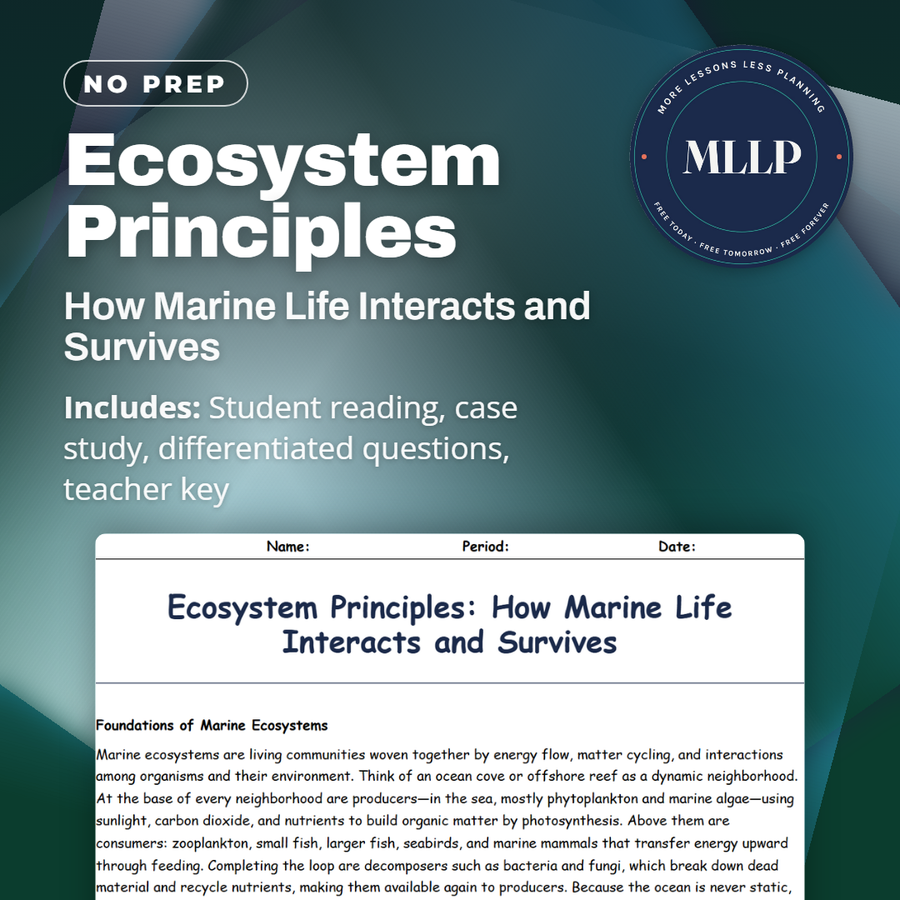
Ecosystem Principles: How Marine Life Interacts and Survives
Quality reviewed September 2026
Facts verified September 14, 2026
- Subject
- Science
- Grades
- Grades 9-12
- Length
- 7-page student worksheet
- Time
- About one 50-minute class period
- Great for
- Sub plans and independent work
- Includes
- Reading passage, comprehension questions + full answer key
- Format
- Print-and-go PDF
What students do
- Match terms like trophic pyramid, mutualism, niche, decomposer, and keystone species to their correct definitions
- Fill in the blank sentences on the 10% rule, realized niches, and phytoplankton
- Answer multiple choice questions on food web structure, carrying capacity, and types of symbiosis
- Write short answers and case study questions on biodiversity, commensalism, and the sea otter and kelp forest cascade
What it covers
- How producers, consumers, and decomposers move energy through a marine food web
- Predation, competition, and symbiosis, and how niches and carrying capacity limit populations
- A case study on sea otters, sea urchins, and kelp forests as an example of a trophic cascade
Start reading this worksheet
Foundations of Marine Ecosystems
Marine ecosystems are living communities woven together by energy flow, matter cycling, and interactions among organisms and their environment. Think of an ocean cove or offshore reef as a dynamic neighborhood. At the base of every neighborhood are producers (in the sea, mostly phytoplankton and marine algae) using sunlight, carbon dioxide, and nutrients to build organic matter by photosynthesis. Above them are consumers: zooplankton, small fish, larger fish, seabirds, and marine mammals that transfer energy upward through feeding. Completing the loop are decomposers such as bacteria and fungi, which break down dead material and recycle nutrients, making them available again to producers. Because the ocean is never static, currents, tides, and seasonal changes constantly shuffle where organisms live and how they interact. A patch of nutrient-rich upwelling can spark a bloom of phytoplankton, which boosts zooplankton, which supports fish, and so on. Ecologists call this cascading connection a food web, because even simple “who-eats-whom” chains are actually interlaced networks. The more links a food web has, the more resilient it tends to be after disturbances like storms or temporary declines in a species.
Interactions That Shape Survival
Marine life doesn’t just coexist; it interacts in ways that determine who thrives and who struggles. Predation regulates populations, preventing any one species from monopolizing resources. Competition happens when organisms need the same limited resource: light in shallow seagrass meadows, space on a crowded reef, or nitrogen in offshore waters. Species reduce direct conflict by occupying different ecological niches: specific roles that combine habitat, diet, behavior, and timing. Not all interactions are competitive. Symbiosis, long-term biological relationships, can boost survival. Mutualism benefits both partners (think zooxanthellae living within coral tissues, sharing sugars for shelter). Commensalism benefits one partner without harming the other (a remora hitching a ride on a shark). Parasitism benefits one at a cost to the other (isopods that feed on fish). These interactions shape community structure as much as predator-prey relationships do. When interactions are balanced, ecosystems show stability; when key interactions are disrupted (say, by the loss of a top predator), communities can reorganize rapidly, sometimes into less diverse, less productive states.
Energy Flow and Stability
The ocean’s energy architecture is often pictured as a trophic pyramid. Producers form a wide base; primary consumers feed on them; secondary and tertiary consumers sit higher up. At each step, only a fraction of energy moves forward, commonly summarized as the “10% rule.” That means vast producer biomass supports smaller consumer biomass, and apex predators are necessarily fewer. Stability emerges when multiple pathways exist for energy to travel. If one forage fish declines, a predator with flexible diet options can switch to another prey. That redundancy (supported by biodiversity) helps the whole system resist shocks. By contrast, simplified systems with only a few dominant links are vulnerable: remove a single link and the structure wobbles.
Like what you read? The full reading, the case study, and every question set are in the free download below, along with the answer key.
Why this matters
Remove one predator from a Pacific kelp forest and the ecosystem can collapse, exactly what happened when sea otter numbers dropped and urchins were left free to devour the kelp. Producers and decomposers moving energy, the 10% rule limiting what survives each step, and competition and symbiosis deciding which species share a niche are the pieces behind that collapse.
I have students predict what happens to the kelp forest before showing them the sea otter case study, and the guesses are usually wrong in a useful way. That gap is where the 10% rule stops being abstract and starts explaining why removing one keystone species changes everything downstream.
From one teacher to another
This reading breaks down the building blocks of a marine ecosystem, from producers and decomposers to the predator-prey and symbiotic relationships that hold a food web together. It covers the 10% rule for energy transfer and explains why niches narrow once competition and predation are factored in. The case study follows sea otters, sea urchins, and kelp forests along the North Pacific coast, showing what happens to a kelp forest when its keystone predator disappears.
What you get
Download
Where should I send the next one?
Everything here is free and it stays that way. Leave your email and I'll send you the new lessons as they go up. You can unsubscribe from any one of them.
Related resources
Abiotic and Biotic Factors Shaping Marine Ecosystems
Biodiversity Hotspots in the Ocean
Ecological Niches and Competition in Marine Ecosystems
Human Influences on Marine Ecosystems
Keystone Species and Their Role in Ecosystem Balance
Marine Food Chains and Webs
Every lesson on this site is free to download and use. If one of them saved you a prep period, you can chip in a few bucks toward my three kids' daycare fund. That's genuinely where tips go.