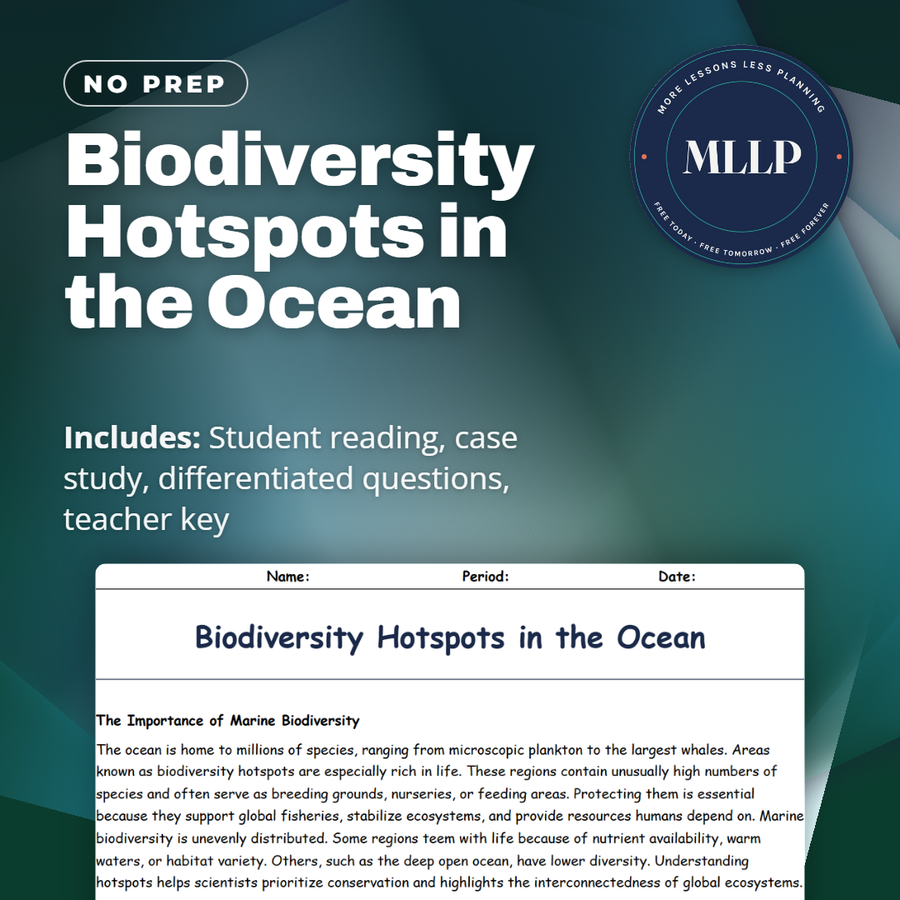
Biodiversity Hotspots in the Ocean
Quality reviewed September 2026
Facts verified September 14, 2026
- Subject
- Science
- Grades
- Grades 9-12
- Length
- 6-page student worksheet
- Time
- About one 50-minute class period
- Great for
- Sub plans and independent work
- Includes
- Reading passage, comprehension questions + full answer key
- Format
- Print-and-go PDF
What students do
- Match terms like coral reefs, estuaries, mangroves, the Great Barrier Reef, and seagrass beds to their correct definitions
- Fill in the blank sentences on coral reef biodiversity, estuaries, and the Great Barrier Reef
- Answer multiple choice questions on what makes biodiversity hotspots unique and what ecosystem services mangroves provide
- Write short answers and case study questions on why estuaries act as nurseries and why the Great Barrier Reef is at risk
What it covers
- Why coral reefs, estuaries, and mangroves count as marine biodiversity hotspots
- What makes hotspots worth protecting for fisheries and coastal communities
- A case study on the Great Barrier Reef and the threats it faces from warming and pollution
Start reading this worksheet
The Importance of Marine Biodiversity
The ocean is home to millions of species, ranging from microscopic plankton to the largest whales. Areas known as biodiversity hotspots are especially rich in life. These regions contain unusually high numbers of species and often serve as breeding grounds, nurseries, or feeding areas. Protecting them is essential because they support global fisheries, stabilize ecosystems, and provide resources humans depend on. Marine biodiversity is unevenly distributed. Some regions teem with life because of nutrient availability, warm waters, or habitat variety. Others, such as the deep open ocean, have lower diversity. Understanding hotspots helps scientists prioritize conservation and highlights the interconnectedness of global ecosystems.
Coral Reefs, Estuaries, and Mangroves
Coral reefs are among the most famous biodiversity hotspots. Built by coral polyps and supported by their algae partners, they host thousands of fish, invertebrates, and plants. Though reefs cover less than 1% of the ocean floor, they may house 25% of all marine species. Estuaries, where rivers meet the sea, are also hotspots. The mix of fresh and salt water creates a nutrient-rich environment that supports juvenile fish, migratory birds, and shellfish. Estuaries act as nurseries, protecting young species before they move into the open ocean. Mangrove forests form another hotspot, with their tangled roots sheltering fish, crabs, and shrimp. Mangroves also stabilize coastlines, reduce erosion, and serve as buffers against storms. Together, coral reefs, estuaries, and mangroves form interconnected systems that sustain biodiversity on a global scale.
Like what you read? The full reading, the case study, and every question set are in the free download below, along with the answer key.
Why this matters
Not every patch of ocean pulls its weight equally: a small stretch of reef, estuary, or mangrove forest can support far more species than the open water around it. Estuaries work as nurseries for young fish, mangroves hold coastlines together during storms, and reefs pack in more life per square mile than almost anywhere else.
The Great Barrier Reef case study grounds that in one place under real pressure, tracking the reef's scale against the bleaching and overfishing it now faces. Fisheries and coastal communities depend on exactly what is at risk in that one reef, and naming the stakes is what turns the earlier vocabulary about hotspots from a list of terms into something worth protecting.
From one teacher to another
This worksheet introduces students to the ocean's biodiversity hotspots, the regions that pack in an outsized share of marine life. Readings cover coral reefs, estuaries, and mangroves, explaining how each one supports young fish, migratory birds, and coastal stability in a different way. The case study zooms in on the Great Barrier Reef, tracing its scale alongside the bleaching and overfishing pressure it now faces.
What you get
Download
Where should I send the next one?
Everything here is free and it stays that way. Leave your email and I'll send you the new lessons as they go up. You can unsubscribe from any one of them.
Related resources
Abiotic and Biotic Factors Shaping Marine Ecosystems
Ecological Niches and Competition in Marine Ecosystems
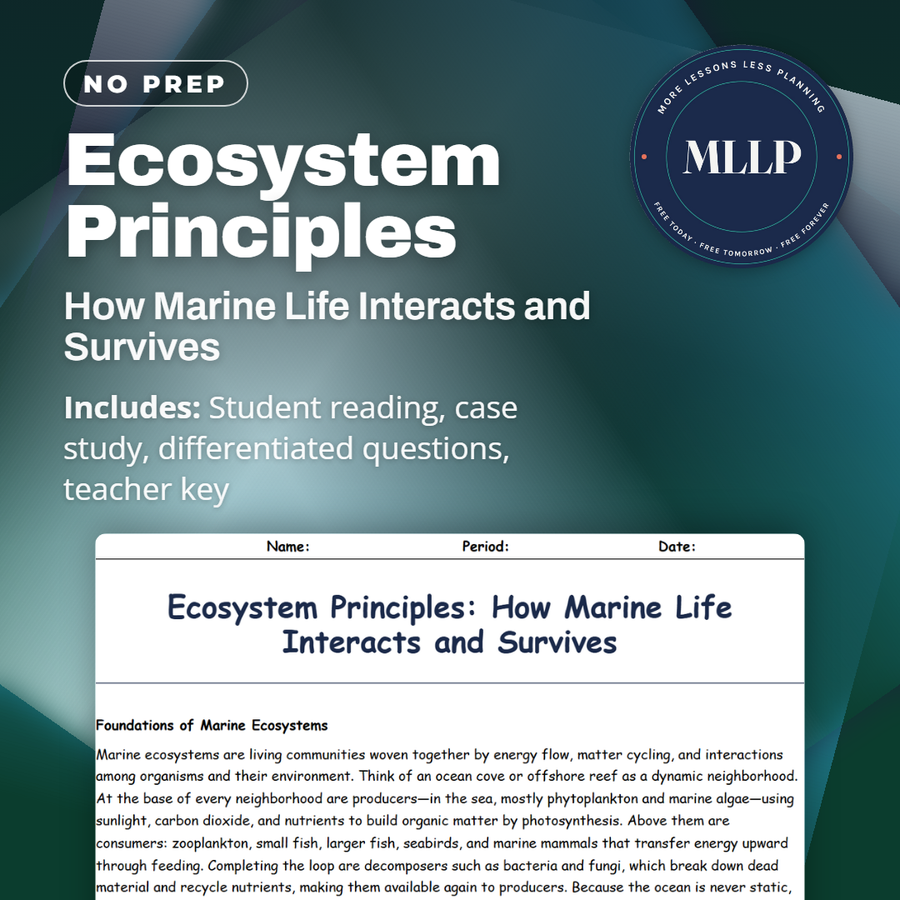
Ecosystem Principles: How Marine Life Interacts and Survives
Human Influences on Marine Ecosystems
Keystone Species and Their Role in Ecosystem Balance
Marine Food Chains and Webs
Every lesson on this site is free to download and use. If one of them saved you a prep period, you can chip in a few bucks toward my three kids' daycare fund. That's genuinely where tips go.