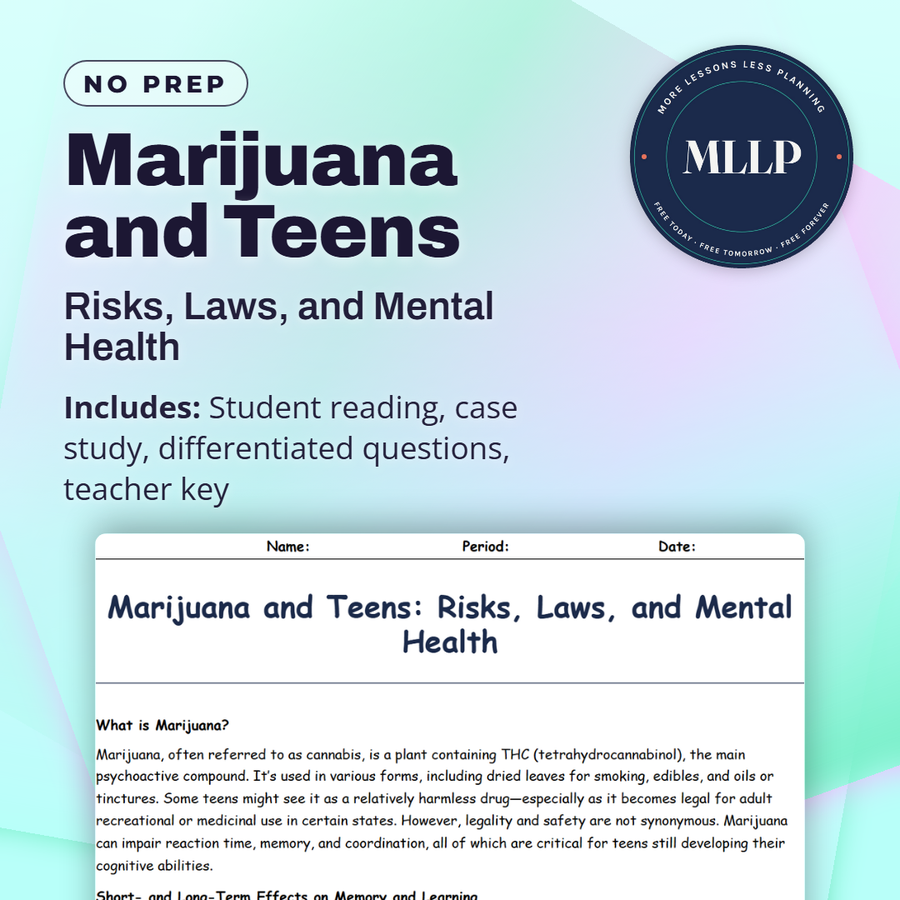
Marijuana and Teens: Risks, Laws, and Mental Health
Quality reviewed September 2026
Facts verified September 21, 2026
- Subject
- Career & Life Skills
- Grades
- Grades 9-12
- Length
- 7-page student worksheet
- Time
- About one 50-minute class period
- Great for
- Sub plans and independent work
- Includes
- Reading passage, comprehension questions + full answer key
- Format
- Print-and-go PDF
What students do
- Match five terms - THC, Schedule I, anxiety, edible, and depression - to the definition that fits each one
- Fill in three blanks identifying marijuana's psychoactive ingredient, its legal status for teens, and the kind of function it can impair
- Answer three multiple-choice questions on marijuana's short-term effect on the brain, its legal status, and a concern specific to teen users
- Write short answers on why legality can be mistaken for safety, and what healthier options exist for handling stress
What it covers
- THC's effect on memory, motivation, and academic performance, both immediately and over the long term
- How adolescent brain development makes emotional regulation and impulse control more vulnerable to THC than an adult's brain
- Jaylen's case study of using marijuana to cope with anxiety at a new school, and how that choice backfired into worse anxiety and a suspension
Start reading this worksheet
What is Marijuana?
Marijuana, often referred to as cannabis, is a plant containing THC (tetrahydrocannabinol), the main psychoactive compound. It’s used in various forms, including dried leaves for smoking, edibles, and oils or tinctures. Some teens might see it as a relatively harmless drug—especially as it becomes legal for adult recreational or medicinal use in certain states. However, legality and safety are not synonymous. Marijuana can impair reaction time, memory, and coordination, all of which are critical for teens still developing their cognitive abilities.
Short- and Long-Term Effects on Memory and Learning
The immediate effects of marijuana can include distorted perception and short-term memory loss. In a high school context, even occasional use could interfere with the ability to study or retain information. Over the long term, heavy marijuana use has been associated with declines in IQ, motivation, and overall academic achievement. This is particularly concerning for teens, whose brains are actively forming new neural connections. Marijuana can disrupt these processes, potentially affecting mental sharpness and learning capacity.
Effects on Teen Brain Development
During adolescence, the brain is still refining pathways that govern emotional regulation, decision-making, and impulse control. THC can alter the balance of neurotransmitters, leading to changes in mood, behavior, and sometimes even brain structure. Though not everyone who smokes marijuana will experience severe consequences, the risk is notably higher for younger users. Some teens who use marijuana frequently show symptoms of anxiety, depression, and may have a higher tendency toward addictive behaviors. Understanding these risks is vital: experimenting with marijuana at 15 can have different implications compared to an adult in their late 20s.
Like what you read? The full reading, the case study, and every question set are in the free download below, along with the answer key.
Why this matters
Several states now allow marijuana for adults, and that fact travels through a school faster than any lesson I could give, usually stripped of the age limit attached to it. Students need a clear answer for why the same drug carries a different risk for a fifteen-year-old than for an adult, and the brain development research in this reading gives them that answer instead of a lecture. It also matters because Jaylen's path, using a substance to manage social anxiety, is a pattern I see constantly, and this reading names the cycle before a student finds themselves inside it.
If you or someone you know is struggling, call or text 988 (Suicide & Crisis Lifeline, US) or talk to a trusted adult right away.
From one teacher to another
Jaylen's case study opens the way I want students to read this one: he tries marijuana to fit in at a new school, decides it's harmless because some states have legalized it for adults, and ends up in a cycle of missed homework and panic attacks instead. From there the reading moves into what's actually happening inside a teenage brain, and the sections on memory and emotional regulation explain why an adult using marijuana and a fifteen-year-old using marijuana are not the same risk. I also spend real time on the state-versus-federal confusion, because a lot of students genuinely don't realize that legalization for adults in a state doesn't extend to a teenager.
What you get
Download
Where should I send the next one?
Everything here is free and it stays that way. Leave your email and I'll send you the new lessons as they go up. You can unsubscribe from any one of them.
Related resources
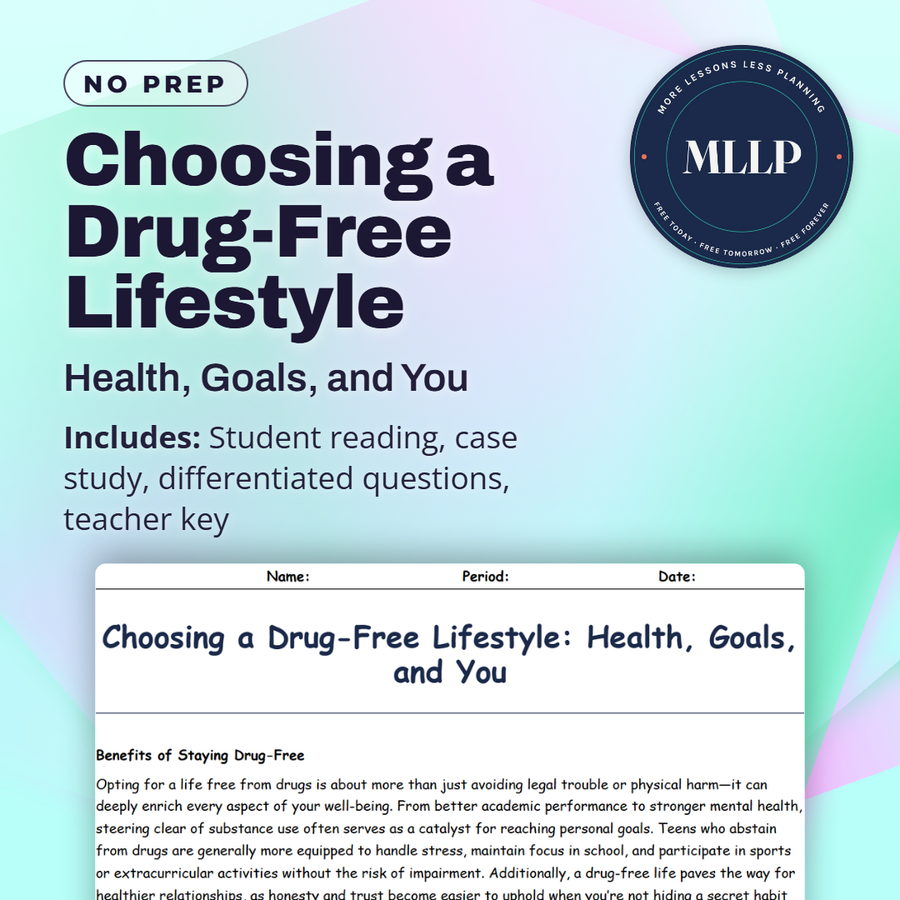
Choosing a Drug-Free Lifestyle: Health, Goals, and You
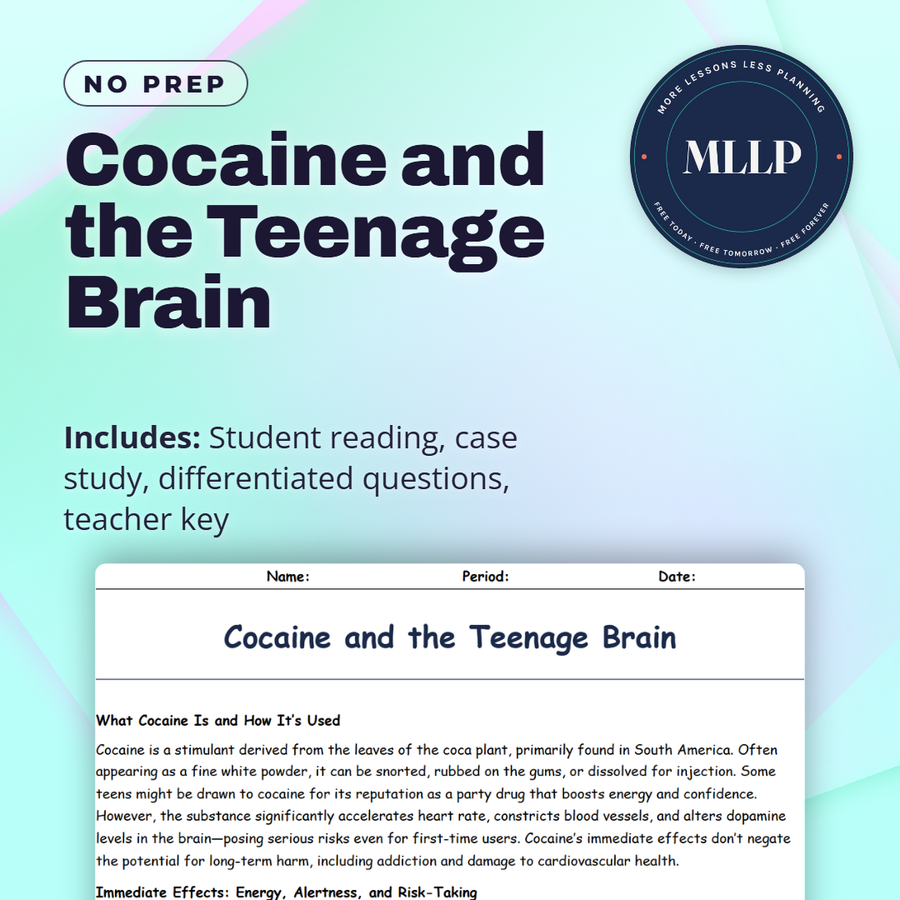
Cocaine and the Teenage Brain
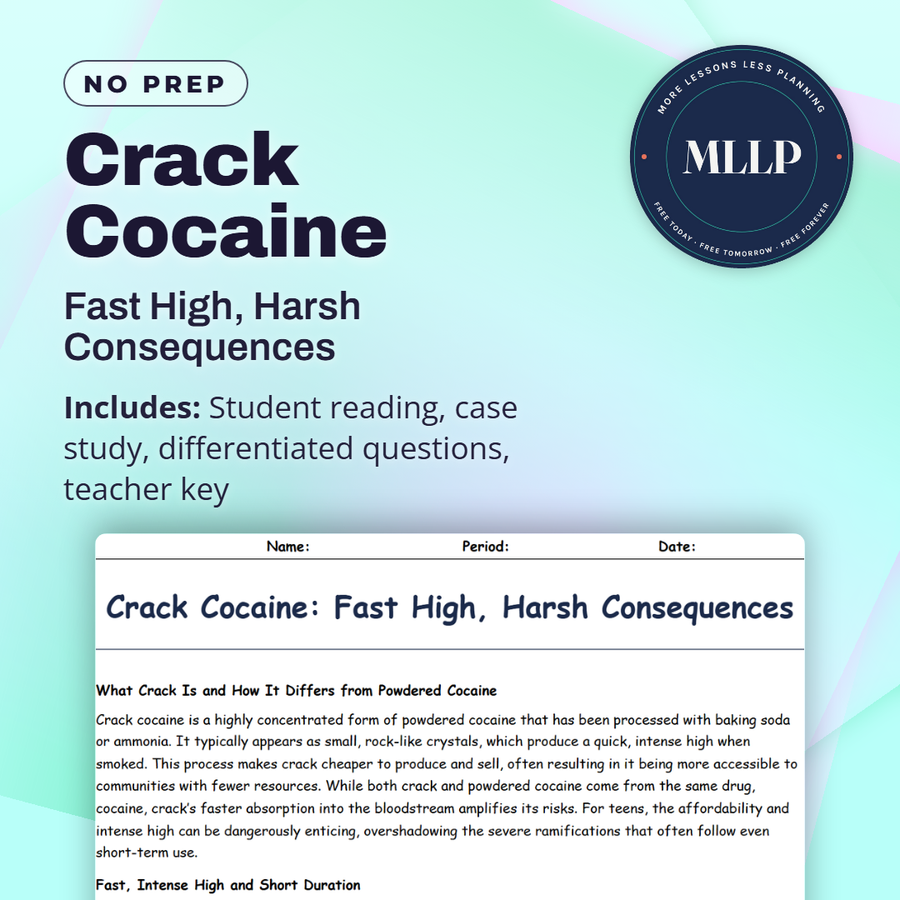
Crack Cocaine: Fast High, Harsh Consequences
Heroin and Teens: Understanding the Risks and Realities
How Addiction Changes the Brain: Science for Students
How to Handle Peer Pressure and Say No with Confidence
Every lesson on this site is free to download and use. If one of them saved you a prep period, you can chip in a few bucks toward my three kids' daycare fund. That's genuinely where tips go.