Major Climate Zones: Polar, Temperate, Tropical
Quality reviewed September 2026
Facts verified September 14, 2026
- Subject
- Social Studies
- Grades
- Grades 9-12
- Length
- 7-page student worksheet
- Time
- About one 50-minute class period
- Great for
- Sub plans and independent work
- Includes
- Reading passage, comprehension questions + full answer key
- Format
- Print-and-go PDF
What students do
- Match terms like Savanna, Permafrost, Temperate Rainforest, ITCZ, and Tundra to their correct definitions
- Fill in the blank sentences on tropical regions, tundra, and the temperate zone
- Answer multiple choice questions on which climate zone has the most dramatic seasonal changes, how rainforests differ from savannas, and what defines a polar climate
- Write short answers on why polar regions signal broader climate change, how wind patterns shape tropical rainfall, and why so many major cities grew up in temperate zones
What it covers
- Polar climates, including tundra and ice-cap conditions, permafrost, and how climate change is affecting sea ice and glaciers
- Temperate climates like Mediterranean and humid continental zones, and tropical climates including rainforests, savannas, and the ITCZ
- A case study on climate change in the Tropical Andes, where glacial retreat is affecting water supply and farming communities
Start reading this worksheet
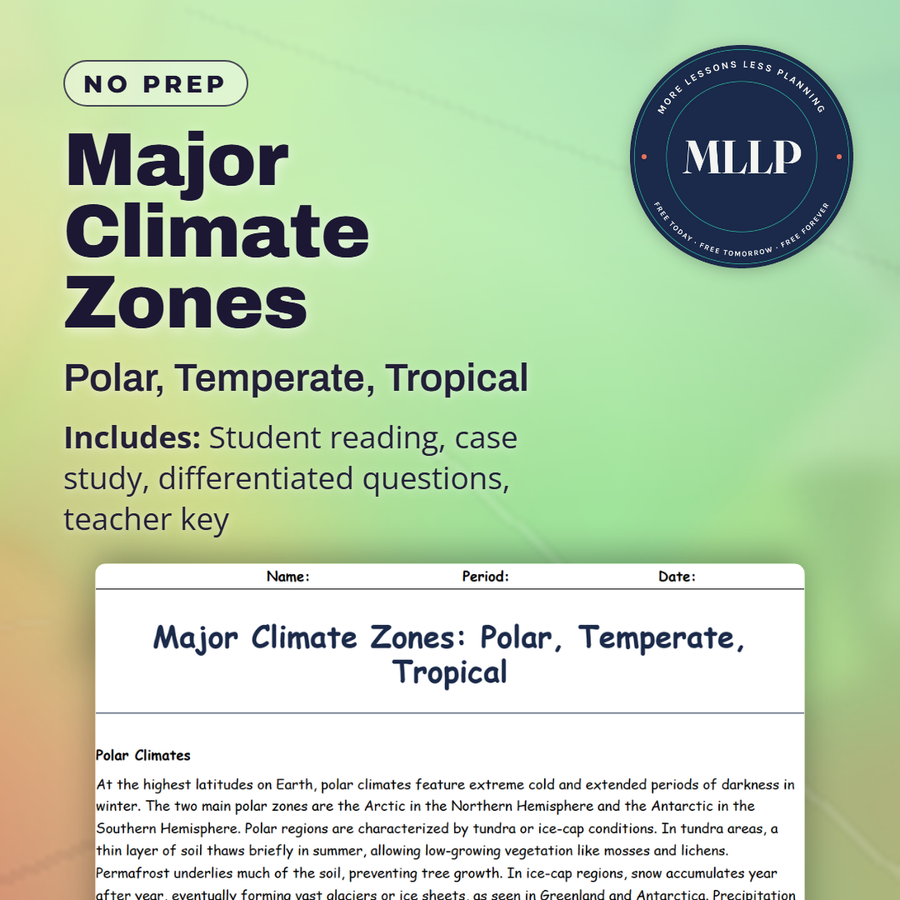
Polar Climates
At the highest latitudes on Earth, polar climates feature extreme cold and extended periods of darkness in winter. The two main polar zones are the Arctic in the Northern Hemisphere and the Antarctic in the Southern Hemisphere. Polar regions are characterized by tundra or ice-cap conditions. In tundra areas, a thin layer of soil thaws briefly in summer, allowing low-growing vegetation like mosses and lichens. Permafrost underlies much of the soil, preventing tree growth. In ice-cap regions, snow accumulates year after year, eventually forming vast glaciers or ice sheets, as seen in Greenland and Antarctica. Precipitation in polar zones is minimal, often falling as snow. The air is typically dry because cold air cannot hold much moisture. Yet climate change is dramatically affecting these regions. Sea ice is declining, glaciers are retreating, and permafrost is thawing. These changes impact wildlife—like polar bears and penguins—and indigenous communities who rely on ice for hunting and travel. Polar climates act as a barometer for global climate shifts, their sensitivity highlighting broader environmental issues such as rising sea levels.
Temperate Climates
Temperate climates lie in the mid-latitudes, with seasonal changes in temperature and varying precipitation patterns. Within this broad category, climates can range from Mediterranean (mild, wet winters and hot, dry summers) to humid continental (warm summers and cold, snowy winters). The difference in seasons arises from Earth’s tilt, causing varying sunlight angles throughout the year. Temperature swings are more pronounced than in tropical areas, but less severe than in polar zones. These moderate conditions support diverse ecosystems, including deciduous forests, grasslands, and temperate rainforests. Most of the world’s major cities lie within temperate zones, partly because the moderate climate is conducive to agriculture and economic development. However, these regions are not immune to extreme weather; hurricanes can impact coastal temperate zones, while inland areas might experience tornadoes or blizzards. The interplay of air masses from higher and lower latitudes often triggers rapid weather shifts, like sudden thunderstorms or heatwaves.
Like what you read? The full reading, the case study, and every question set are in the free download below, along with the answer key.
Why this matters
Glaciers near the equator sound like a contradiction until the Tropical Andes case study explains it: genuine glaciers sit inside a tropical latitude, and that ice is retreating along with the water supply farming communities depend on.
Tropical is supposed to mean uniformly hot and wet, and the Tropical Andes breaks that idea fast. Seeing a tropical location with real glaciers changes how tundra, temperate zones, and the ITCZ read too, less like three vocabulary lists and more like one connected system.
From one teacher to another
This one covers the three major climate zones side by side, so students can compare what drives temperature and precipitation at the poles, in the mid-latitudes, and near the equator. The Tropical Andes case study is a strong addition since it shows a tropical location with genuine glaciers, a useful counterpoint to the idea that tropical means uniformly warm and wet. I like that the quick reference table lets students check basic facts before moving into the matching and fill-in-the-blank sections. This pairs well with the biomes and ecosystems worksheet for a fuller picture of how climate shapes life on Earth.
What you get
Download
Where should I send the next one?
Everything here is free and it stays that way. Leave your email and I'll send you the new lessons as they go up. You can unsubscribe from any one of them.
Related resources
Biomes & Ecosystems: Life Across Earth’s Habitats
Climate vs. Weather: Understanding the Difference
Convergent Boundaries: Where Plates Collide
Deserts: Survival in the Harshest Climates
Divergent Boundaries: Where Plates Pull Apart
Earth’s Layers: From Crust to Core
Every lesson on this site is free to download and use. If one of them saved you a prep period, you can chip in a few bucks toward my three kids' daycare fund. That's genuinely where tips go.