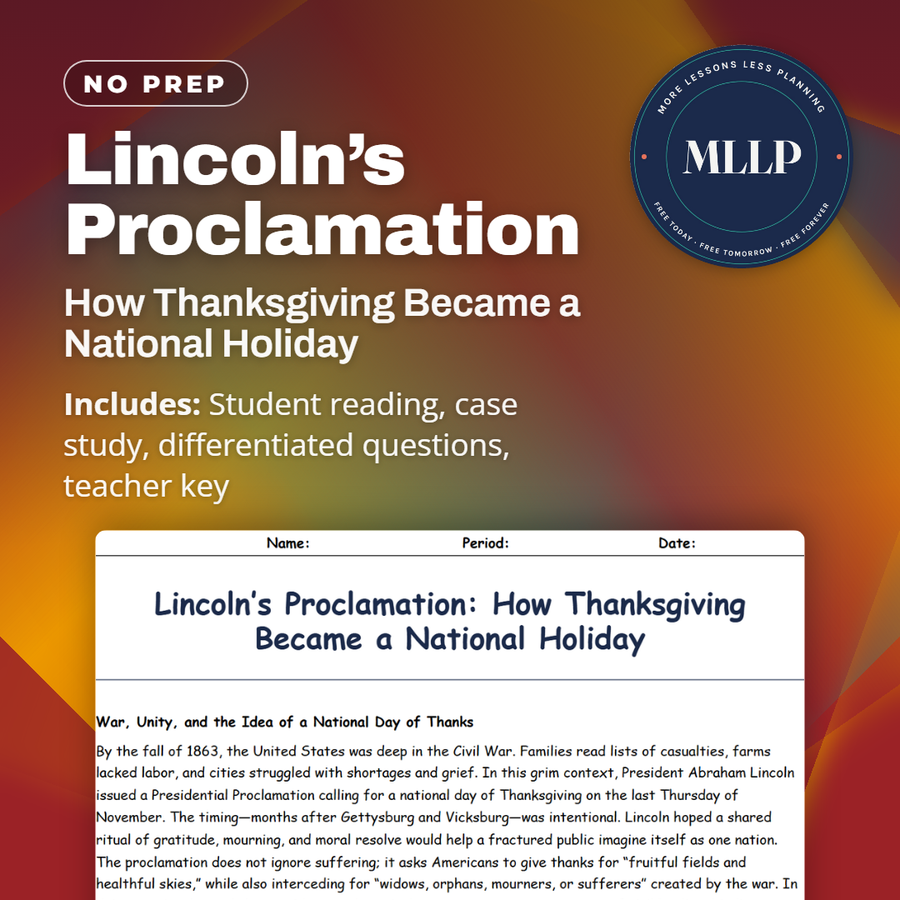
Lincoln’s Proclamation: How Thanksgiving Became a National Holiday
Quality reviewed September 2026
Facts verified September 9, 2026
- Subject
- Social Studies
- Grades
- Grades 9-12
- Length
- 8-page student worksheet
- Time
- About one 50-minute class period
- Great for
- Sub plans and independent work
- Includes
- Reading passage, comprehension questions + full answer key
- Format
- Print-and-go PDF
What students do
- Analyze how the 1863 proclamation balanced gratitude with the grief of the Civil War
- Explain how Sarah Josepha Hale's magazine campaign pushed a holiday into federal policy
- Trace Thanksgiving from local harvest days to the date Congress fixed in 1941
- Match Seward, Hale, Gettysburg and Vicksburg, and civil religion to their roles
What it covers
- A national day of thanks in the middle of the Civil War
- Sarah Josepha Hale and the power of print
- Thanksgiving as civil religion and shared ritual
Start reading this worksheet
War, Unity, and the Idea of a National Day of Thanks
By the fall of 1863, the United States was deep in the Civil War. Families read lists of casualties, farms lacked labor, and cities struggled with shortages and grief. In this grim context, President Abraham Lincoln issued a Presidential Proclamation calling for a national day of Thanksgiving on the last Thursday of November. The timing was intentional: it came months after Gettysburg and Vicksburg. Lincoln hoped a shared ritual of gratitude, mourning, and moral resolve would help a fractured public imagine itself as one nation. The proclamation does not ignore suffering; it asks Americans to give thanks for “fruitful fields and healthful skies,” while also interceding for “widows, orphans, mourners, or sufferers” created by the war. In doing so, Lincoln used the presidency’s rhetorical power to construct a moment of civil healing, binding private households to a public ethic of charity. The move was not about victory parades or celebration; it was about setting a calendar anchor for unity. Instead of scattered regional observances, the country would try a single, annual act of remembrance, even while armies still faced each other across battle lines.
From Local Harvest Days to a National Tradition
Before 1863, “thanksgiving” days were declared irregularly by governors to mark harvests, drought relief, or survival after crises. New England communities often held yearly autumn feasts, but there was no national standard. The innovation in 1863 was not inventing gratitude; it was federalizing and standardizing it. A proclamation from the executive branch reframed Thanksgiving as a recurring national observance. The wording, drafted with help from Secretary of State William H. Seward, balanced providence with patriotism, calling citizens to acknowledge blessings and to care for the vulnerable. This redefinition had political effects: shared observances build legitimacy, foster solidarity, and create what scholars call imagined communities, groups of people who feel connected to strangers because they mark time together. After the war, presidents continued issuing annual proclamations. Later, a date controversy in the 1930s was nicknamed “Franksgiving”; it ended when Congress fixed the holiday on the fourth Thursday of November in 1941. Meanwhile, the iconic meal (turkey, cranberries, pumpkin pie) evolved through regional tastes, print culture, and later mass media. The durable core message from 1863 remained: gratitude, public charity, and a sense of shared national fate.
Sarah Josepha Hale and the Power of Print
The path to a national Thanksgiving was also a story of media advocacy. For decades, editor Sarah Josepha Hale, known for her leadership at Godey’s Lady’s Book, campaigned for a national day of thanks. Through persuasive editorials, carefully crafted letters to governors and presidents, and themed content (menus, poems, and moral essays), Hale advanced a cultural vision that blended domestic ideals with civic harmony. Her magazine reached hundreds of thousands of readers, especially middle-class households that looked to periodicals for guidance on etiquette, recipes, and moral instruction. Hale’s approach illustrates how print networks can shape policy by mobilizing culture first: stories and recipes build affection for an idea, then editorials and letter-writing push it into the political sphere. When Lincoln issued the proclamation in 1863, it aligned with wartime needs and Hale’s long-running campaign. The result demonstrates how civil society, media, and executive power can converge to create an enduring institution.
Like what you read? The full reading, the case study, and every question set are in the free download below, along with the answer key.
Why this matters
Thanksgiving had no fixed date until Congress wrote the fourth Thursday of November into law in 1941. Before that it moved by presidential proclamation almost every year, which is what Lincoln did in 1863, in the middle of the Civil War. His proclamation did not celebrate a victory. It asked a divided country for thanks while naming widows, orphans, and mourners in the same breath.
Sarah Josepha Hale spent decades pushing this holiday through her magazine before any president acted on it, and that timeline is the real lesson: persistence in print built policy before persuasion in politics did. By the question on civil religion, nobody treats Thanksgiving as something that just happened.
From one teacher to another
The proclamation asks a country in the middle of the Civil War to give thanks for fruitful fields while remembering widows, orphans, mourners, and sufferers. My students expect a feel-good holiday origin and instead get a document written months after Gettysburg and Vicksburg, drafted with help from Seward, that was trying to hold a fractured public together. The reading follows Sarah Josepha Hale's decades of editorials and letters, which is a useful lesson in how media pressure reaches a president. The case study reconstructs the day the letter arrived at the Executive Mansion, and the questions end with civil religion and why a shared date still does political work.
What you get
Download
Where should I send the next one?
Everything here is free and it stays that way. Leave your email and I'll send you the new lessons as they go up. You can unsubscribe from any one of them.
Related resources
Black Friday Forensics: Shoplifting, Organized Theft, and Crowd Violence
Black Friday Smart Shopper: Economics and Personal Finance in Action
Black Friday: Are the “Deals” Actually Good for Shoppers?
Black Friday’s Economic Impact: Who Gains, Who Pays, and What It Means for the Economy
Budget a Feast: Unit Prices, Deals, and Receipts
Colonial Foodways: Indigenous Knowledge and European Adaptation
Every lesson on this site is free to download and use. If one of them saved you a prep period, you can chip in a few bucks toward my three kids' daycare fund. That's genuinely where tips go.