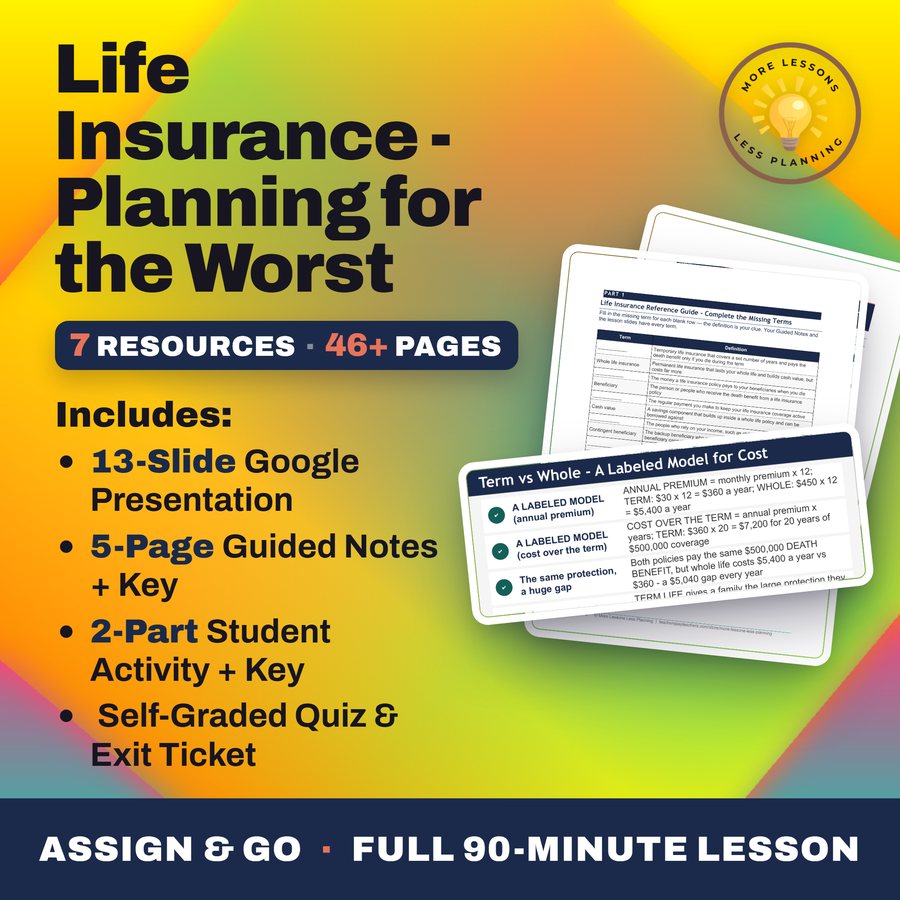
Life Insurance - Planning for the Worst
Quality reviewed September 2026
- Grades
- Grades 9-12
- Time
- About two 50-minute class periods
- Includes
- 11 ready-to-teach files
- Format
- Word (.docx) · PowerPoint (.pptx)
- Slide deck
- Guided notes
- Guided notes teacher key
- Activity + answer key
- Quiz + answer key
- Exit ticket + answer key
- Teacher guide
- Teacher presentation notes
What students do
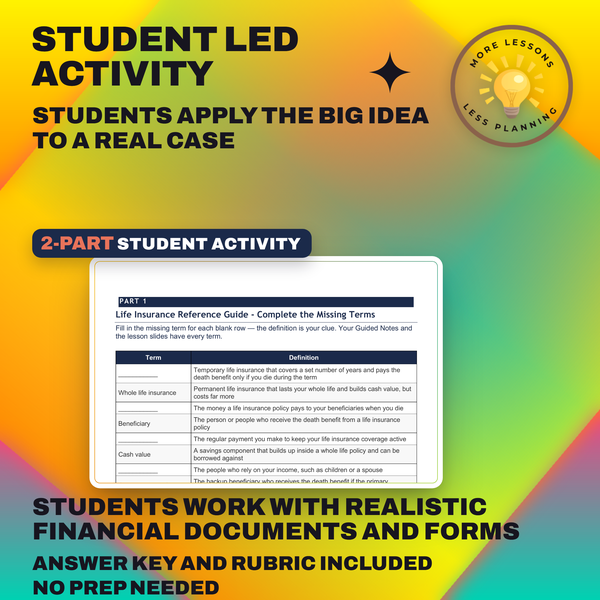
- Sort features of term and whole life insurance and calculate the annual premium for each
- Calculate how much coverage a family needs using income times years to replace
- Read a bar chart comparing monthly premiums for the same $500,000 death benefit
- Advise a young family on choosing a policy and naming primary and contingent beneficiaries
What it covers
- Why term life costs about $30 a month while whole life costs about $450 for the identical $500,000 death benefit
- The coverage-needed formula, annual income times years to replace, used to justify a real coverage amount
- Primary versus contingent beneficiaries, and why the named beneficiary overrides a will
- Who actually needs life insurance, people whose income other people depend on, versus who does not
Learning targets
- Explain what life insurance does - it pays a death benefit to your beneficiaries if you die
- Distinguish term life insurance (temporary, cheap, no cash value) from whole life insurance (permanent, builds cash value, more expensive)
- Explain who a beneficiary is (primary vs contingent) and why you keep beneficiaries updated
- Explain who needs life insurance (people whose income others rely on) and estimate coverage using a labeled model
Peek inside
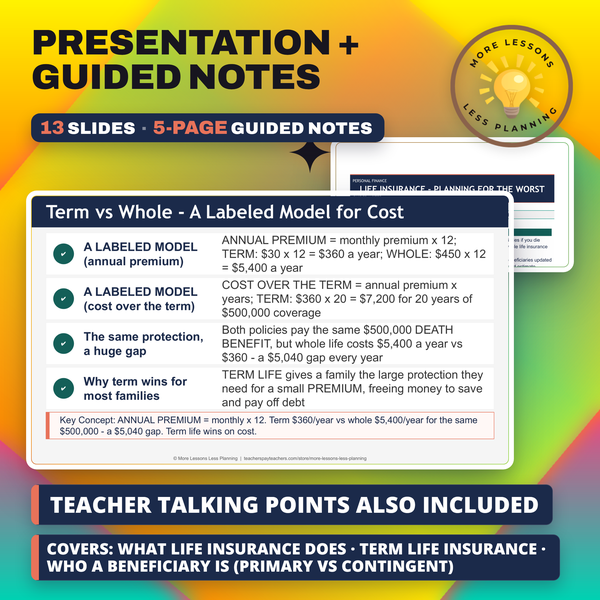
✔
It protects people, not a thing
LIFE INSURANCE pays money to the people who depend on you if you DIE - it protects your family's income, not an object
✔
The payout is the death benefit
1. Temporary life insurance that covers a set number of years and pays the death benefit only if you die during the term is .
Why this matters
Term life costs about $30 a month. Whole life costs about $450 for the identical $500,000 payout. That gap only makes sense once you understand life insurance protects the people who depend on your income, not you, and teenagers rarely have a reason to think about who would be counting on their paycheck.
The beneficiary piece is what I want to stick. Since the name on the policy overrides the will, I ask students to explain in writing why skipping that update after a marriage, divorce, or new baby isn't harmless paperwork. It usually reframes the whole unit for them: insurance is really about the people left behind.
From one teacher to another
This is the one insurance lesson in the unit that isn't protecting a car or an apartment, it's protecting people, so I open by making that distinction explicit: life insurance pays a death benefit to the people who relied on your income, not to you. Students work the actual cost gap between the two kinds of policy, term life running about $30 a month against whole life at roughly $450 for the exact same $500,000 death benefit, and once they've done that math themselves the fifteen-times difference stops being an abstract vocabulary distinction. They also calculate how much coverage a family would actually need using income times years to replace, which turns "how much insurance do I need" from a guess into a formula they can defend. The beneficiary piece is the part I want to stick longest: the name on the policy overrides the will, so I make them explain in writing why that means updating it after every marriage, divorce, or new kid isn't optional paperwork.
Every file in this toolkit
-
Activity (Student)
Jordan is 30, earns $50,000, and has two kids and a mortgage, so Dana Reyes sorts term from whole life features, prices a $500,000 policy at $30 versus $450 a month, then sizes coverage at ten times income.
-
Activity (Answer Key)
Term life costs Jordan $360 a year against whole life's $5,400 for the identical $500,000 death benefit, a $5,040 gap, and that same $500,000 is exactly what a $50,000 income times ten years of replacement produces.
-
Exit Ticket (Student)
What makes a policy temporary instead of permanent gets tested early, then a $30 monthly premium turns into its yearly cost and a last item asks who actually collects a payout. Death benefit, beneficiary, and term life insurance need to appear in the response.
-
Exit Ticket (Answer Key)
Comparing a $30-a-month term policy against a $450-a-month whole life policy for identical coverage is what this rubric rewards, plus correct use of death benefit, beneficiary, and term life insurance to explain why term suits a new parent.
-
Guided Notes (Student)
A healthy 30-year-old pays about $30 a month for term life on a $500,000 policy, and that figure gets set against whole life's $450 a month before building the income-times-years coverage formula.
-
Guided Notes (Teacher Key)
$360 a year is the term premium confirmed against $5,400 for whole life on the same $500,000 payout, plus the income-times-years formula that sets how much coverage a family actually needs.
-
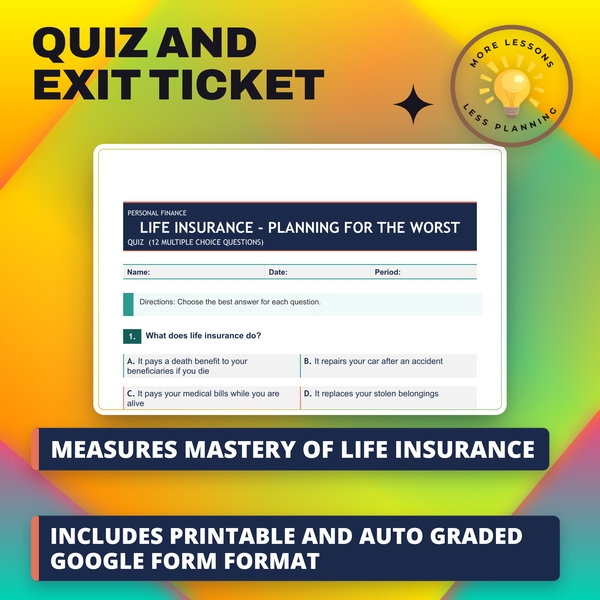
Quiz (Student)
A $500,000 death benefit priced two ways, $30 a month for term against $450 for whole life, runs through several calculations, next to primary and contingent beneficiaries.
-
Quiz (Answer Key)
$5,400 stands as the correct annual premium on that whole life policy, while a $500,000 coverage estimate built from a parent's $50,000 income settles the beneficiary math.
-
Slides
$30 a month for term life against $450 for whole life on the identical $500,000 death benefit is the labeled cost model these slides open with, turning that gap into $360 versus $5,400 a year before covering primary and contingent beneficiaries.
-
Teacher Guide
Term life costs $30 a month against $450 for whole life on the identical $500,000 payout, the gap this guide's income-replacement formula explains. Extensions decide who actually needs coverage, run a three-age cost showdown, and build a full beneficiary plan.
-
Teacher Presentation Notes
The same $500,000 policy runs $360 a year in term premiums or $5,400 in whole life, the cost gap ahead of naming a beneficiary and updating one after a marriage, a divorce, or a new child.
Download
Where should I send the next one?
Everything here is free and it stays that way. Leave your email and I'll send you the new lessons as they go up. You can unsubscribe from any one of them.
Related resources
Choosing Coverage: How Much Do You Really Need?
Health Insurance - The Most Confusing Bill You'll Get

Renters and Homeowners Insurance - Protecting Your Stuff

What Is Insurance - Paying to Protect Yourself
Why Young People Pay More (or Less) - Risk Pricing in Auto Insurance
Banking Basics: Checking, Savings, and Debit Cards Explained
Every lesson on this site is free to download and use. If one of them saved you a prep period, you can chip in a few bucks toward my three kids' daycare fund. That's genuinely where tips go.