


Health Insurance - The Most Confusing Bill You'll Get
Quality reviewed September 2026
- Grades
- Grades 9-12
- Time
- About two 50-minute class periods
- Includes
- 11 ready-to-teach files
- Format
- Word (.docx) · PowerPoint (.pptx)
- Slide deck
- Guided notes
- Guided notes teacher key
- Activity + answer key
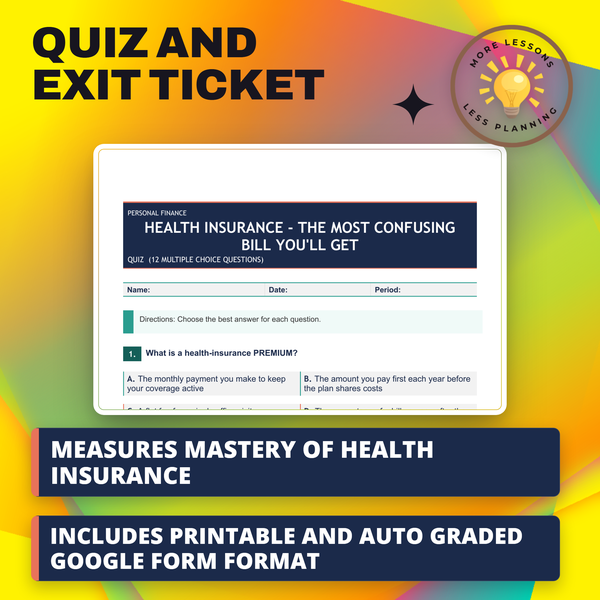
- Quiz + answer key
- Exit ticket + answer key
- Teacher guide
- Teacher presentation notes
What students do
- Split a covered medical bill between patient and insurer using deductible then coinsurance
- Read a bar chart showing exactly who pays what on a $5,000 medical bill
- Compare in-network and out-of-network care to see why the same visit can cost far more
- Trace how an out-of-pocket max caps a patient's cost even on a $30,000 bill
What it covers
- The four cost terms that get mixed up: premium, deductible, copay, and coinsurance
- Why in-network care costs less than out-of-network care on the same plan
- The out-of-pocket max as the yearly cap that protects against a catastrophic bill
- How to read an Explanation of Benefits and check it against the actual bill
Learning targets
- Identify the four core health-insurance cost terms (premium, deductible, copay, coinsurance) and what each one means
- Explain how a network works (in-network vs out-of-network) and what the out-of-pocket max protects you from
- Calculate how a covered medical bill splits between you and the insurer using a labeled model (deductible first, then coinsurance, capped at the out-of-pocket max)
- Explain how employer and marketplace plans differ and how to read an EOB (Explanation of Benefits)
Peek inside
✔
Four different costs, four words
Health insurance uses PREMIUM, DEDUCTIBLE, COPAY, and COINSURANCE - four separate costs that people mix up
✔
A bill is SPLIT, not all yours
Four Costs, Four Words
Health insurance uses four separate cost words that people mix up: PREMIUM, DEDUCTIBLE, COPAY, and .
A covered medical bill is SPLIT between you and the - it is not all yours and not all theirs.
The Words Decide the Split
How much of a bill is YOURS depends on your deductible, your coinsurance, and your out-of-pocket .
Once you know the four terms and how a bill splits, a medical bill and an insurance statement stop being .
1. Q1. The monthly payment you make just to keep your health coverage active, whether or not you see a doctor, is your .
Why this matters
A $5,000 medical bill splits into exactly $1,800 for the patient and $3,200 for the insurer, and once students rebuild that split themselves, deductible first, then a coinsurance percentage, the four terms that get mixed up constantly finally separate into four different things instead of one blur.
The out-of-pocket max is the part students remember longest, since they assume a $30,000 bill means $30,000 of pain until they trace how that yearly cap protects a patient from paying the full amount. I end on the Explanation of Benefits because it's the document that shows up in a real mailbox someday and nobody explains what it says.
From one teacher to another
Health insurance is the one financial document almost every adult admits they can't fully read, so I anchor the whole lesson to a single number a student can hold onto: a $5,000 bill that splits into exactly $1,800 for the patient and $3,200 for the insurer. Once they can rebuild that split themselves, deductible first, then their percentage, capped at the max, the four confusing words stop being confusing. I ended on the EOB specifically because that's the document that shows up in real life and nobody ever explains what it actually is.
Every file in this toolkit
-
Activity (Student)
Alex's $5,000 medical bill splits into a $1,000 deductible and 20 percent coinsurance, and Morgan Reyes repeats that model on a $600 bill that never reaches coinsurance and a $30,000 bill capped by the out-of-pocket max.
-
Activity (Answer Key)
A $5,000 covered bill splits into Alex's $1,000 deductible plus $800 in 20% coinsurance, an $1,800 total that would balloon to $6,800 on a $30,000 bill if the $4,000 out-of-pocket max did not cap it there instead.
-
Exit Ticket (Student)
Naming the monthly charge that just keeps a policy active is the first item, then a $5,000 bill gets split by a deductible and coinsurance rate and a $30,000 bill gets capped by the yearly out-of-pocket max. Deductible, coinsurance, and out-of-pocket max drive the response.
-
Exit Ticket (Answer Key)
The $1,800 owed on a $5,000 bill after a $1,000 deductible and 20 percent coinsurance earns points here, together with explaining that a $4,000 out-of-pocket max caps a year's cost no matter how large a later bill runs.
-
Guided Notes (Student)
Alex pays $300 a month for the premium and covers a $1,000 deductible first, and the notes move through copay, coinsurance, the network, and an out-of-pocket max that caps the plan at $4,000.
-
Guided Notes (Teacher Key)
$1,800 is what Alex owes on a $5,000 bill once the math runs, split into a $1,000 deductible plus 20 percent coinsurance on the rest, capped by the $4,000 out-of-pocket max.
-
Quiz (Student)
A $5,000 covered bill with a $1,000 deductible and 20% coinsurance runs through several calculations, next to the out-of-pocket max and what actually separates an EOB from a bill.
-
Quiz (Answer Key)
$3,200 as the insurer's share of that $5,000 covered bill is marked correct, tied to the $4,000 out-of-pocket cap on a separate $30,000 bill and why an EOB isn't a bill itself.
-
Slides
$300 a month in premium keeps the plan active on one slide, then a $1,000 deductible, a flat $30 copay, and 20 percent coinsurance split a bill piece by piece before a $4,000 out-of-pocket max caps what a $30,000 hospital bill could cost.
-
Teacher Guide
$5,000 in covered bills splits into a $1,800 share for the patient and $3,200 for the insurer once the deductible and coinsurance layer in, the model this guide teaches. Extensions sort eight cost-term scenarios, label a real EOB, and price two competing health plans.
-
Teacher Presentation Notes
The same $5,000 medical bill splits into $1,800 owed and $3,200 covered once a $1,000 deductible and coinsurance apply, the worked example that follows naming premium, deductible, copay, and coinsurance one by one.
Download
Where should I send the next one?
Everything here is free and it stays that way. Leave your email and I'll send you the new lessons as they go up. You can unsubscribe from any one of them.
Related resources
Choosing Coverage: How Much Do You Really Need?

Life Insurance - Planning for the Worst

Renters and Homeowners Insurance - Protecting Your Stuff

What Is Insurance - Paying to Protect Yourself

Why Young People Pay More (or Less) - Risk Pricing in Auto Insurance
Banking Basics: Checking, Savings, and Debit Cards Explained
Every lesson on this site is free to download and use. If one of them saved you a prep period, you can chip in a few bucks toward my three kids' daycare fund. That's genuinely where tips go.