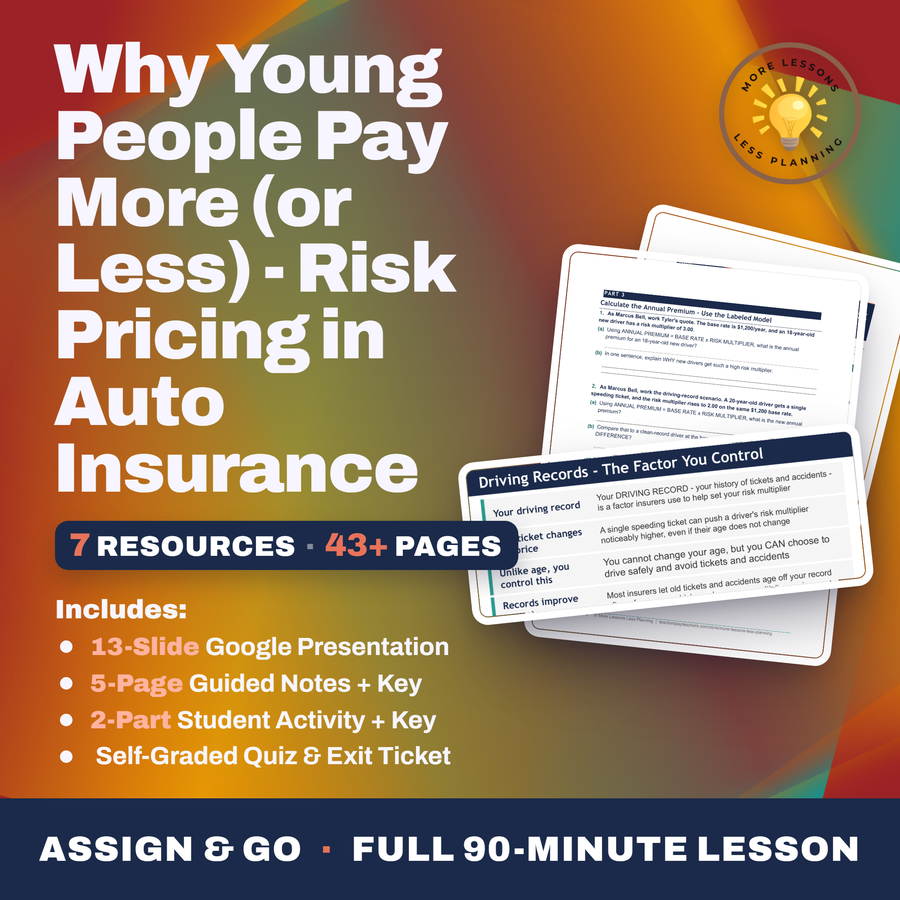
Why Young People Pay More (or Less) - Risk Pricing in Auto Insurance
Quality reviewed September 2026
- Grades
- Grades 9-12
- Time
- About two 50-minute class periods
- Includes
- 11 ready-to-teach files
- Format
- Word (.docx) · PowerPoint (.pptx)
- Slide deck
- Guided notes
- Guided notes teacher key
- Activity + answer key
- Quiz + answer key
- Exit ticket + answer key
- Teacher guide
- Teacher presentation notes
What students do
- Calculate an annual premium from a base rate and a risk multiplier
- Compare four driver risk profiles, from an 18-year-old new driver to a 40-year-old with a clean record
- Explain why one speeding ticket doubled a 20-year-old driver's premium
- Advise a new driver on how to lower their own risk multiplier over time
What it covers
- The labeled model insurers use to price risk, annual premium equals base rate times risk multiplier
- Why age and driving record are the two biggest factors in a young driver's price
- How to calculate the dollar and percent difference between two driver profiles
Learning targets
- Explain how insurers price risk and why premiums vary from driver to driver
- Explain why age and driving experience are major factors in a young driver's premium
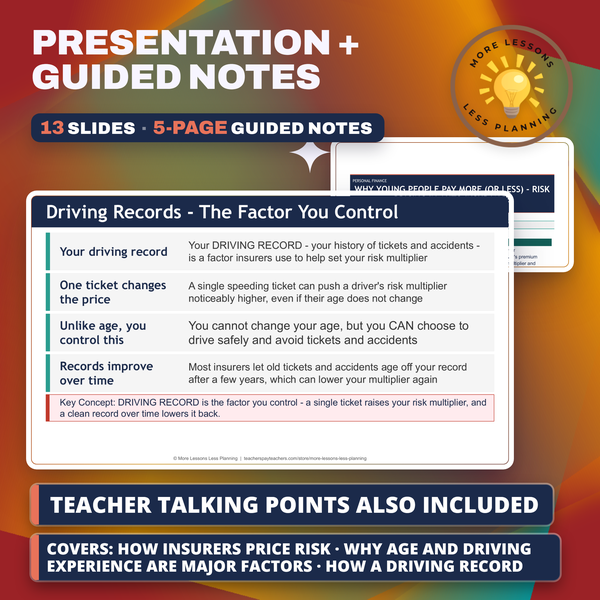
- Explain how a driving record (tickets, accidents) changes a driver's risk multiplier and premium
- Calculate the annual premium and the premium difference between driver risk profiles using a labeled model
Peek inside
✔
Insurers do not guess
Insurers use UNDERWRITING - the process of measuring your RISK and setting your PRICE - to set every premium
✔
Statistics, not stereotypes
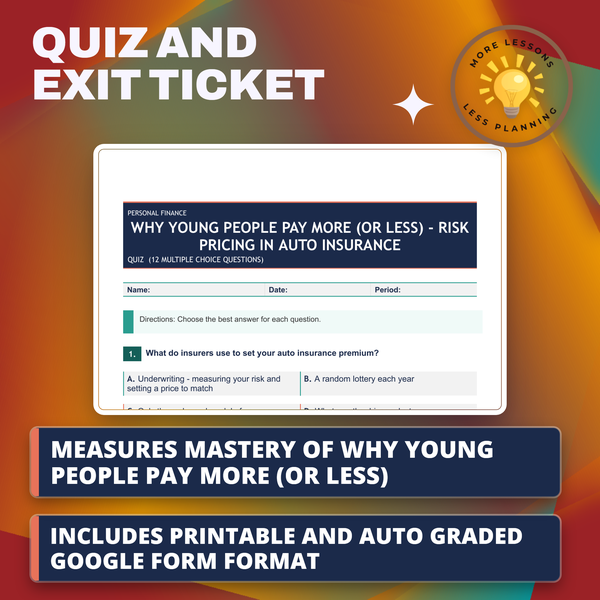
1. Q1. The amount you pay for your insurance coverage is your .
Why this matters
A twenty-year-old with one speeding ticket does not just pay a little more for car insurance. This lesson shows the number doubling, the exact same base rate multiplied by a risk factor that punishes one mistake far harder than most students expect before they run the math themselves.
What changes for my students once they've worked all four driver profiles is that insurance stops looking arbitrary. They can point to the specific multiplier driving an eighteen-year-old's price above a forty-year-old's clean record, and once they see the formula controls the outcome, the conversation shifts from complaining about the cost to asking what actually lowers it.
From one teacher to another
Every new driver in my room already wants to know why their quote costs more than their parents', so that's the question this lesson actually answers. Students work the same formula insurers use, run it across four real driver profiles, and watch one speeding ticket double a twenty-year-old's premium before they ever touch a rate table. It turns a real source of frustration into a genuine math lesson, which is exactly the trade I'm always looking for.
Every file in this toolkit
-
Activity (Student)
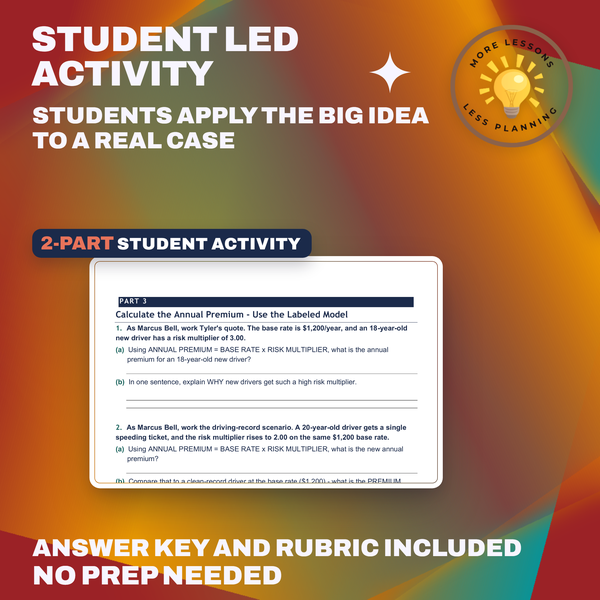
Tyler's first quote comes in at $3,600, so Marcus Bell runs the base-rate-times-multiplier formula behind it, prices a single speeding ticket's jump against a clean-record 40-year-old's $1,020, then reads all four driver profiles on one chart.
-
Activity (Answer Key)
Tyler's $1,200 base rate turns into a $3,600 premium once an 18-year-old's risk multiplier of 3.00 gets applied, while a single speeding ticket alone doubles a 20-year-old's rate to $2,400, and the riskiest profile on the chart still costs 253% more than a 40-year-old's clean $1,020.
-
Exit Ticket (Student)
Defining risk pricing in one line is the opening item, then a $1,200 base rate and a 3.00 multiplier become an annual premium calculation before naming the one factor a driver actually controls. Risk multiplier, base rate, and driving record belong in the write.
-
Exit Ticket (Answer Key)
This rubric grades naming the base rate, the risk multiplier, and why a new driver's premium runs so high, checked against a sample response and three answer choices for a fast grade.
-
Guided Notes (Student)
An 18-year-old new driver's risk multiplier of 3.00 turns a $1,200 base rate into $3,600 a year, and the page tracks underwriting and actuarial risk down to a 40-year-old's lower 0.85 multiplier.
-
Guided Notes (Teacher Key)
$3,600 is the annual premium for an 18-year-old new driver at a 3.00 risk multiplier, against just $1,020 for a 40-year-old with a clean record at a 0.85 multiplier off the same base rate.
-
Quiz (Student)
The base-rate formula gets tested against why a new driver's inexperience earns the highest risk multiplier, how one speeding ticket doubles a driver's premium off a $1,200 base rate, and what a good-student discount actually does.
-
Quiz (Answer Key)
The $3,600 premium on a 3.00 risk multiplier and the 253 percent gap between the riskiest and safest driver profiles are both marked correct across this whole answer set.
-
Slides
A risk multiplier of 3.00 triples an 18-year-old's $1,200 base rate to a $3,600 premium on these slides, stepping down to a clean-record 40-year-old's 0.85 multiplier and $1,020 a year, with a speeding ticket named as the one factor a driver controls.
-
Teacher Guide
An 18-year-old new driver's risk multiplier of x3.00 is the highest figure in this 55-point guide, triple what a clean-record 25-year-old pays. Extensions price five more driver profiles, plan five years of multiplier-lowering moves, and compare risk pricing across auto, health, and life insurance.
-
Teacher Presentation Notes
An 18-year-old new driver pays $3,600 a year against the same $1,200 base rate an experienced driver starts from, the gap that teaches annual premium as base rate times risk multiplier before a clean record lowers it.
Download
Where should I send the next one?
Everything here is free and it stays that way. Leave your email and I'll send you the new lessons as they go up. You can unsubscribe from any one of them.
Related resources
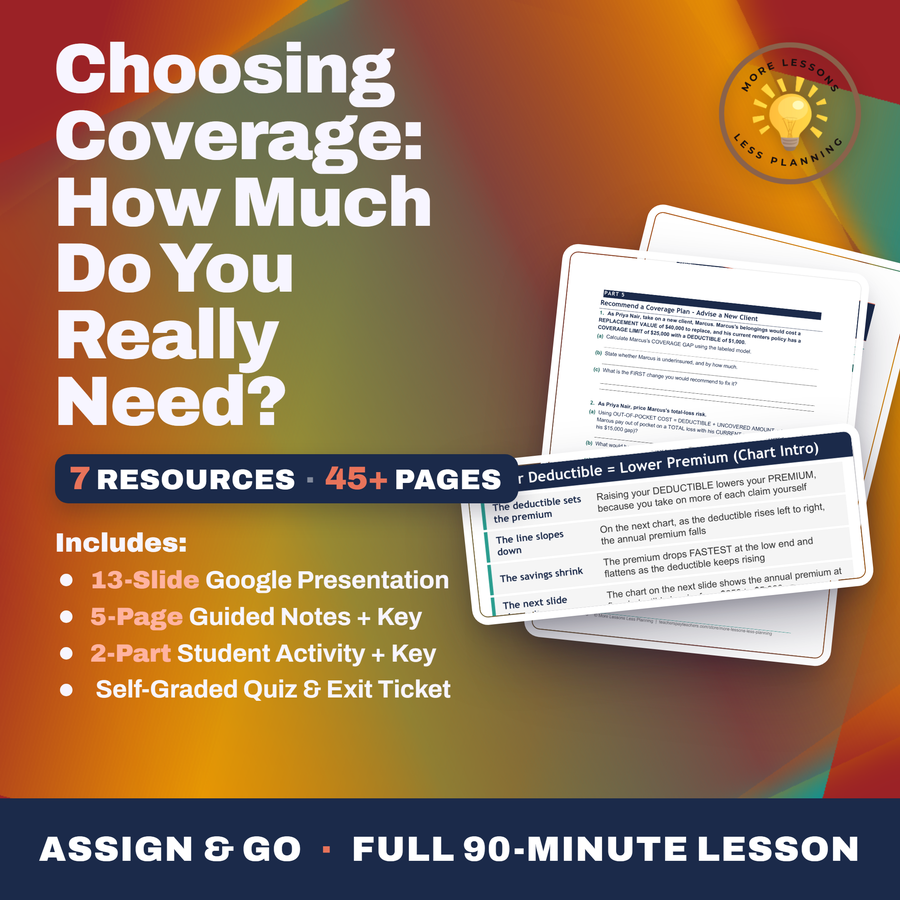
Choosing Coverage: How Much Do You Really Need?
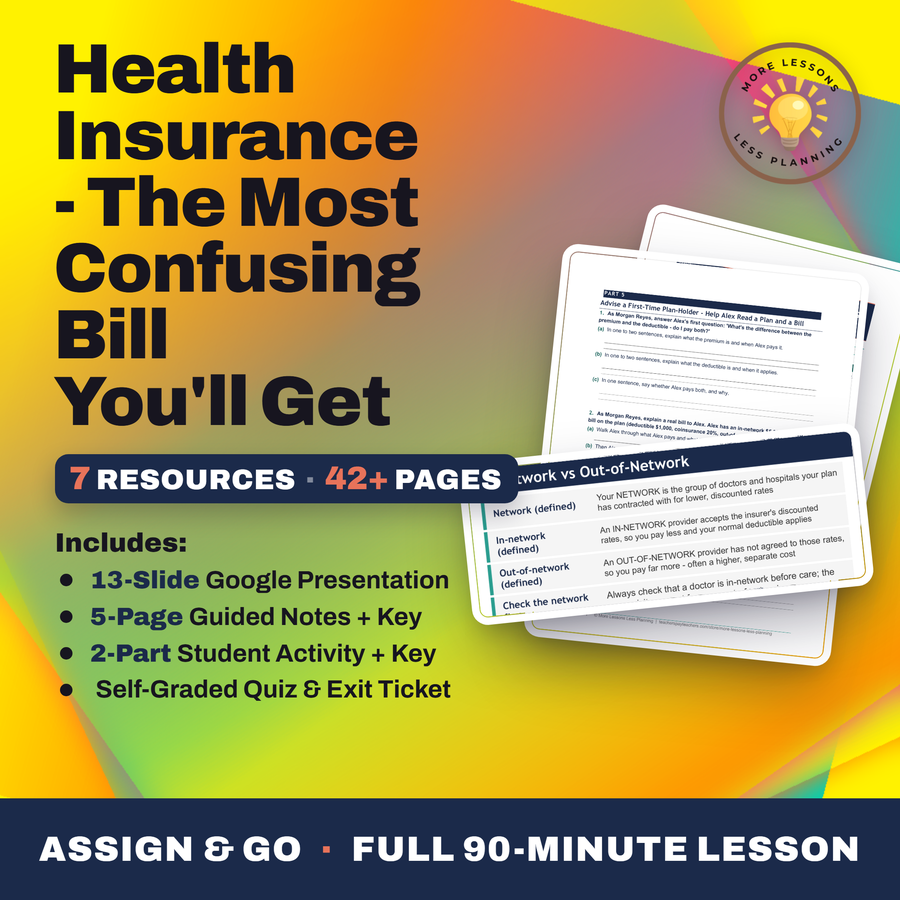
Health Insurance - The Most Confusing Bill You'll Get
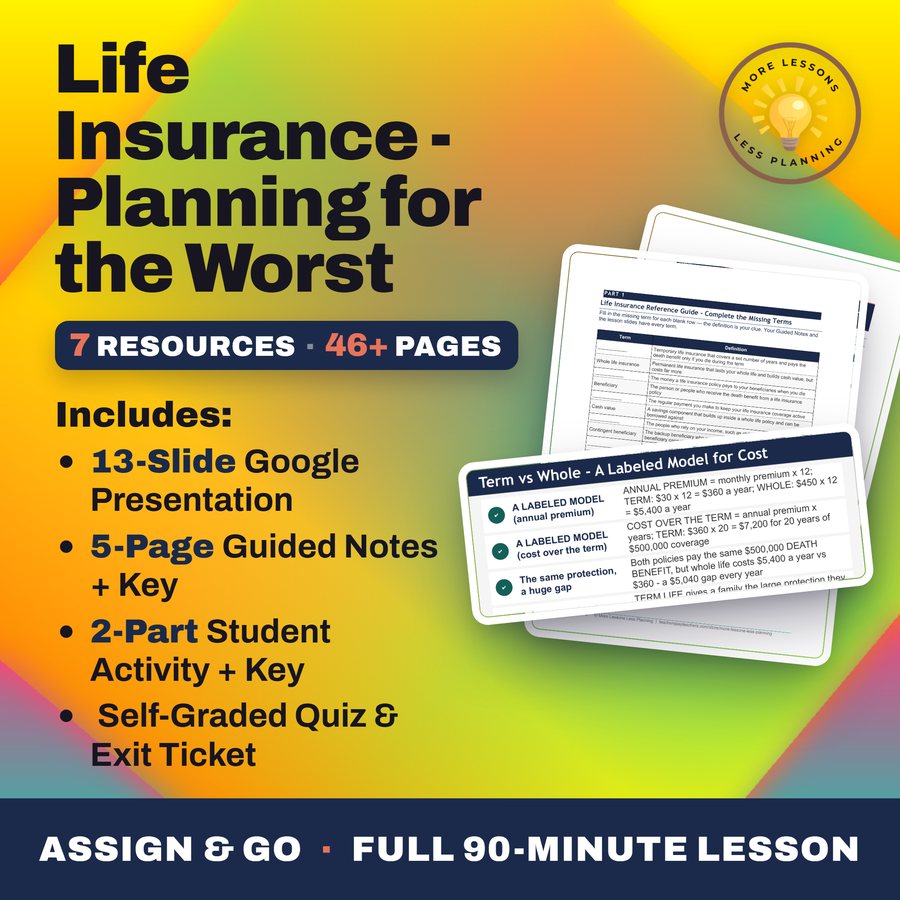
Life Insurance - Planning for the Worst

Renters and Homeowners Insurance - Protecting Your Stuff
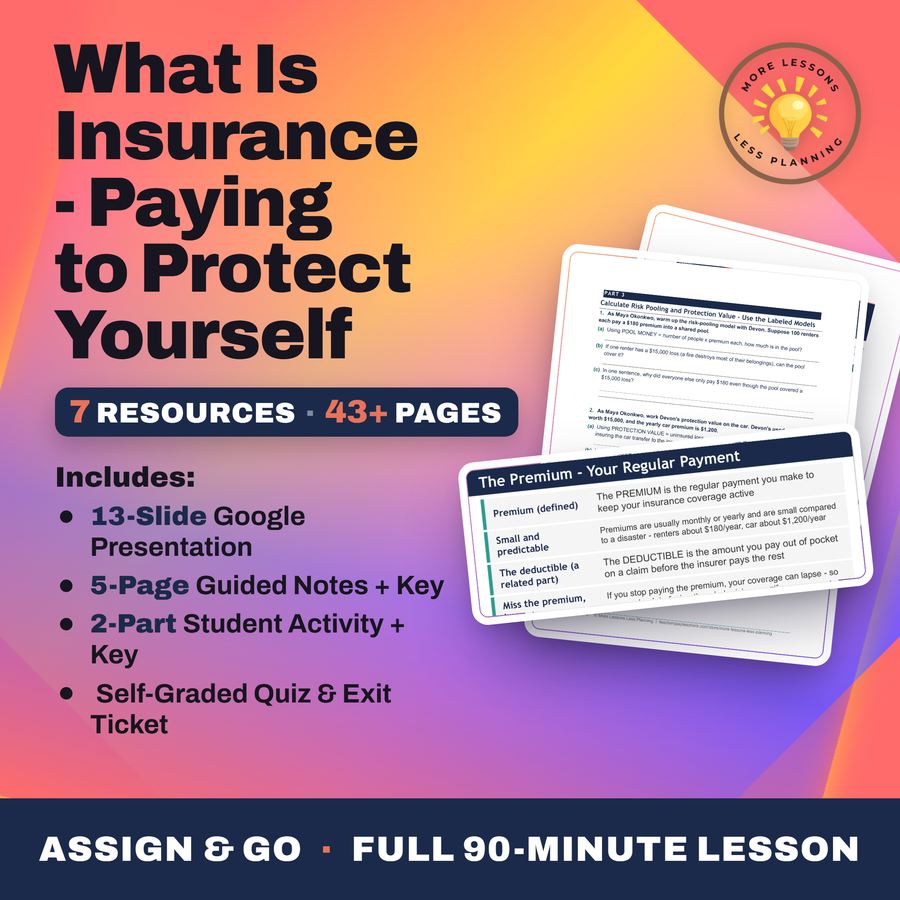
What Is Insurance - Paying to Protect Yourself
Banking Basics: Checking, Savings, and Debit Cards Explained
Every lesson on this site is free to download and use. If one of them saved you a prep period, you can chip in a few bucks toward my three kids' daycare fund. That's genuinely where tips go.