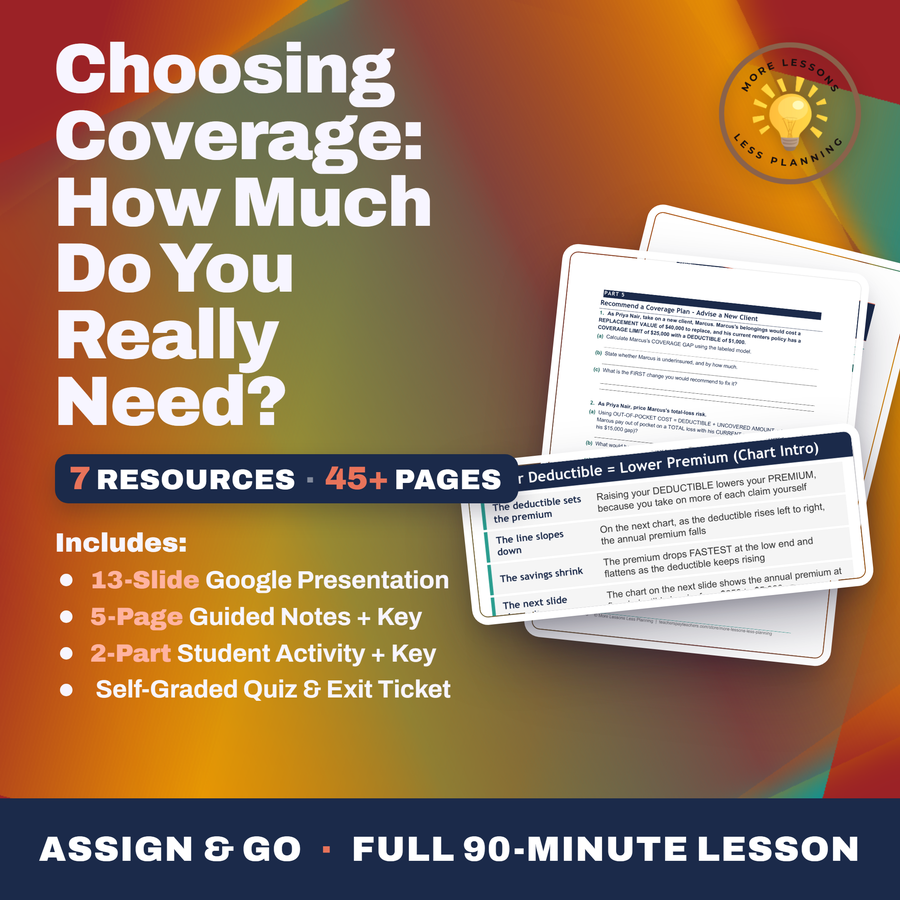
Choosing Coverage: How Much Do You Really Need?
Quality reviewed September 2026
- Grades
- Grades 9-12
- Time
- About two 50-minute class periods
- Includes
- 11 ready-to-teach files
- Format
- Word (.docx) · PowerPoint (.pptx)
- Slide deck
- Guided notes
- Guided notes teacher key
- Activity + answer key
- Quiz + answer key
- Exit ticket + answer key
- Teacher guide
- Teacher presentation notes
What students do
- Calculate a coverage gap using coverage gap equals replacement value minus coverage limit for real client scenarios
- Read a line chart of premium versus deductible and find where raising a deductible stops paying off
- Calculate out-of-pocket cost on a claim using out-of-pocket cost equals deductible plus uncovered amount
- Write a full coverage recommendation for a new client, addressing limit, deductible, and a yearly policy review
What it covers
- The coverage-gap formula, and why it floors at zero once your limit exceeds your replacement value
- A deductible-premium tradeoff chart running from $250 to $5,000 for students to find where the savings curve bends
- Why underinsurance stays invisible until a claim, and how a yearly policy review catches it
- Matching a deductible to what your savings could actually cover on a claim
Learning targets
- Evaluate how much coverage a given situation requires
- Explain the tradeoff between a higher deductible and a lower premium
- Calculate a coverage gap and the out-of-pocket cost of a claim
- Recognize underinsurance and recommend a coverage plan
Peek inside
✔
Start with what you would lose
Add up the REPLACEMENT VALUE - what it would cost today to replace the property you own
✔
Set the coverage limit to match
Why this matters
Devon is twenty-four, rents his own place, and owns $30,000 worth of belongings that his policy only covers up to $20,000. Most renters never learn they're underinsured until a fire or a break-in forces the question, which is exactly the gap this lesson puts in front of students first.
The deductible chart is the surprise: raising it from $250 toward $5,000 helps less and less the higher you go, and students have to find the exact point where it stops paying off. By the time they recommend coverage for a new client, they're defending a deductible against what that person could actually afford out of pocket, not chasing the lowest premium.
From one teacher to another
I built this one around a single decision I want every student walking away able to make: how much coverage is actually enough. The whole lesson runs through Devon, a 24-year-old renter whose belongings would cost $30,000 to replace but whose policy only covers $20,000, and students work the coverage-gap formula on his numbers themselves, then carry that gap into a real out-of-pocket bill on a total loss. The deductible-premium chart is the part that surprises them, since the savings from raising your deductible aren't a straight line, and I have them find the exact point on the curve where paying a higher deductible stops being worth it. By the end they're recommending a full coverage plan for a new client and have to justify the deductible against that person's actual savings, not just chase the lowest premium.
Every file in this toolkit
-
Activity (Student)
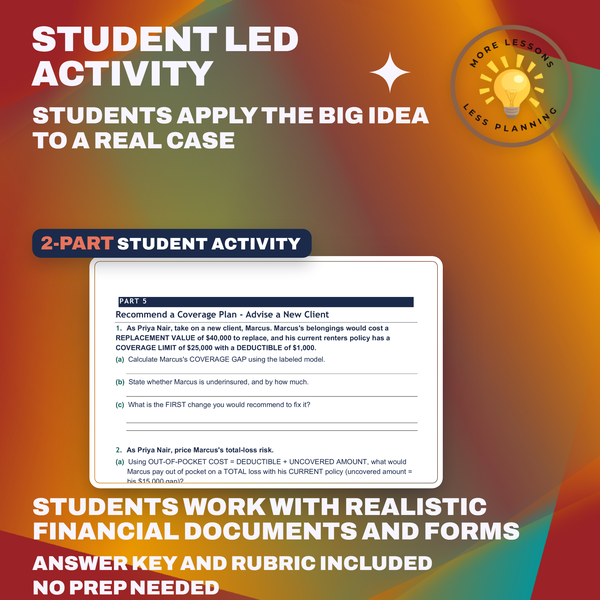
Devon Carter's belongings would cost $30,000 to replace but his renters policy caps out at $20,000, so students size that coverage gap, read a deductible-premium chart, then check a second client's numbers before recommending a plan.
-
Activity (Answer Key)
$10,000 is the gap between Devon's $30,000 replacement value and his $20,000 coverage limit, and raising that limit drops his total out-of-pocket cost from $10,500 to $500, while Renata's higher $25,000 limit floors her gap at zero.
-
Exit Ticket (Student)
Replacement value tested at $30,000 against a $20,000 coverage limit becomes the gap calculation, next to what a higher deductible does to a premium and a plain definition of underinsurance. Replacement value, coverage limit, and coverage gap belong in the write.
-
Exit Ticket (Answer Key)
The $10,000 gap between a $30,000 replacement value and a $20,000 coverage limit drives this rubric, together with correct use of all three vocabulary terms and the reasoning that a gap that size counts as real underinsurance.
-
Guided Notes (Student)
Devon owns $30,000 in belongings but carries only a $20,000 policy limit, and that gap drives the deductible-premium tradeoff on a chart running from $250 to $5,000 in out-of-pocket cost.
-
Guided Notes (Teacher Key)
$10,000 is Devon's underinsured coverage gap once the numbers are worked through, next to the deductible chart spanning $250 to $5,000 and the four-step process for setting a coverage level.
-
Quiz (Student)
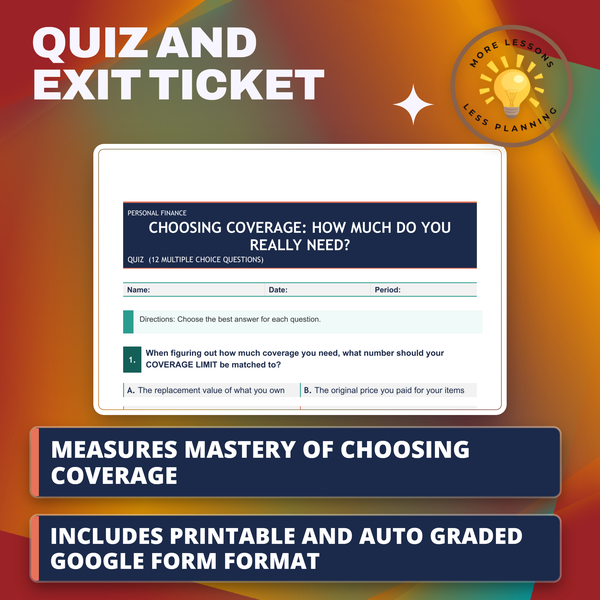
A $30,000 replacement value against a $20,000 policy limit sets up a coverage-gap calculation, next to the deductible-premium chart and what underinsurance actually means for a policyholder.
-
Quiz (Answer Key)
The $5,000 deductible is marked as carrying the lowest annual premium on this chart, next to a $10,000 coverage gap and the $250 saved by raising a deductible from $500 to $1,000.
-
Slides
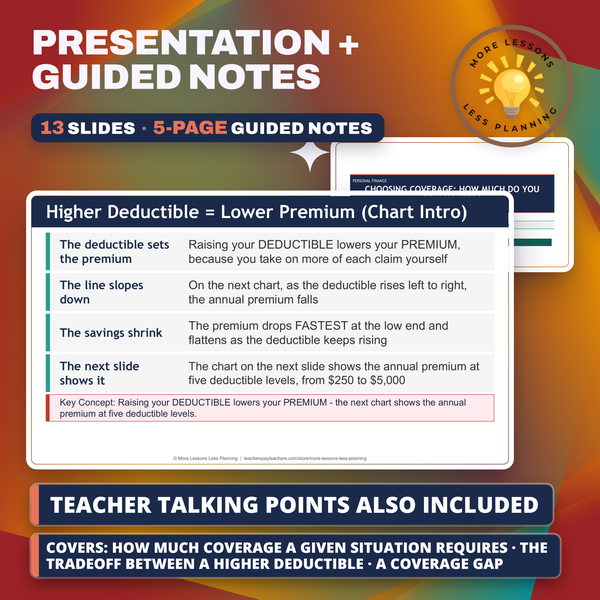
$30,000 in belongings sits against Devon's $20,000 policy limit on the slide that names the resulting $10,000 coverage gap, then a five-level deductible chart and a $10,500 out-of-pocket total show what being underinsured costs him.
-
Teacher Guide
Coverage gaps of $10,000 open up when Devon Carter's $30,000 in belongings meets a $20,000 policy limit, the capstone math behind this Unit 8 guide. A 55-point rubric grades extensions on personal coverage gaps, deductible tradeoffs, and coverage across four life stages.
-
Teacher Presentation Notes
A five-row premium table starts at a $250 deductible and climbs to $5,000, the chart behind the coverage gap formula, replacement value minus coverage limit, and why a renter needs less coverage than a homeowner.
Download
Where should I send the next one?
Everything here is free and it stays that way. Leave your email and I'll send you the new lessons as they go up. You can unsubscribe from any one of them.
Related resources
Health Insurance - The Most Confusing Bill You'll Get
Life Insurance - Planning for the Worst
Renters and Homeowners Insurance - Protecting Your Stuff
What Is Insurance - Paying to Protect Yourself
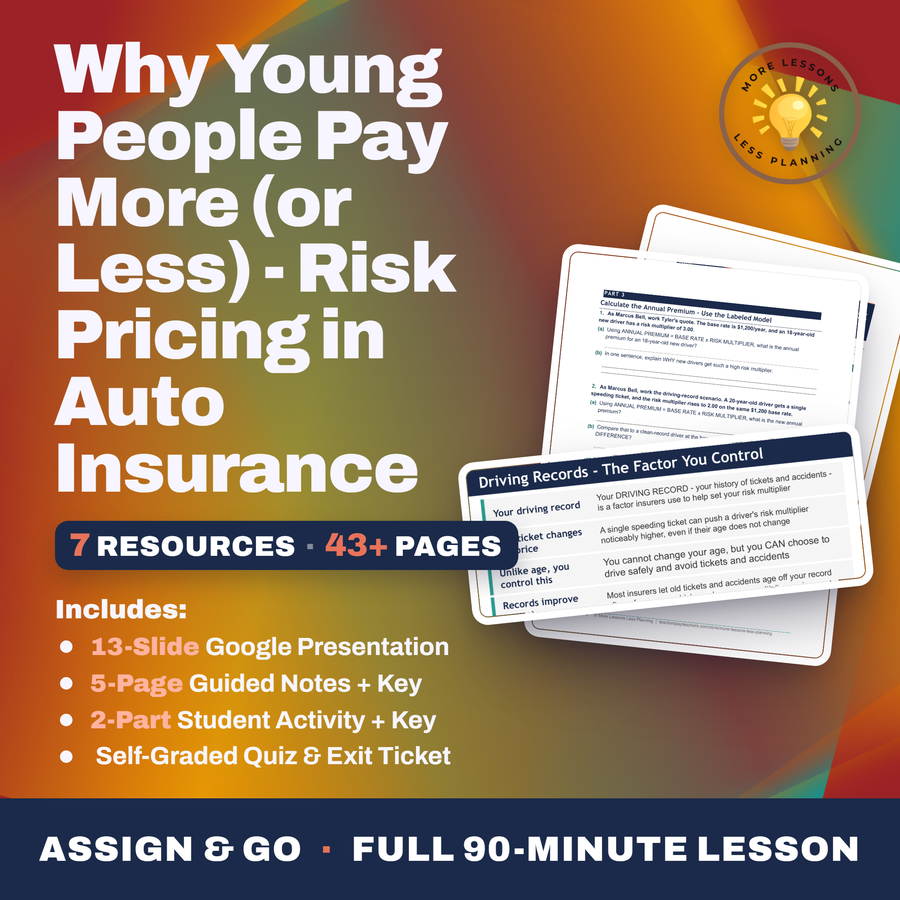
Why Young People Pay More (or Less) - Risk Pricing in Auto Insurance
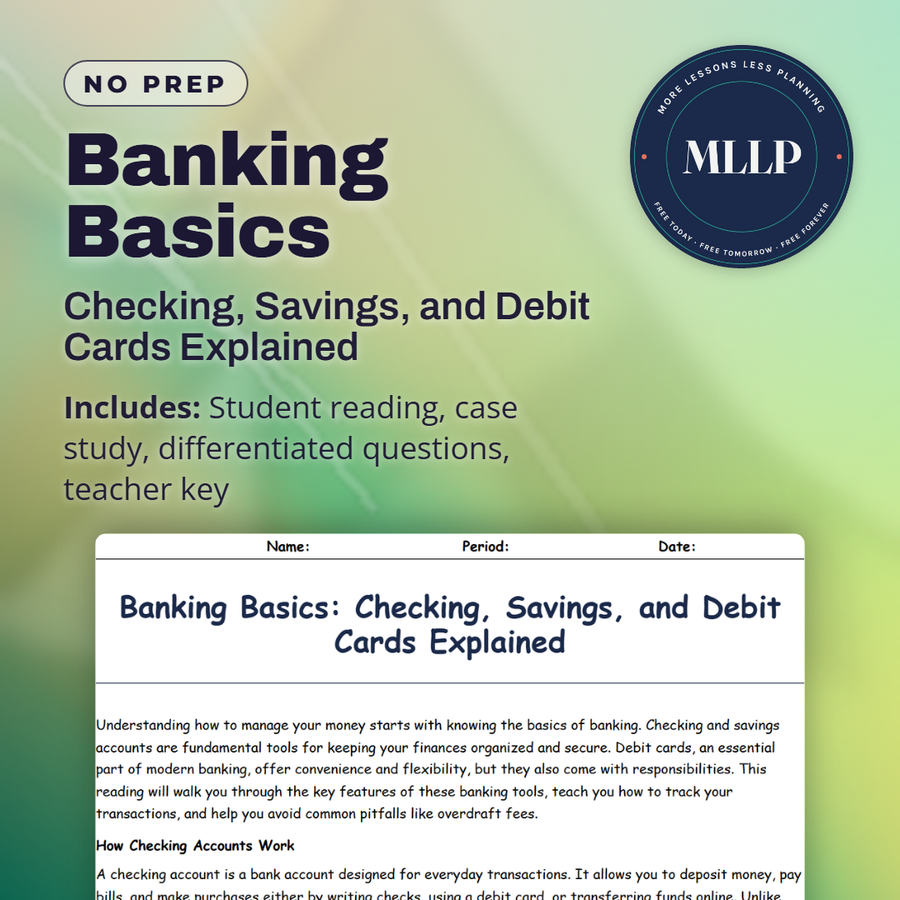
Banking Basics: Checking, Savings, and Debit Cards Explained
Every lesson on this site is free to download and use. If one of them saved you a prep period, you can chip in a few bucks toward my three kids' daycare fund. That's genuinely where tips go.