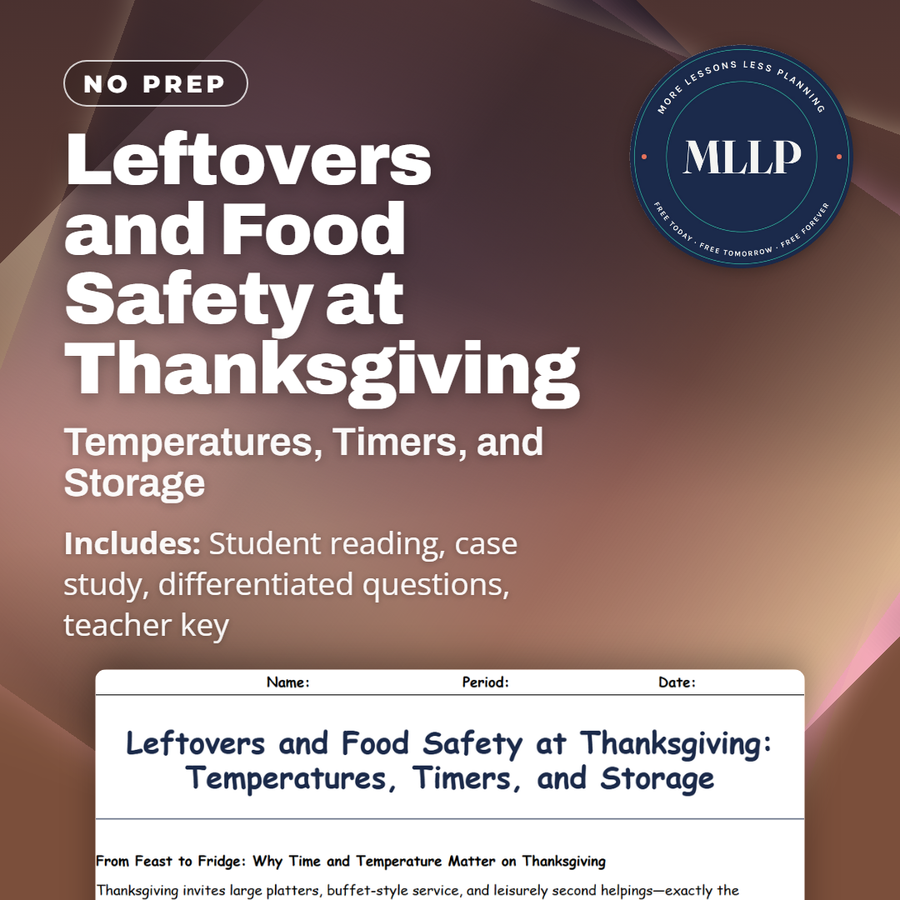
Leftovers and Food Safety at Thanksgiving: Temperatures, Timers, and Storage
Quality reviewed September 2026
Facts verified September 9, 2026
- Subject
- Health & PE
- Grades
- Grades 9-12
- Length
- 8-page student worksheet
- Time
- About one 50-minute class period
- Great for
- Sub plans and independent work
- Includes
- Reading passage, comprehension questions + full answer key
- Format
- Print-and-go PDF
What students do
- Apply the two-hour rule to prevent bacterial growth in holiday foods
- Calculate safe cooling times for deep versus shallow containers
- Design a Black Friday snack board that stays out of the Danger Zone
- Evaluate a case-study family's mistakes and propose fixes
What it covers
- Bacterial growth in the Danger Zone (40-140°F)
- Thermal mass and cooling rates for dense foods
- FIFO inventory and three-to-four day storage windows
Start reading this worksheet
From Feast to Fridge: Why Time and Temperature Matter on Thanksgiving
Thanksgiving invites large platters, buffet-style service, and leisurely second helpings: exactly the conditions that raise foodborne illness risk if you’re not careful with time–temperature control. After cooking, foods must stay out of the Danger Zone (40–140°F) where bacteria like Clostridium perfringens, Salmonella, and Staphylococcus aureus multiply quickly. A carved turkey resting under foil on the counter, a pan of stuffing left “to cool,” or a saucepan of gravy parked warm on the stove can drift into this range fast. The rule of thumb is the two-hour rule: refrigerate or freeze perishable foods within two hours of coming off heat (one hour if your kitchen is above 90°F during a crowded cookathon). The Thanksgiving twist is thermal mass: big roasts and deep casseroles retain heat in their centers even when edges feel merely warm. That means the core can sit in the Danger Zone long after the serving surface seems safe to touch. To protect your crowd, plan active cooling: smaller portions, shallow containers (≤ 2 inches deep), airflow around pans, and a clear handoff from table to fridge.
Cool Fast, Reheat Hot: Turkey, Stuffing, Gravy, and Pies
Thanksgiving leftovers are best when they move down through the Zone quickly and back up past it decisively. Start by carving the turkey soon after service: slice breast meat, debone legs and thighs, and distribute pieces into shallow, labeled containers. For stuffing, especially if it was baked in the bird or packed thick in a casserole, spread it into two or three shallow dishes so heat can escape; dense, starchy foods hold heat and cool slowly. Gravy and sauces should be strained if needed, then chilled in wide containers or jars with the lid left slightly ajar until cool (then sealed). Mashed potatoes, green-bean casserole, and sweet potatoes also benefit from shallow pans and a spot on a cooling rack to let air circulate beneath. When it’s time to reheat, aim for 165°F throughout. Use a food thermometer in the center and the thickest parts of mixed plates. Stir gravy and soups to eliminate cold pockets and bring them to a rolling boil. For pumpkin pie and pecan pie, the concern is more quality than pathogen growth: custards should be refrigerated within two hours as well, then rewarmed gently (or served cold) to avoid curdling or weeping. Remember: taste and smell won’t reveal unsafe food. Temperature and time will.
Thanksgiving Traps: Crowd Controls, Travel Plates, and Black Friday Grazing
Holidays add unique pitfalls. A busy kitchen runs warmer, which shrinks your safe window before refrigeration; set a timer when food hits the table. “Family-style forever” buffets tempt everyone to nibble for hours, so it’s better to stage servings: place half the stuffing and half the turkey out, and refill from the fridge. If guests take to-go plates, remind them to refrigerate promptly (within 2 hours of your mealtime, not theirs) and to reheat to 165°F before eating. If you’re driving leftovers to a relative’s house, pack them already cold with ice packs in an insulated bag; warm-to-cool food in sealed containers can trap heat and stay in the Danger Zone the entire trip. Black Friday grazing is another risk: a platter of turkey and cheese set out for “just an hour” can turn into three during movie marathons. Build safer snack boards with items that hold cold well, and keep small refills in the fridge so the main board doesn’t linger. Finally, practice cross-contamination control during cleanup: once the turkey is carved, retire any board or knife that touched raw poultry earlier; switch to clean boards, knives, and towels for leftovers.
Like what you read? The full reading, the case study, and every question set are in the free download below, along with the answer key.
Why this matters
The Owens family carved a sixteen pound turkey at 3:45 and left it out on the island until dessert at six, not realizing that a warm kitchen and a deep casserole dish meant the center of that food never left the temperature range bacteria like best.
Food safety sounds like common sense until students do the actual math on cooling times for a deep dish versus a shallow one, and realize that a few convenient hours on the counter is exactly how half a family ends up sick the next day. Once they've rebuilt the Owens' timeline with shallow containers and a two hour timer, they stop trusting how the food looks and start trusting a clock.
From one teacher to another
Thanksgiving sprawls across hours and kitchens, and that's where safety slips. The case study walks through the Owens family buffet: they roast a 16-lb turkey, carve it at 3:45, and leave everything on the island until dessert at 6 p.m., not realizing the warm kitchen and deep casserole dishes mean the food's center stayed in the bacteria-friendly zone the whole time. By next day, half the family gets ill. Students analyze the exact points where time or temperature failed, then rebuild the plan: carve early, use shallow containers, label with times, and set a two-hour timer. The answer key drills the math, how many minutes does a 4-inch-deep pan of stuffing need to cool safely, and why a pizza box on the counter overnight is riskier than you think.
What you get
Download
Where should I send the next one?
Everything here is free and it stays that way. Leave your email and I'll send you the new lessons as they go up. You can unsubscribe from any one of them.
Related resources
Black Friday Forensics: Shoplifting, Organized Theft, and Crowd Violence
Black Friday Smart Shopper: Economics and Personal Finance in Action
Black Friday: Are the “Deals” Actually Good for Shoppers?
Black Friday’s Economic Impact: Who Gains, Who Pays, and What It Means for the Economy
Budget a Feast: Unit Prices, Deals, and Receipts
Colonial Foodways: Indigenous Knowledge and European Adaptation
Every lesson on this site is free to download and use. If one of them saved you a prep period, you can chip in a few bucks toward my three kids' daycare fund. That's genuinely where tips go.