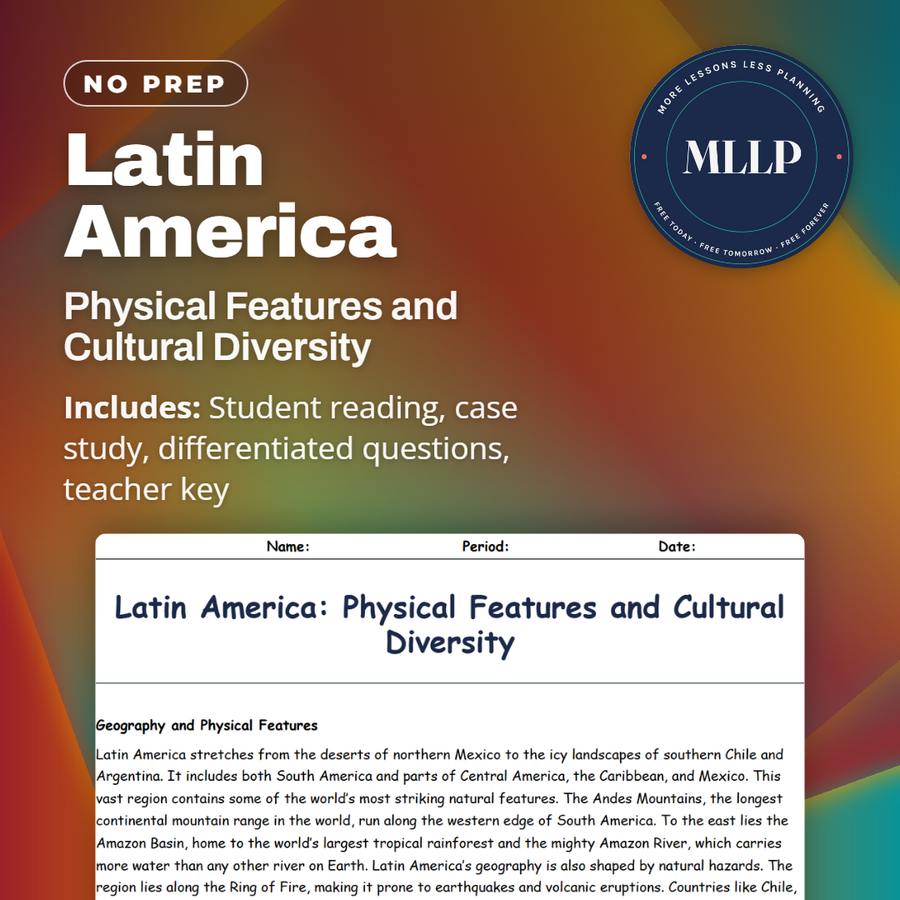
Latin America: Physical Features and Cultural Diversity
Quality reviewed September 2026
Facts verified September 14, 2026
- Subject
- Social Studies
- Grades
- Grades 9-12
- Length
- 7-page student worksheet
- Time
- About one 50-minute class period
- Great for
- Sub plans and independent work
- Includes
- Reading passage, comprehension questions + full answer key
- Format
- Print-and-go PDF
What students do
- Match terms like the Andes Mountains, the Amazon Basin, and MERCOSUR to their correct definitions
- Fill in the blank sentences on the Amazon Rainforest, the Spanish language, and Venezuela's oil exports
- Answer multiple choice questions on the Amazon River, the Aztec, Maya, and Inca civilizations, and threats to the Amazon Rainforest
- Write short answers on how colonization shaped Latin America's languages and religions, why economic inequality persists, and how the Amazon regulates climate
What it covers
- Latin America's physical geography, including the Andes Mountains, the Amazon Basin, and the region's earthquake and volcano risk along the Ring of Fire
- The region's cultural history, from the Aztec, Maya, and Inca civilizations through Spanish and Portuguese colonization
- A case study on the Amazon Rainforest and the deforestation from farming, logging, and mining that threatens it
Start reading this worksheet
Geography and Physical Features
Latin America stretches from the deserts of northern Mexico to the icy landscapes of southern Chile and Argentina. It includes both South America and parts of Central America, the Caribbean, and Mexico. This vast region contains some of the world’s most striking natural features. The Andes Mountains, the longest continental mountain range in the world, run along the western edge of South America. To the east lies the Amazon Basin, home to the world’s largest tropical rainforest and the mighty Amazon River, which carries more water than any other river on Earth. Latin America’s geography is also shaped by natural hazards. The region lies along the Ring of Fire, making it prone to earthquakes and volcanic eruptions. Countries like Chile, Mexico, and Peru regularly face these natural challenges. Climate varies dramatically: the Caribbean islands have tropical climates, while Patagonia in southern Argentina experiences cold, windy weather. Fertile lands such as Brazil’s interior plains and Mexico’s central plateau support agriculture, while natural resources like oil, silver, copper, and coffee drive economies. This geographic diversity has created both opportunities and obstacles for the people of Latin America.
Cultural Diversity and History
Latin America’s culture is deeply influenced by its Indigenous, European, and African roots. Before European colonization, powerful civilizations like the Aztec, Maya, and Inca built advanced cities, agricultural systems, and traditions that still impact the region today. Spanish and Portuguese colonization introduced new languages, religions, and political systems. As a result, most of Latin America speaks Spanish or Portuguese, and Roman Catholicism remains the dominant religion. The arrival of enslaved Africans added another layer of cultural diversity. African traditions blended with Indigenous and European influences, shaping music, food, and festivals. Today, Latin America is famous for its rich cultural life—salsa, samba, tango, and mariachi music are celebrated worldwide. At the same time, the region struggles with issues of inequality and cultural tension. Indigenous groups continue to fight for land rights and recognition, while urban areas face rapid growth and economic challenges. Latin America’s cultural diversity is both its strength and its ongoing challenge, shaping how people see themselves and their societies.
Economic Development and Challenges
Latin America has abundant natural resources, but its economies have faced struggles throughout history. Countries like Venezuela and Mexico rely heavily on oil exports, while Chile and Peru are major producers of copper and silver. Brazil, with its vast farmland, exports soybeans, coffee, and beef, making it an agricultural powerhouse. Yet despite these resources, the region has often faced economic inequality. Wealth is concentrated among small elites, while large populations remain in poverty. The 20th and 21st centuries have seen efforts to expand industry and trade. Many Latin American countries are members of trade organizations such as MERCOSUR and have developed stronger ties to global markets. However, corruption, political instability, and reliance on exports continue to slow progress. Migration also plays a key role in the economy—millions of Latin Americans move within the region or to North America seeking better opportunities. Economic success is possible, but it remains uneven, highlighting the challenges of balancing growth with fairness.
Like what you read? The full reading, the case study, and every question set are in the free download below, along with the answer key.
Why this matters
The Andes run the length of a continent that also sits on the Ring of Fire, so the mountains defining Latin America's geography still bring real earthquake and eruption risk. Deforestation from farming, logging, and mining is cutting into the Amazon Basin at the same time.
I bring this in after a unit that treated Latin America as one block, since it forces students to separate the Aztec, Maya, and Inca before layering on Spanish and Portuguese colonization. The deforestation questions turn geography into a real trade-off.
From one teacher to another
This reading covers Latin America's physical geography, from the Andes Mountains to the Amazon Basin, alongside its Indigenous, European, and African cultural roots. I like that the case study on the Amazon Rainforest connects geography directly to a current issue, deforestation driven by farming, logging, and mining. Students get to weigh economic activity against environmental protection using real content from the passage. This pairs well with a unit on world biomes or Latin American history.
What you get
Download
Where should I send the next one?
Everything here is free and it stays that way. Leave your email and I'll send you the new lessons as they go up. You can unsubscribe from any one of them.
Related resources
Every lesson on this site is free to download and use. If one of them saved you a prep period, you can chip in a few bucks toward my three kids' daycare fund. That's genuinely where tips go.