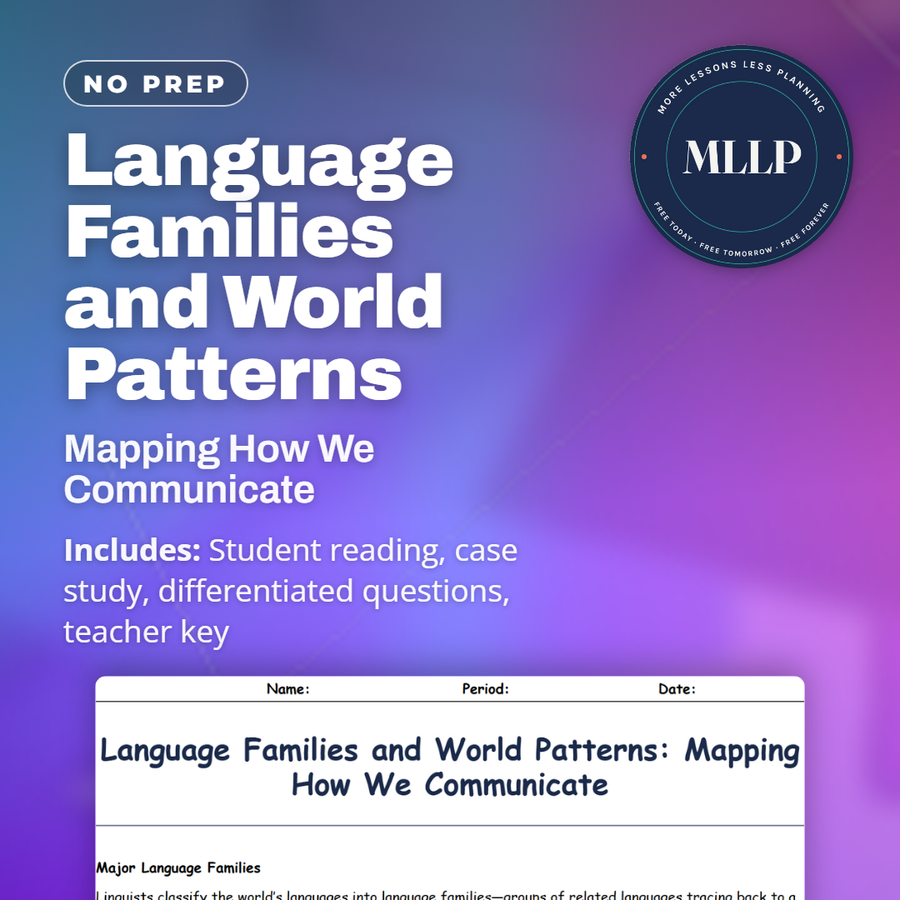
Language Families and World Patterns: Mapping How We Communicate
Quality reviewed September 2026
Facts verified September 14, 2026
- Subject
- Social Studies
- Grades
- Grades 9-12
- Length
- 7-page student worksheet
- Time
- About one 50-minute class period
- Great for
- Sub plans and independent work
- Includes
- Reading passage, comprehension questions + full answer key
- Format
- Print-and-go PDF
What students do
- Match terms like Lingua Franca, Dialect, and Bilingual Education to their correct definitions
- Fill in the blank sentences on language families, dialects, and endangered languages
- Answer multiple choice questions on what a language family is, why languages become endangered, and how dialects form
- Write short answers on how government policy affects minority languages, the benefits of speaking a global lingua franca, and why documenting endangered languages matters
What it covers
- Major world language families like Indo-European, Sino-Tibetan, and Niger-Congo, and how migration shaped their spread
- Dialects, language endangerment, and preservation efforts including bilingual education and digital archives
- A case study on the Nortan language, nearly lost to a handful of elders, being revived through technology and community effort
Start reading this worksheet
Major Language Families
Linguists classify the world’s languages into language families: groups of related languages tracing back to a common ancestral tongue. One of the largest is the Indo-European family, encompassing English, Spanish, Hindi, Russian, and many others. Another key family is Sino-Tibetan, which includes Mandarin Chinese and several languages spoken across East Asia. Other notable families include Afro-Asiatic, prominent in the Middle East and North Africa (Arabic, Hebrew), and Niger-Congo, found in Sub-Saharan Africa. Each family branches into numerous subfamilies and individual languages, reflecting migrations and cultural shifts over thousands of years.
Spatial Distribution of Languages
Languages do not spread uniformly. Historical migrations, conquests, and trade routes shape where particular languages dominate. For instance, the spread of Indo-European languages partially correlates with ancient migrations from the Eurasian Steppe. European colonization later exported Indo-European languages (like French, Portuguese, and English) to the Americas, Africa, and parts of Asia. Physical geography also plays a role: mountainous regions often preserve linguistic diversity by isolating small communities, leading to unique local dialects or languages. Today, global languages such as English often serve as lingua francas, facilitating communication in international business, diplomacy, and tourism. This can overshadow local tongues, creating tension between global unity and linguistic preservation. While speaking English may offer economic advantages, it can also lead to language shift, where younger generations abandon their ancestral language in favor of a more dominant one.
Dialects, Endangered Languages, and Preservation Efforts
Within each language family, dialects can emerge based on region, social class, or historical influences. A dialect might differ in pronunciation, vocabulary, or grammar. Even within one language, local dialects can be so distinct that speakers from different regions have difficulty understanding each other. Dialects are often markers of regional identity and pride. Unfortunately, many languages worldwide are endangered, with only a handful of fluent speakers left. Factors like urban migration, intermarriage, and compulsory education in a dominant language accelerate linguistic decline. Losing a language means losing unique cultural traditions, oral histories, and worldviews. Preservation efforts might include documentation, bilingual education, or community-driven initiatives to teach children their heritage language. Technology also plays a role: digital archives and smartphone apps offer new ways to keep endangered languages alive.
Like what you read? The full reading, the case study, and every question set are in the free download below, along with the answer key.
Why this matters
Indo-European and Sino-Tibetan are not abstract categories, they are the reason a student's own first language traces back through centuries of migration. The Nortan case study shows the stakes: a language down to a handful of elders, saved by documenting and teaching it again.
Students think language loss just happens, the way species disappear, so the Nortan revival shows it can be reversed. Once language families read as branches shaped by real migration, the matching section stops feeling like trivia.
From one teacher to another
This one maps out how language families spread across the globe and why some languages thrive while others fade. I like that it connects the abstract idea of a language family to concrete examples like Indo-European and Sino-Tibetan, then follows up with a case study on the Nortan language revival that shows preservation in action. It pairs well with a unit on migration or cultural diffusion.
What you get
Download
Where should I send the next one?
Everything here is free and it stays that way. Leave your email and I'll send you the new lessons as they go up. You can unsubscribe from any one of them.
Related resources

Cultural Diffusion and Exchange: How Ideas Spread Around the World
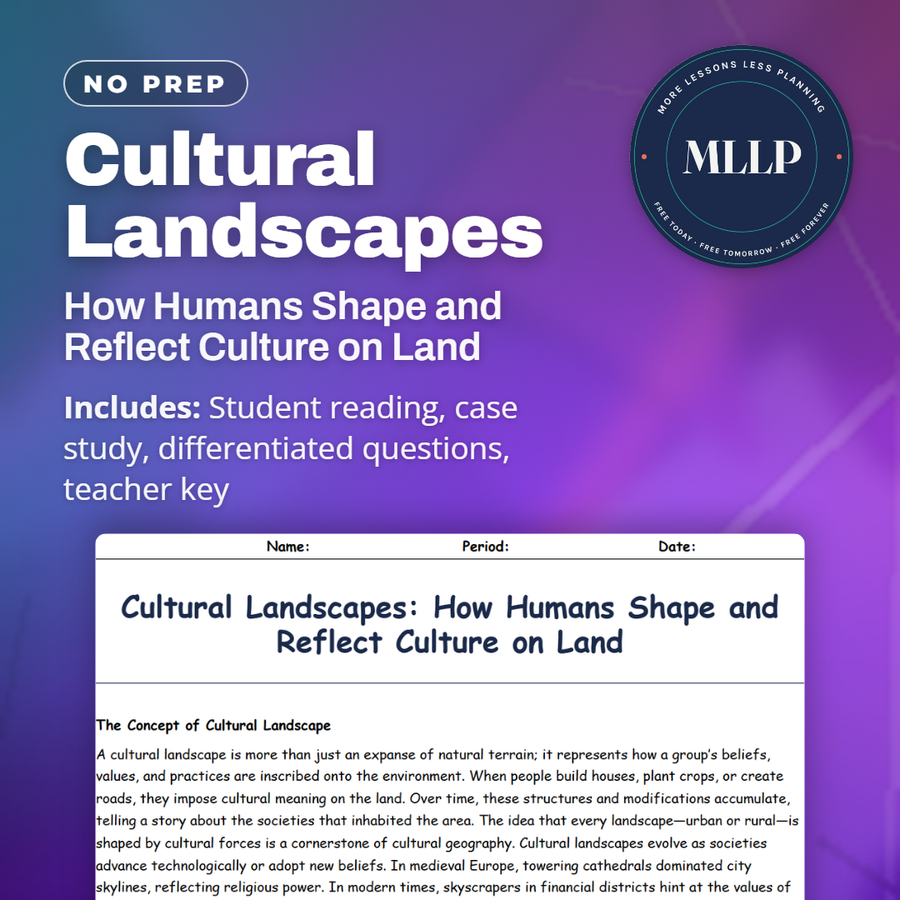
Cultural Landscapes: How Humans Shape and Reflect Culture on Land
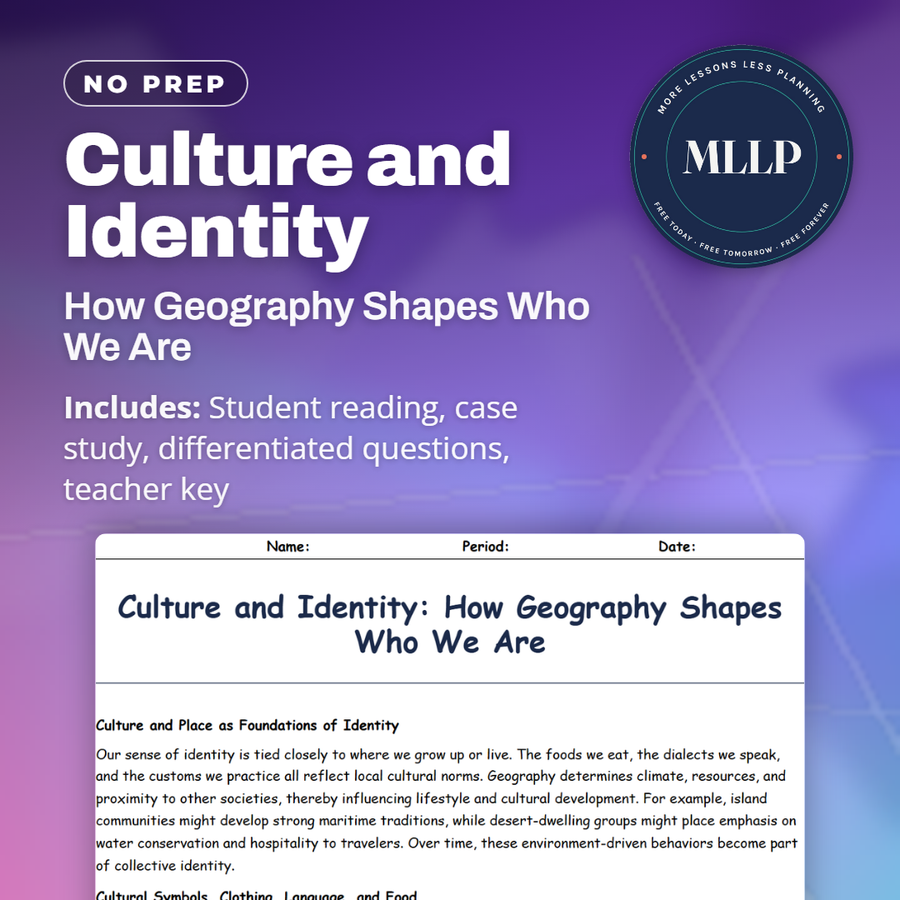
Culture and Identity: How Geography Shapes Who We Are
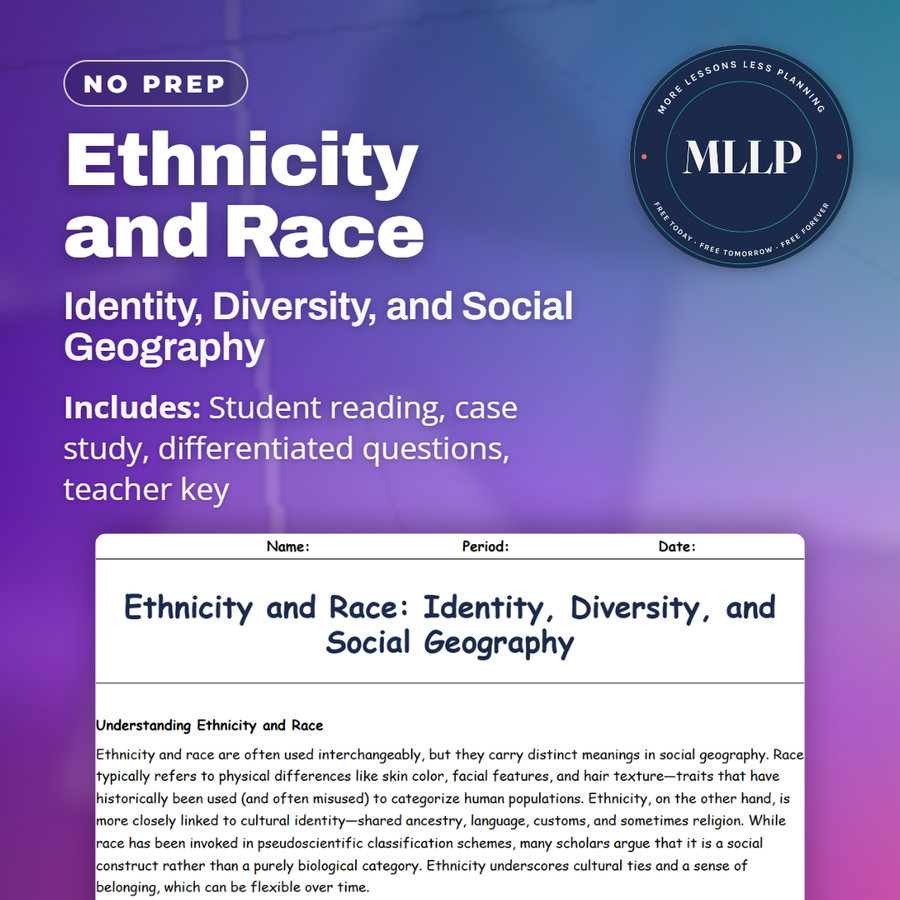
Ethnicity and Race: Identity, Diversity, and Social Geography
Exploring the Elements of Culture: Language, Religion, and Customs
Folk Culture vs. Popular Culture: Local Traditions and Global Trends
Every lesson on this site is free to download and use. If one of them saved you a prep period, you can chip in a few bucks toward my three kids' daycare fund. That's genuinely where tips go.