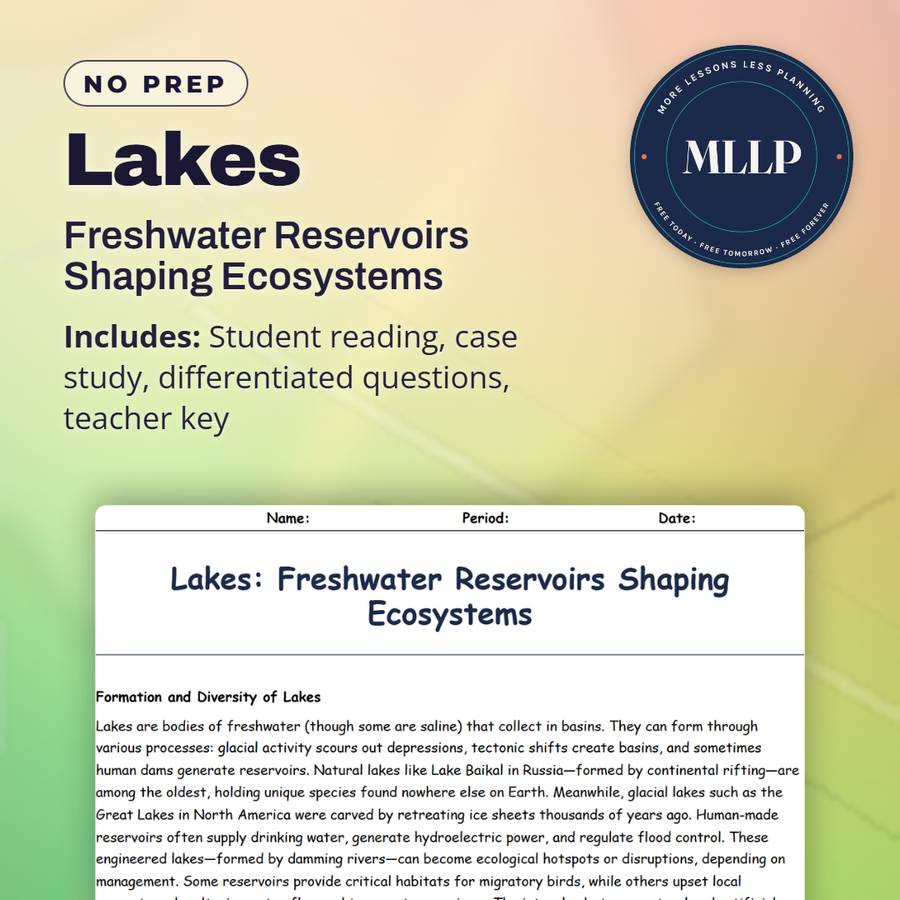
Lakes: Freshwater Reservoirs Shaping Ecosystems
Quality reviewed September 2026
Facts verified September 14, 2026
- Subject
- Social Studies
- Grades
- Grades 9-12
- Length
- 6-page student worksheet
- Time
- About one 50-minute class period
- Great for
- Sub plans and independent work
- Includes
- Reading passage, comprehension questions + full answer key
- Format
- Print-and-go PDF
What students do
- Match terms like Algal Bloom, Buffer Zone, Aeration, Tectonic Lake, and Reservoir to their correct definitions
- Fill in the blank sentences on glacial lakes, tectonic lakes, and algal blooms
- Answer multiple choice questions on how glacial lakes form, what makes Lake Baikal unique, and how human-made reservoirs are created
- Write short answers on why lakes are vulnerable to pollution, how reservoirs can both help and disrupt ecosystems, and what communities can do to protect lake water quality
What it covers
- How lakes form, from glacial lakes like the Great Lakes to tectonic lakes like Lake Baikal and human-made reservoirs created by dams
- The ecological importance of lakes as freshwater habitats and nutrient sinks, and the threats they face from runoff and pollution
- A case study on restoring a polluted lake in Silverdale using buffer zones, replanted vegetation, and aeration to bring back water quality and fish populations
Start reading this worksheet
Formation and Diversity of Lakes
Lakes are bodies of freshwater (though some are saline) that collect in basins. They can form through various processes: glacial activity scours out depressions, tectonic shifts create basins, and sometimes human dams generate reservoirs. Natural lakes like Lake Baikal in Russia, formed by continental rifting, are among the oldest, holding unique species found nowhere else on Earth. Meanwhile, glacial lakes such as the Great Lakes in North America were carved by retreating ice sheets thousands of years ago. Human-made reservoirs often supply drinking water, generate hydroelectric power, and regulate flood control. These engineered lakes (formed by damming rivers) can become ecological hotspots or disruptions, depending on management. Some reservoirs provide critical habitats for migratory birds, while others upset local ecosystems by altering water flow and temperature regimes. The interplay between natural and artificial lakes shapes much of our global freshwater landscape.
Ecological Importance
As freshwater ecosystems, lakes are vital for wildlife. They host fish, amphibians, birds, and countless invertebrates. Aquatic plants grow near the shoreline, while phytoplankton flourish in open waters. Lakes also act as nutrient sinks, trapping sediments and organic material that would otherwise flow downstream. These nutrients support complex food webs, from microscopic zooplankton to top predators like fish-eating birds and mammals. However, lakes are sensitive to changes in water quality and quantity. Pollutants from agricultural runoff can trigger algal blooms, depleting oxygen and harming fish. Similarly, overuse or diversion of water for irrigation can lower lake levels, shrinking habitats and concentrating pollutants. Managing lake health involves balancing human needs with the requirements of the broader ecosystem. Those needs include recreation, fishing, and water supply.
Like what you read? The full reading, the case study, and every question set are in the free download below, along with the answer key.
Why this matters
Lake Baikal formed along a tectonic rift, not glacial carving like the Great Lakes, and that origin explains why its basin behaves so differently. A lake can still be damaged fast, the way the reservoir at Silverdale lost fish to runoff before buffer zones and aeration brought it back.
Students are surprised a dam-built reservoir even counts as a lake, since they picture lakes as something nature finishes alone. The Silverdale restoration shows a lake is a system people can damage or repair, not scenery.
From one teacher to another
This worksheet is useful for showing students that not all lakes form the same way, and that the formation story actually explains a lot about what makes each one unique, from Lake Baikal's ancient tectonic origin to a reservoir built behind a dam. The Silverdale case study gives a clear, step-by-step look at how a lake gets restored after agricultural runoff damages it. I like pairing the quick reference table with the matching section so students have the vocabulary locked in before the short answer questions. This fits well in a unit on water systems or human impact on the environment.
What you get
Download
Where should I send the next one?
Everything here is free and it stays that way. Leave your email and I'll send you the new lessons as they go up. You can unsubscribe from any one of them.
Related resources
Biomes & Ecosystems: Life Across Earth’s Habitats
Climate vs. Weather: Understanding the Difference

Convergent Boundaries: Where Plates Collide
Deserts: Survival in the Harshest Climates

Divergent Boundaries: Where Plates Pull Apart
Earth’s Layers: From Crust to Core
Every lesson on this site is free to download and use. If one of them saved you a prep period, you can chip in a few bucks toward my three kids' daycare fund. That's genuinely where tips go.