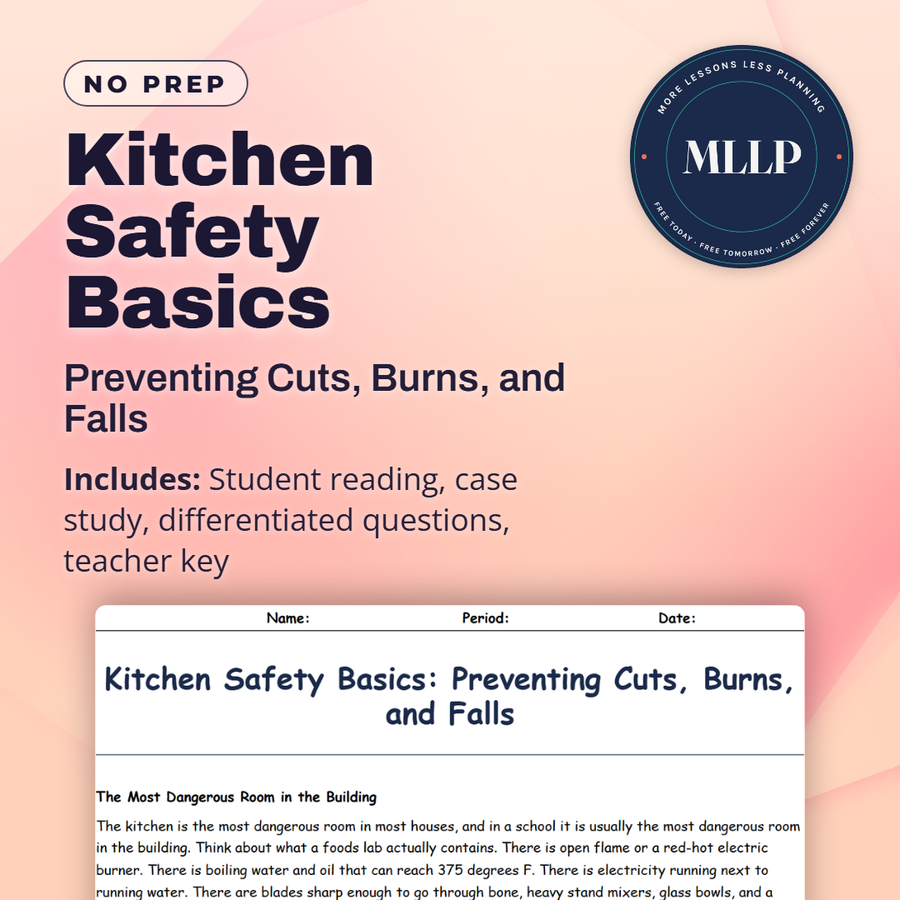
Kitchen Safety Basics: Preventing Cuts, Burns, and Falls
Quality reviewed September 2026
Facts verified September 23, 2026
- Subject
- Career & Life Skills
- Grades
- Grades 9-12
- Length
- 8-page student worksheet
- Time
- About one 50-minute class period
- Great for
- Sub plans and independent work
- Includes
- Reading passage, comprehension questions + full answer key
- Format
- Print-and-go PDF
What students do
- Cuts, burns, and falls get separated into the specific habits that prevent each one
- Identify why a sharp knife is safer to use than a dull one
- Two injuries that rushing makes more likely in a kitchen get explained using the reading's own logic
- Devon's reflex to grab a falling knife gets checked against what the reading says to do instead
What it covers
- Why a sharp knife is safer to use than a dull one
- The correct first aid steps for a burn from a hot pan
- Why closed-toe, non-slip shoes are required in a kitchen
Start reading this worksheet
The Most Dangerous Room in the Building
The kitchen is the most dangerous room in most houses, and in a school it is usually the most dangerous room in the building. Think about what a foods lab actually contains. There is open flame or a red-hot electric burner. There is boiling water and oil that can reach 375 degrees F. There is electricity running next to running water. There are blades sharp enough to go through bone, heavy stand mixers, glass bowls, and a floor that gets slick the second somebody spills. Then the bell rings and a class of teenagers tries to use all of it at once in fifty minutes. The National Safety Council has estimated that roughly one out of every three injuries that happen at home happen in the kitchen. Restaurant and food service workers get hurt on the job more often than workers in many manufacturing plants. That sounds dramatic until you look at what causes the injuries, because almost none of them are exotic. Three categories account for nearly everything: cuts, burns, and slips or falls. Nobody gets hurt by a mysterious kitchen hazard that could not be predicted. They get hurt by a knife they were not paying attention to, a pan handle they grabbed bare-handed, or a puddle nobody bothered to wipe up. That is genuinely good news, because a problem with three causes is a problem you can train against. Every rule in this reading exists because somebody already learned it the hard way and wrote it down so the next person would not have to.
A Dull Knife Is the One That Cuts You
The single most surprising rule in any kitchen is that a sharp knife is safer than a dull one. Students hear that and assume it is backwards. It is not. A sharp blade bites into food on contact and goes where you aim it. A dull blade skates across the surface of an onion or a tomato skin, so the cook pushes harder to compensate. Now you have a heavy tool, extra force behind it, and a blade that can slide off the food in any direction with all that force still loaded. That is how people end up in urgent care. Sharpness is only half of knife safety. The other half is the claw grip, where you curl your fingertips back under your knuckles and let the flat side of the blade ride against your knuckle wall as a guide. Your fingertips are simply not in the same zip code as the edge. Cut on a stable board, and if the board slides, put a damp paper towel underneath it. Carry a knife point down with the blade turned away from your leg, and say something out loud when you walk behind someone. Wash knives one at a time and never drop them into a sink full of soapy water where the next person reaches in blind. And if a knife ever leaves the counter, do not try to catch it. Step back, get your feet clear, and let it hit the floor. A knife is replaceable. Tendons in your hand are not.
Steam, Grease, and Burns You Never See Coming
Burns divide into two families, and most people only respect one of them. Dry heat burns come from the obvious sources: a burner, a sheet pan, an oven rack, the handle of a skillet that has been over a flame for ten minutes. Those hurt immediately and people learn fast. Scalds are the sneaky ones. A scald is a burn from hot liquid or steam, and steam is worse than boiling water because it carries extra energy that it dumps into your skin the instant it condenses. That is why you always lift a pot lid with the far edge first, tilting the opening away from your face so the steam column goes toward the wall instead of your eyes. It is also why you never lean over a pot you are about to drain. Grease deserves its own paragraph. Water that gets into hot oil turns into steam instantly and blows droplets of oil out of the pan in every direction, so food goes into a fryer gently and dry, never dropped from a height. Use dry oven mitts, because a wet mitt conducts heat straight to your hand and turns into a steam pocket. Turn pot handles inward so nobody catches one with a sleeve. If you do get burned, cool the area under running water for ten to twenty minutes. Do not use ice, which damages tissue further, and do not use butter, oil, or toothpaste, which trap heat in the skin instead of pulling it out.
Like what you read? The full reading, the case study, and every question set are in the free download below, along with the answer key.
Why this matters
Cuts and burns are the injuries I actually see in a foods lab, which makes this the reading with the most immediate payoff. The claw grip and the rule about letting a falling knife hit the floor sound small until a student pictures Devon's case study, four stitches from grabbing a blade out of reflex while rushing to beat the bell. The reading is honest that none of this is about being naturally careful, it is about building a habit that survives the moment a class gets rushed, which is exactly when injuries happen. Students who practice stepping back from a dropped knife in a low-stakes lab are the ones who do it automatically in a restaurant kitchen years later.
From one teacher to another
A foods lab packs open flame, boiling oil, sharp blades, and a floor that turns slick the moment something spills into one room, then asks a class of teenagers to share it in fifty minutes. The reading breaks kitchen injuries into three predictable categories, cuts, burns, and falls, and spends real time on the counterintuitive rule that a sharp knife is safer than a dull one, because a dull blade skates and needs extra force behind it. Students read through the claw grip, the difference between a dry heat burn and a scald, and the correct first aid for each. The floor section is short but absolute: clean a spill the moment it happens, not at cleanup time. The case study follows Devon, who caught a falling chef's knife by the blade while rushing to finish a stir-fry before the bell.
What you get
Download
Where should I send the next one?
Everything here is free and it stays that way. Leave your email and I'll send you the new lessons as they go up. You can unsubscribe from any one of them.
Related resources
Cleaning vs. Sanitizing: They Are Not the Same Thing
Cross-Contamination and How to Stop It
Date Labels, Spoilage, and When to Throw It Out
Food Handler Hygiene: Gloves, Hair, and When to Stay Home
Foodborne Illness: The Pathogens That Make People Sick
HACCP: How Professionals Keep Food Safe
Every lesson on this site is free to download and use. If one of them saved you a prep period, you can chip in a few bucks toward my three kids' daycare fund. That's genuinely where tips go.