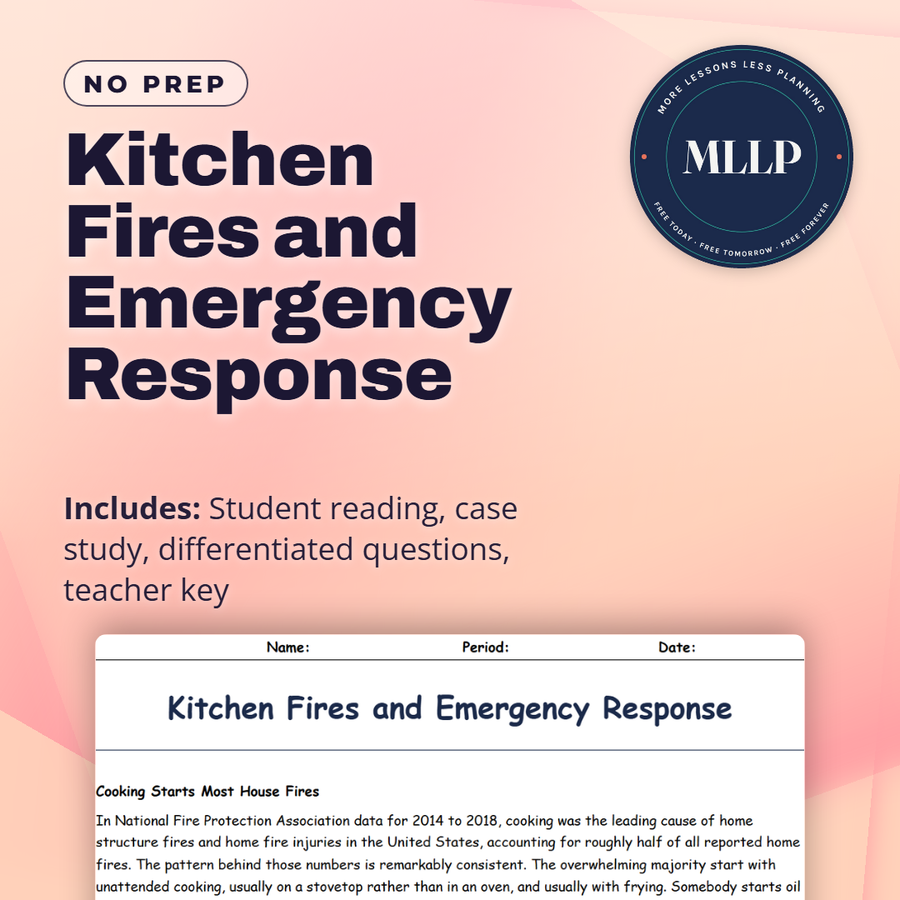
Kitchen Fires and Emergency Response
Quality reviewed September 2026
Facts verified September 23, 2026
- Subject
- Career & Life Skills
- Grades
- Grades 9-12
- Length
- 9-page student worksheet
- Time
- About one 50-minute class period
- Great for
- Sub plans and independent work
- Includes
- Reading passage, comprehension questions + full answer key
- Format
- Print-and-go PDF
What students do
- The fire triangle, fuel, oxygen, and heat, gets connected to the reason a lid smothers a pan fire
- Explain why water makes a grease fire dramatically worse instead of putting it out
- Sweep through the PASS steps in the order a fire extinguisher actually requires
- Tyler's instinct to grab a cup of water gets tested against what actually happens when water hits hot oil
What it covers
- Why water makes a grease fire spray instead of go out
- The PASS steps for operating a fire extinguisher
- The RACE framework for deciding whether to fight or leave
Start reading this worksheet
Cooking Starts Most House Fires
In National Fire Protection Association data for 2014 to 2018, cooking was the leading cause of home structure fires and home fire injuries in the United States, accounting for roughly half of all reported home fires. The pattern behind those numbers is remarkably consistent. The overwhelming majority start with unattended cooking, usually on a stovetop rather than in an oven, and usually with frying. Somebody starts oil heating, steps away for what they intend to be thirty seconds, and gets pulled into a phone call, a doorbell, or another room. Cooking oil does not announce itself before it catches fire, and once it does the fire grows faster than most people expect. Thanksgiving is the single busiest day of the year for home cooking fires by a wide margin, followed by Christmas Day, for exactly the reasons you would guess: unfamiliar recipes, crowded kitchens, distractions, and multiple burners running at once. Understanding this pattern reframes fire safety. It is not primarily about equipment or heroics. The most effective fire prevention measure in any kitchen is a person who stays in the room. Everything else in this reading covers what to do when prevention has already failed, which is worth knowing precisely because it is the situation where instinct is reliably wrong. Turkey fryers deserve a specific warning inside that Thanksgiving statistic. Lowering a partially frozen or wet turkey into hot oil causes a violent boilover that catches fire, and fire departments run public demonstrations of it every November for exactly that reason.
The Fire Triangle and Classes of Fire
Every fire requires three things at once: fuel, oxygen, and heat. Remove any one and the fire goes out. That principle, called the fire triangle, is the logic behind every extinguishing method there is. Water works on ordinary fires by removing heat. A lid on a pan works by removing oxygen, which is called smothering. Baking soda works chemically by releasing carbon dioxide that displaces oxygen. Fires are sorted into classes according to what is burning, and using the wrong class of extinguisher can make a fire dramatically worse. Class A covers ordinary combustibles like paper, cloth, wood, and most trash. Class B covers flammable liquids such as gasoline and solvents. Class C covers energized electrical equipment, where water would conduct current back to the person holding the hose. Class D covers combustible metals, which is a manufacturing concern rather than a kitchen one. Class K is the one that matters most in a kitchen, and it covers cooking oils, greases, and fats. Class K extinguishers use a wet chemical agent that reacts with hot oil to form a soapy foam layer, a process called saponification, which seals the surface and cools it. Commercial kitchens are required to have a Class K extinguisher near cooking equipment, and most also have an automatic hood suppression system above the fryers and range. Multipurpose ABC extinguishers, the red canisters found in most homes and classrooms, cover the three most common classes at once. They are the right tool for a trash can or an electrical fire, but they are not rated for a deep fryer, and their dry chemical can scatter burning oil if aimed directly into a pan.
Why Water Makes a Grease Fire Worse
The instinct to throw water on a fire is powerful and, for a grease fire, catastrophically wrong. Understanding the physics makes the rule stick better than memorizing it. Cooking oil in a burning pan is somewhere above 600 degrees F. Water boils at 212 degrees F. When water hits that oil it does not sit on top or mix in; it sinks, because water is denser than oil, and then it flashes to steam instantly. Liquid water expands roughly seventeen hundred times in volume when it becomes steam. That expansion happens underneath the burning oil and blows it out of the pan in every direction as a cloud of flaming droplets. Fire departments demonstrate this every year with a cup of water and a pot of burning oil, and the resulting fireball routinely reaches the ceiling. The correct response to a pan fire is to smother it. Turn off the heat if you can reach the knob safely. Slide a metal lid or a baking sheet over the pan from the side, keeping your hand and arm behind the lid rather than over the pan, and leave it in place until the pan is completely cool. Do not move the pan, because carrying a burning pan spreads fire along your path and puts it against your body. Baking soda works on a small flare-up. Flour does not; it is combustible and will make things much worse. Fine flour dust suspended in air can actually explode, which is why grain elevators and commercial bakeries have dust control systems. A fire blanket is the other correct tool for a pan fire, and for a person whose clothing has caught fire, and every foods lab should have one mounted where students can reach it without crossing the room.
Like what you read? The full reading, the case study, and every question set are in the free download below, along with the answer key.
Why this matters
Half of my students will cook a holiday meal at home before they ever set foot in a restaurant kitchen, and Thanksgiving is exactly when the reading says kitchen fires spike, thanks to unfamiliar recipes and a crowded stove. The instinct to grab water is so strong that even Tyler, in the case study, was two steps toward the sink before his grandmother stopped him, and the reading explains in physical terms why that instinct would have made things worse instead of better. Knowing the difference between smothering a pan fire and fighting a structural one, using RACE to decide instead of guessing under pressure, is the kind of knowledge that only matters once, but matters completely when it does.
From one teacher to another
Cooking caused roughly half of all reported home fires in National Fire Protection Association data from 2014 to 2018, and the reading spends its first section on the specific pattern behind that number: unattended frying, usually because someone stepped away for what they thought would be thirty seconds. Students learn the fire triangle, fuel, oxygen, and heat, and why a Class K extinguisher exists specifically for the moment cooking oil catches fire. The physics section on water is the one students remember longest, since water sinks into burning oil, flashes to steam, and expands about seventeen hundred times in volume, blasting flaming droplets across the room. PASS and RACE give students two memorable frameworks, one for operating an extinguisher and one for deciding whether to fight a fire at all. The case study follows Tyler, whose grandmother slid a sheet pan over a burning pan of oil instead of reaching for water.
What you get
Download
Where should I send the next one?
Everything here is free and it stays that way. Leave your email and I'll send you the new lessons as they go up. You can unsubscribe from any one of them.
Related resources
Cleaning vs. Sanitizing: They Are Not the Same Thing
Cross-Contamination and How to Stop It
Date Labels, Spoilage, and When to Throw It Out
Food Handler Hygiene: Gloves, Hair, and When to Stay Home
Foodborne Illness: The Pathogens That Make People Sick
HACCP: How Professionals Keep Food Safe
Every lesson on this site is free to download and use. If one of them saved you a prep period, you can chip in a few bucks toward my three kids' daycare fund. That's genuinely where tips go.