Judaism - Covenant and Diaspora
Quality reviewed September 2026
- Subject
- World History
- Grades
- Grades 9-12
- Time
- About two 50-minute class periods
- Includes
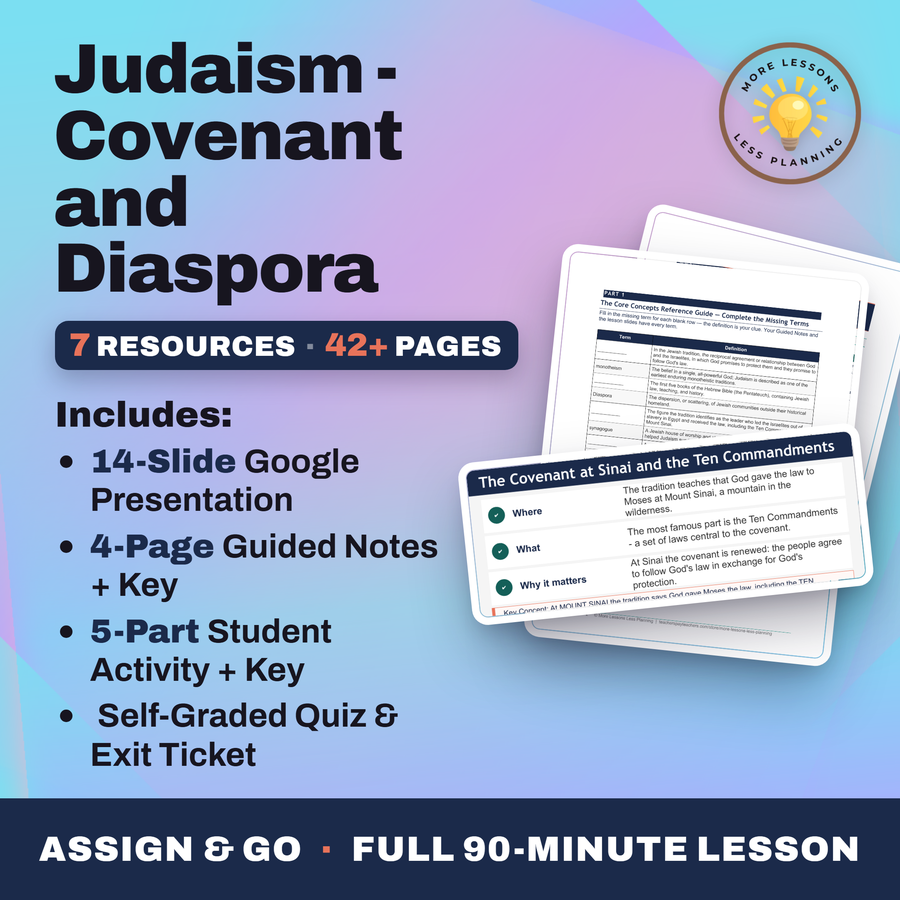
- 11 ready-to-teach files
- Format
- Word (.docx) · PowerPoint (.pptx)
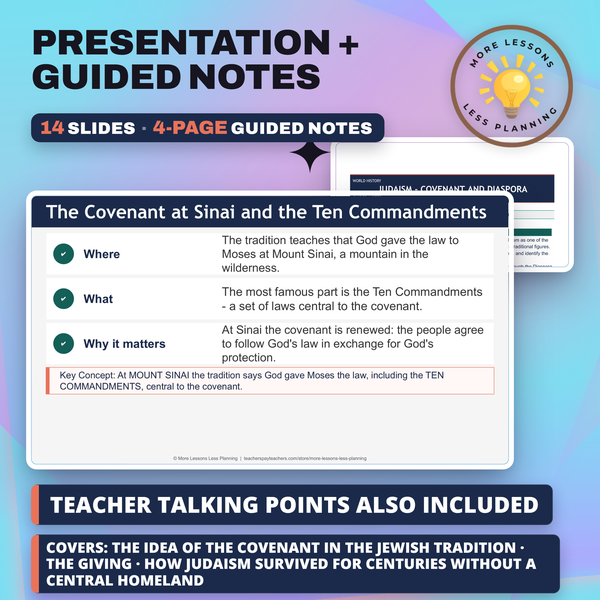
- Slide deck
- Guided notes
- Guided notes teacher key
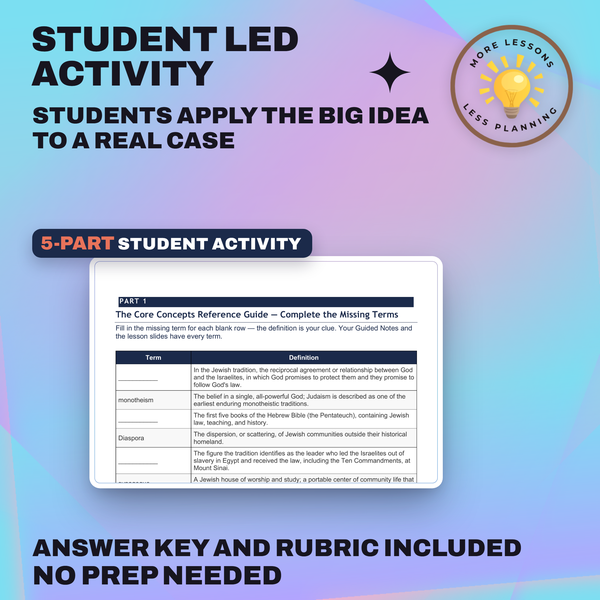
- Activity + answer key
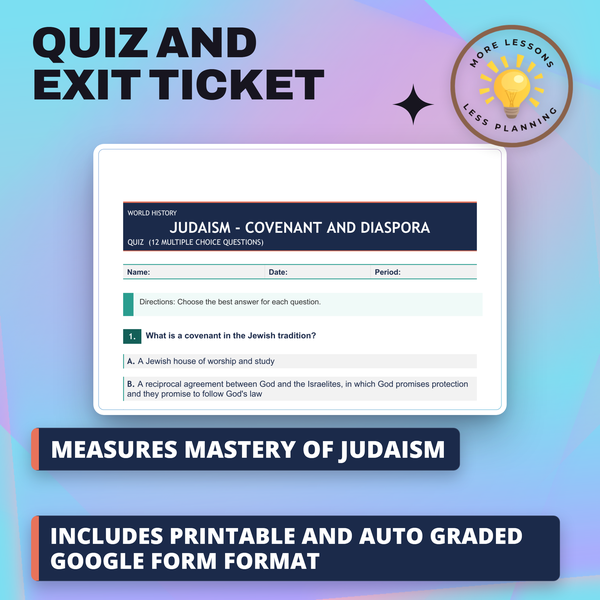
- Quiz + answer key
- Exit ticket + answer key
- Teacher guide
- Teacher presentation notes
What students do
- Define the covenant as the tradition describes it, and explain why Judaism is taught as one of the earliest enduring monotheistic traditions
- Trace the tradition's account of Abraham, Moses, and the giving of the law at Mount Sinai
- Read a passage from Exodus describing the covenant and the Ten Commandments, and identify its "if... then" structure
- Explain how portable practices like the Torah and synagogue worship let Jewish communities keep their identity through the Diaspora
What it covers
- The covenant between God and the Israelites, and Judaism's place as an early enduring monotheistic tradition
- Abraham, Moses, and the giving of the law and the Ten Commandments at Mount Sinai
- A primary source excerpt from the Book of Exodus (King James Version, 1611) with sourcing, comprehension, and analysis questions
- The Diaspora, and how the Torah and the synagogue let a scattered people carry their tradition without a central homeland
Learning targets
- Explain the idea of the covenant in the Jewish tradition and describe Judaism as one of the earliest enduring monotheistic traditions, identifying Abraham and Moses as traditional figures.
- Describe the giving of the law and the Ten Commandments at Mount Sinai, and identify the Torah as the first five books of the Hebrew Bible.
- Explain how Judaism survived for centuries without a central homeland through the Diaspora, using portable practices such as synagogue worship, Torah study, and shared law and holidays.
- Analyze a primary source - a passage from the Book of Exodus - to see how the tradition frames the covenant and its law.
Peek inside
A people and a promise
The tradition traces its origins to Abraham, identified as the first patriarch.
According to the tradition, God first made the covenant with Abraham.
His descendants are known as the Israelites, the early people of the tradition.
What a covenant is
A People and a Promise
is the figure the tradition identifies as the first patriarch, with whom God is said to have first made the covenant.
is the reciprocal agreement between God and the Israelites - God promises to protect them, and they promise to follow God's law.
1. Q1. What one-word term names the reciprocal agreement between God and the Israelites, in which God promises protection and they promise to follow God's law?
Why this matters
Exodus lays out the covenant less like a religious statement and more like a contract, with an if-then structure where each side owes the other specific terms. That structure is concrete enough that a student who has never opened a Bible can still explain exactly what each party in the agreement owed.
Teaching this unit responsibly takes more care than most units in the course, since the stakes of getting the wording right are higher here than almost anywhere else in world history. Walking students through the primary language instead of a paraphrased summary keeps the lesson accurate and respectful at the same time.
From one teacher to another
This is one of the world religions lessons where I'm strict about staying academic - describing what the tradition teaches, never asserting it as fact, and never blurring the ancient Israelites with the modern state of Israel. The guided notes build the covenant, monotheism, and the figures of Abraham and Moses before the primary source: a real passage from the Book of Exodus, in the King James translation, laying out the covenant offered at Sinai and the Ten Commandments. Students have to find the "if... then" structure of the agreement in the text itself, then use their notes to explain why a written covenant and a portable text like the Torah let Jewish communities keep a shared identity through the Diaspora, without a temple or a homeland to anchor them. It's a sober, factual lesson, built to be taught with care. Guided notes, activity, quiz, and exit ticket all come with answer keys, along with a teacher guide.
Every file in this toolkit
Download
Where should I send the next one?
Everything here is free and it stays that way. Leave your email and I'll send you the new lessons as they go up. You can unsubscribe from any one of them.
Related resources
Buddhism and the Four Noble Truths
Christianity - Origins and Spread
Confucianism and Social Order
Daoism and the Tao Te Ching
Hinduism - Origins and Beliefs
Islam - Muhammad and the Five Pillars
Every lesson on this site is free to download and use. If one of them saved you a prep period, you can chip in a few bucks toward my three kids' daycare fund. That's genuinely where tips go.