Daoism and the Tao Te Ching
Quality reviewed September 2026
- Subject
- World History
- Grades
- Grades 9-12
- Time
- About two 50-minute class periods
- Includes
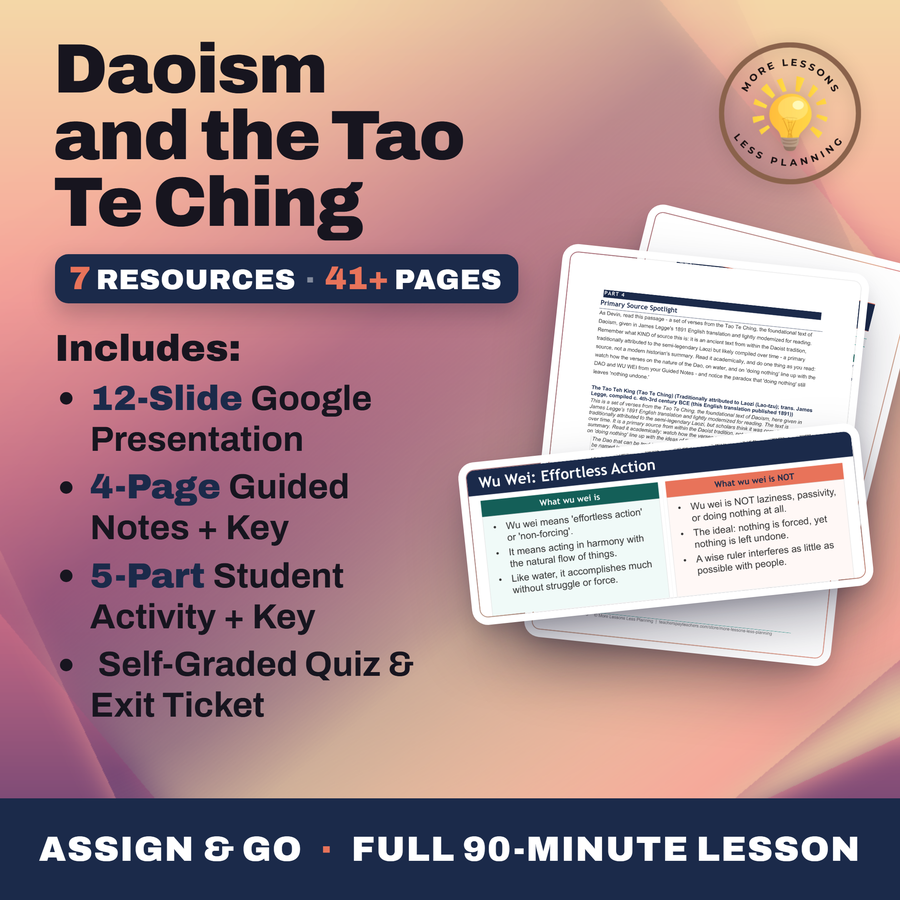
- 11 ready-to-teach files
- Format
- Word (.docx) · PowerPoint (.pptx)
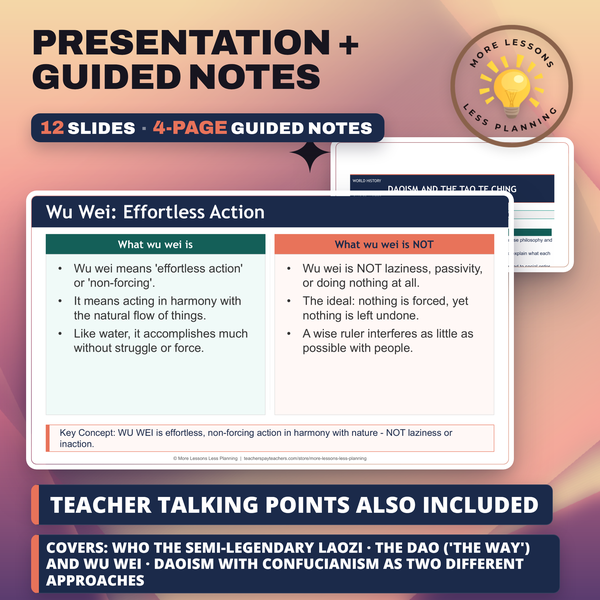
- Slide deck
- Guided notes
- Guided notes teacher key
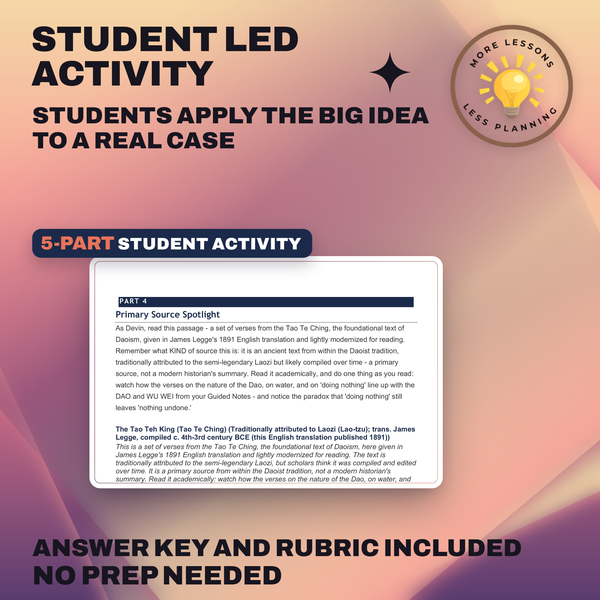
- Activity + answer key
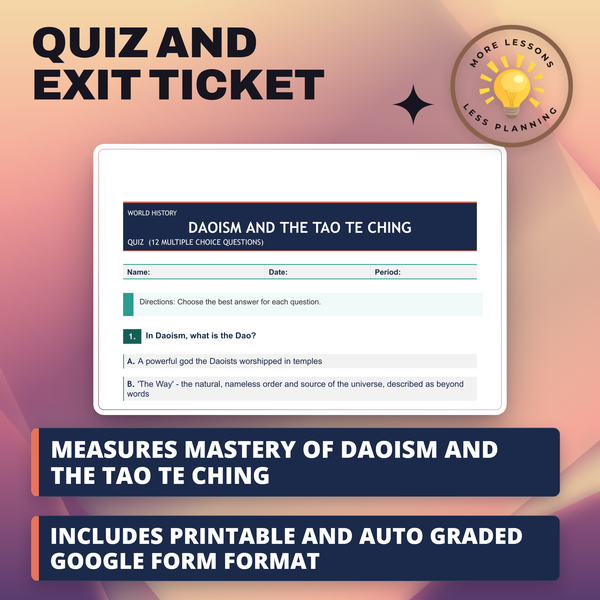
- Quiz + answer key
- Exit ticket + answer key
- Teacher guide
- Teacher presentation notes
What students do
- Define the Dao and wu wei and explain why wu wei doesn't mean doing nothing at all
- Contrast Daoism's approach to social order against Confucianism's emphasis on ritual and hierarchy
- Read an excerpt from the Tao Te Ching and explain what it shows about Daoist ideas in the philosopher's own words
- Fill in a reference guide on Laozi, the Tao Te Ching, and yin and yang before applying those terms to a museum exhibit
What it covers
- The Dao ("the Way") as a nameless natural order, not a god, and why the text calls it beyond words
- Wu wei, the Daoist ideal of effortless, non-forcing action, and why it isn't the same as laziness
- The semi-legendary Laozi and the roughly 81 short chapters of the Tao Te Ching
- The contrast between Daoism's naturalness and Confucianism's actively cultivated social order
Learning targets
- Explain who the semi-legendary Laozi was and what Daoism is as a Chinese philosophy and belief system.
- Define the Dao ('the Way') and wu wei (effortless, non-forcing action) and explain what each one means.
- Contrast Daoism with Confucianism as two different approaches to living and to social order.
- Read an excerpt from the Tao Te Ching as a primary source and explain what it shows about Daoist ideas.
Peek inside
The Master and the Tradition
('Old Master') is the semi-legendary figure traditionally regarded as the founder of Daoism and the traditional author of the Tao Te Ching; scholars debate whether he was a single historical person.
is a Chinese philosophical and religious tradition that teaches living in harmony with the Dao ('the Way') through simplicity, naturalness, and wu wei (effortless action).
The ('Classic of the Way and Virtue') is the foundational Daoist text, traditionally attributed to Laozi.
1. Q1. What term names the central Daoist concept - 'the Way,' the natural, nameless order and source of the universe that the text describes as ineffable (beyond words)?
Why this matters
The Dao itself is described in the Tao Te Ching as something beyond naming, an odd problem for a text that still runs about 81 chapters trying to describe it anyway. Even Laozi, credited with writing it, survives only as a semi-legendary figure, so I remind students the tradition rests on words attributed to someone historians can not confirm existed.
Reading this right after Confucianism makes the pairing work: one tradition tells students to build order through ritual and duty, the other tells them to stop forcing outcomes and trust a natural order instead. Letting students argue which approach works produces a livelier debate than either philosophy alone.
From one teacher to another
Wu wei is the term my students get wrong every single time, because "effortless action" sounds to a 15-year-old like a fancy way of saying "do nothing," and that's exactly the misreading this lesson is built to correct. Once they've read an actual excerpt from the Tao Te Ching in Laozi's own compressed, poetic language, they can see wu wei is about flowing with the natural order instead of forcing it, which is a very different thing from skipping the homework. Setting that next to Confucianism's emphasis on ritual and hierarchy gives students two real answers to the same question, how should a person live, instead of one vague unit on "ancient Chinese philosophy."
Every file in this toolkit
Download
Where should I send the next one?
Everything here is free and it stays that way. Leave your email and I'll send you the new lessons as they go up. You can unsubscribe from any one of them.
Related resources
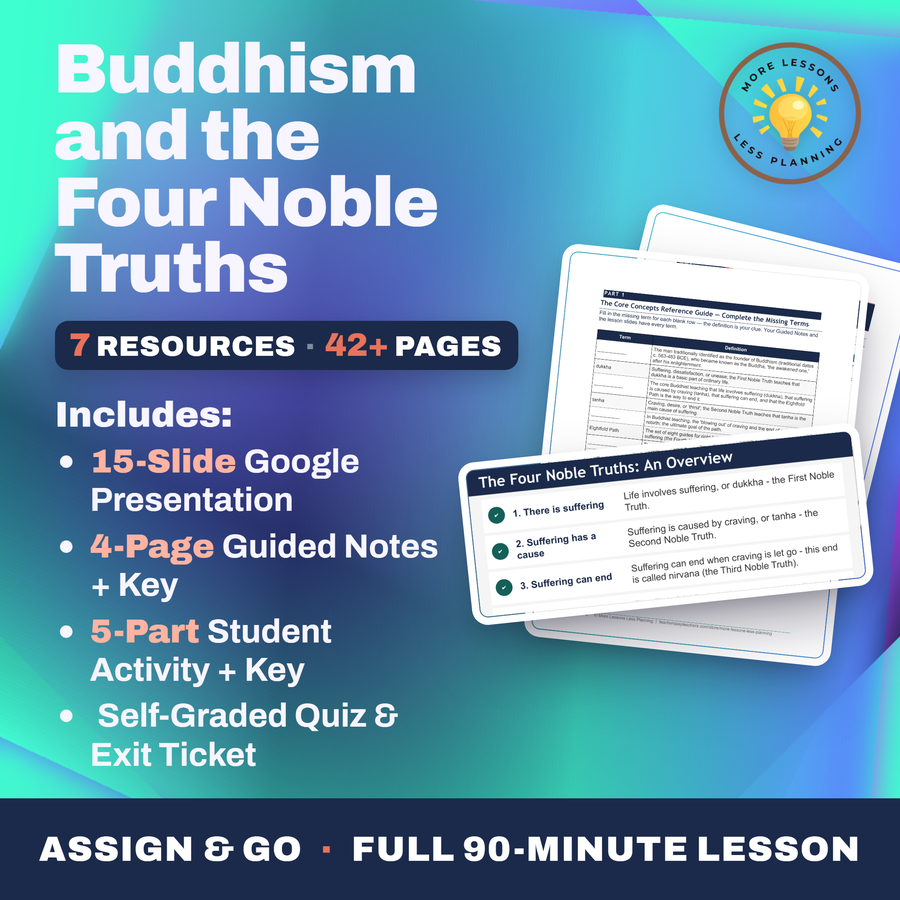
Buddhism and the Four Noble Truths
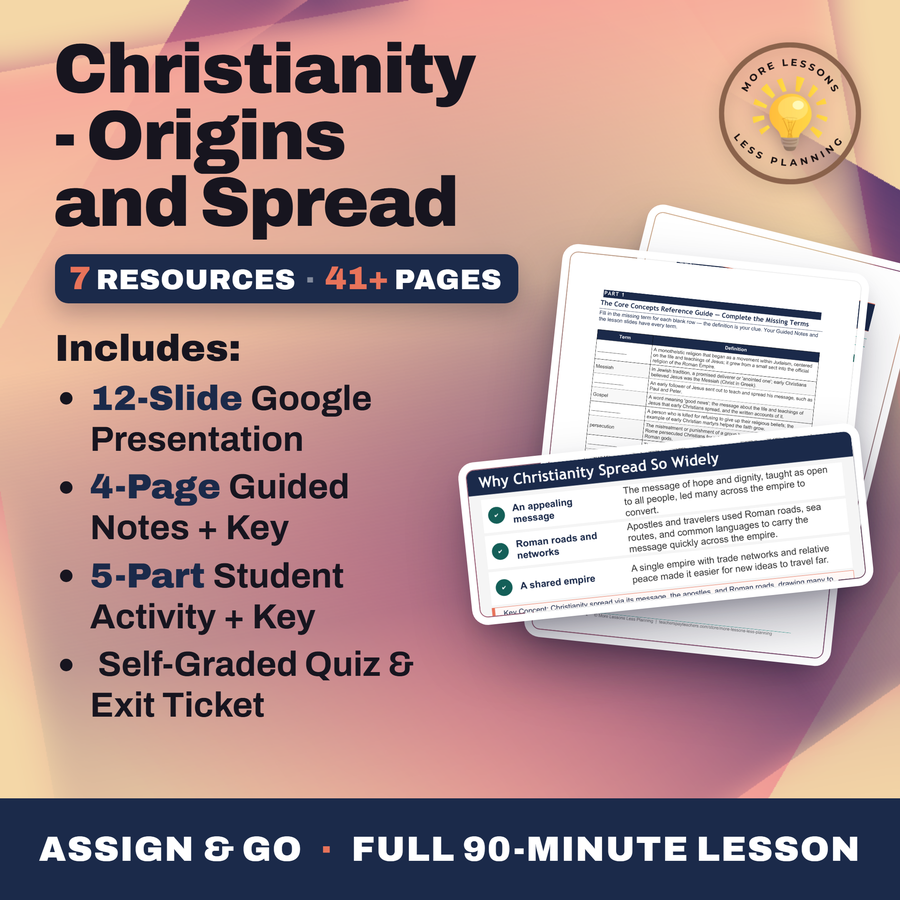
Christianity - Origins and Spread
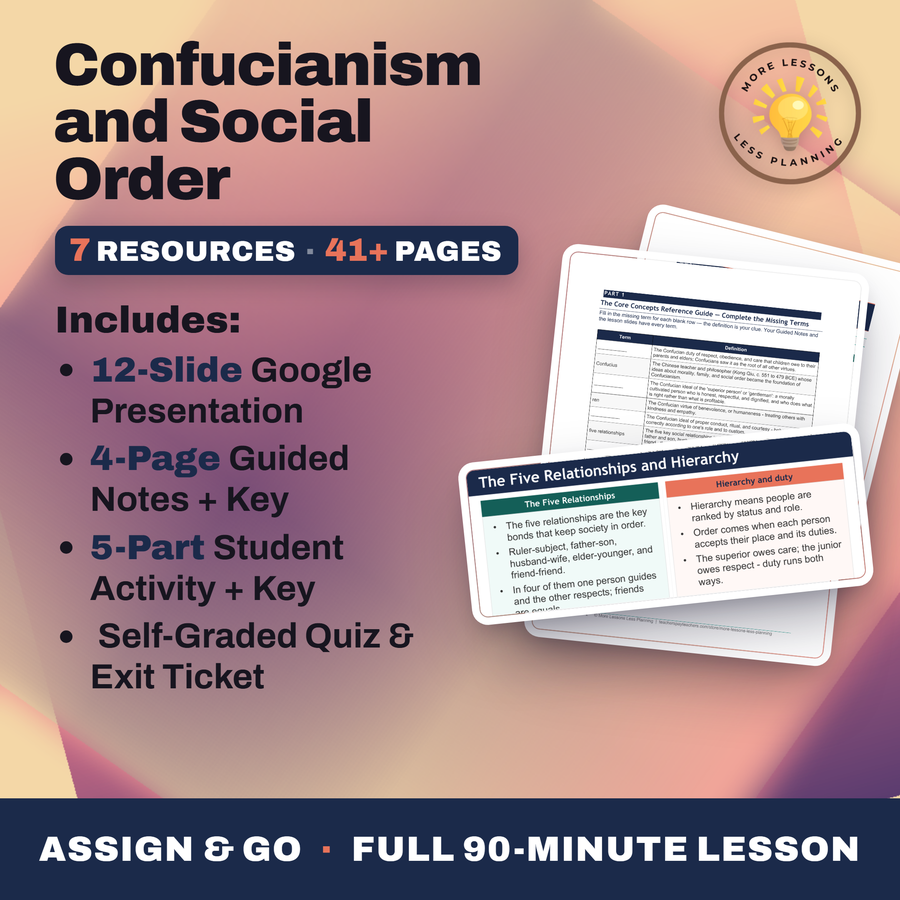
Confucianism and Social Order
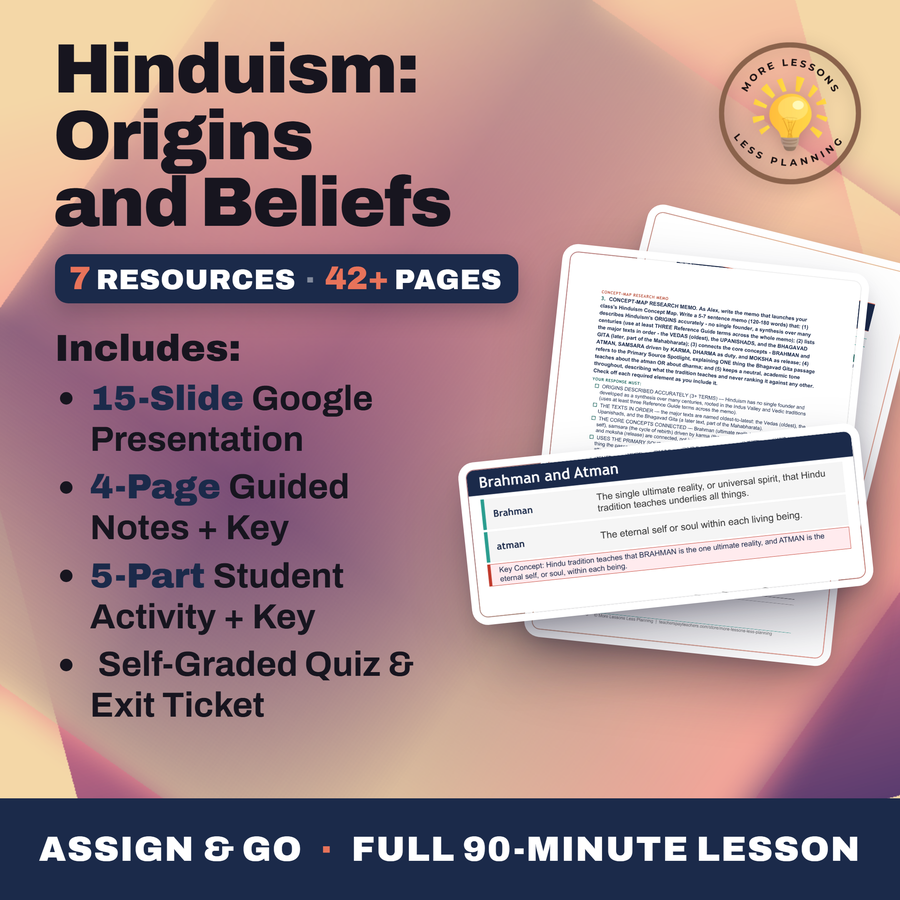
Hinduism - Origins and Beliefs
Islam - Muhammad and the Five Pillars
Judaism - Covenant and Diaspora
Every lesson on this site is free to download and use. If one of them saved you a prep period, you can chip in a few bucks toward my three kids' daycare fund. That's genuinely where tips go.