
Buddhism and the Four Noble Truths
Quality reviewed September 2026
- Subject
- World History
- Grades
- Grades 9-12
- Time
- About two 50-minute class periods
- Includes
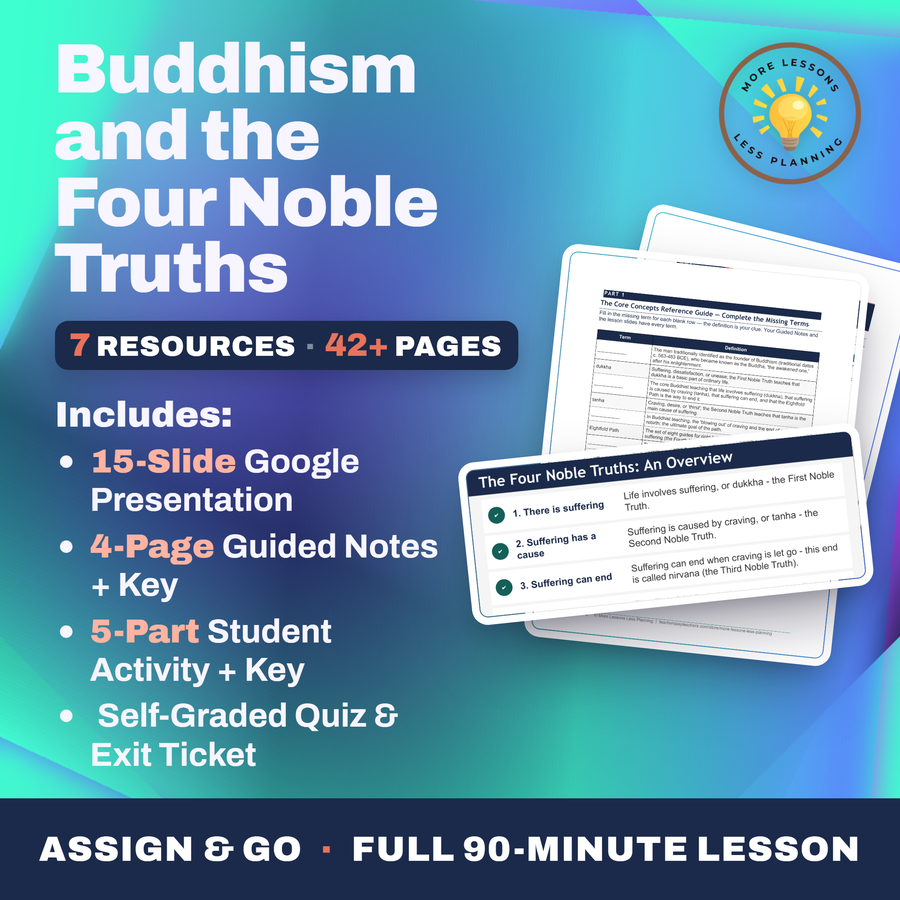
- 11 ready-to-teach files
- Format
- Word (.docx) · PowerPoint (.pptx)
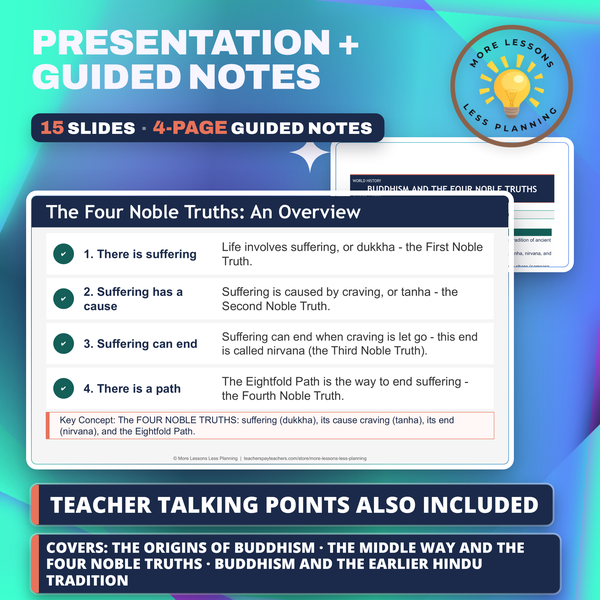
- Slide deck
- Guided notes
- Guided notes teacher key
- Activity + answer key
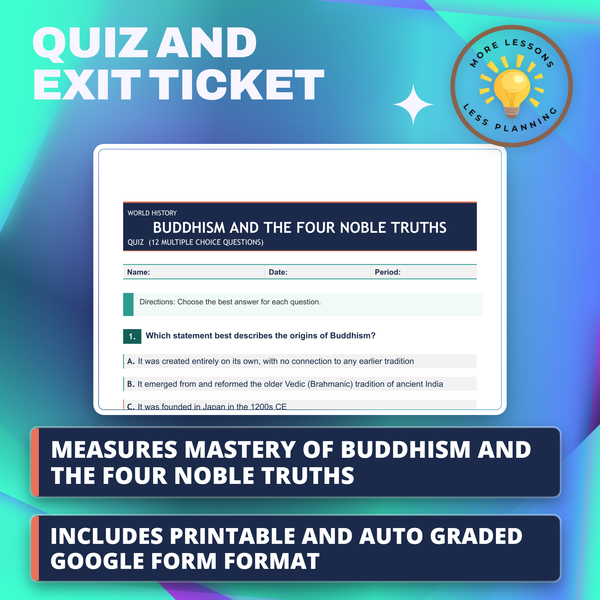
- Quiz + answer key
- Exit ticket + answer key
- Teacher guide
- Teacher presentation notes
What students do
- Trace Buddhism's roots as a reform within the older Vedic tradition, and compare it with Hinduism on samsara, karma, and the goal of nirvana or moksha
- Define the Four Noble Truths - suffering, its cause, its end, and the Eightfold Path - and Siddhartha Gautama's Middle Way between the two extremes
- Read a passage from the Dhammapada and identify the images it uses to describe craving and suffering
- Connect specific lines of the Dhammapada excerpt to the Second and Third Noble Truths using evidence from the text
What it covers
- Buddhism's origin as a reform of the Vedic tradition, and Siddhartha Gautama as its traditional founder
- The Four Noble Truths and the Eightfold Path, explained in academic, comparative terms
- Where Buddhism shares ground with Hinduism (samsara, karma) and where the two traditions diverge
- A primary source excerpt from the Dhammapada (F. Max Muller's 1881 translation) with sourcing, comprehension, and analysis questions
Learning targets
- Explain the origins of Buddhism as a reform within the Vedic (Brahmanic) tradition of ancient India, and identify Siddhartha Gautama as its traditional founder.
- Describe the Middle Way and the Four Noble Truths, and define dukkha, tanha, nirvana, and the Eightfold Path.
- Compare Buddhism and the earlier Hindu tradition, explaining what the two share (samsara and karma) and how they diverge (the authority of the Brahmins and the Vedas; nirvana and moksha).
- Analyze a primary source - a passage from the Dhammapada - to see how the tradition teaches its ideas about craving, suffering, and the path to peace.
Peek inside
A Reform, Not a Rejection
Buddhism grew out of and reformed the (Brahmanic) tradition of ancient India, keeping some ideas while rejecting others.
is the cycle of birth, death, and rebirth that Buddhism shares with the Hindu tradition it grew out of.
is the moral law of cause and effect - shared with the earlier Hindu tradition - in which a person's actions shape their future rebirths.
1. Q1. What two-word term names the balanced path the Buddha taught between extreme self-indulgence and extreme self-denial?
Why this matters
Siddhartha Gautama's Middle Way was framed as an answer to two extremes, and that structure alone tells students something about how new traditions often form: not from a single insight, but from rejecting two failed approaches at once. The Four Noble Truths that follow, suffering, its cause, its end, and the path out, build on that same instinct toward a measured middle.
Students who just finished Hinduism already have samsara and karma in hand, which lets me move fast on vocabulary and slow down on the actual disagreement: where nirvana and moksha genuinely part ways. That comparison is where real analysis starts, not just definition matching.
From one teacher to another
This is one of the world religions lessons I'm most careful with, because the goal is to describe what a tradition teaches, not to judge whether it's true. I built the guided notes around the Four Noble Truths and the Middle Way, then set Buddhism next to the older Vedic tradition it grew out of so students see where the two agree (samsara, karma) and where they split. The primary source is a real passage from the Dhammapada, read as a historical document - students trace its own images, like craving growing "like a creeping vine," and connect them back to specific Noble Truths using their notes. Everything stays in the neutral, descriptive register a world history classroom needs. This one comes with guided notes, a vocabulary-based activity built around the primary source, a quiz, and an exit ticket, all with answer keys, plus a teacher guide that keeps the whole thing academic and respectful.
Every file in this toolkit
Download
Where should I send the next one?
Everything here is free and it stays that way. Leave your email and I'll send you the new lessons as they go up. You can unsubscribe from any one of them.
Related resources
Christianity - Origins and Spread
Confucianism and Social Order
Daoism and the Tao Te Ching
Hinduism - Origins and Beliefs
Islam - Muhammad and the Five Pillars
Judaism - Covenant and Diaspora
Every lesson on this site is free to download and use. If one of them saved you a prep period, you can chip in a few bucks toward my three kids' daycare fund. That's genuinely where tips go.