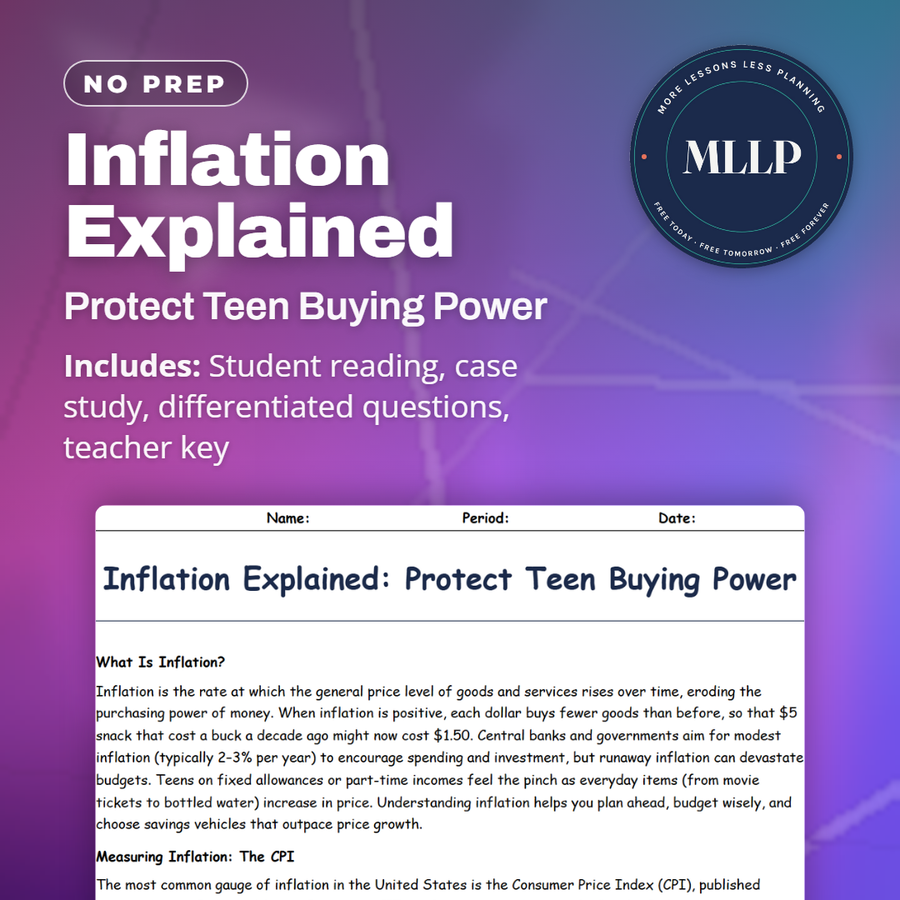
Inflation Explained: Protect Teen Buying Power
Quality reviewed September 2026
Facts verified September 24, 2026
- Subject
- Career & Life Skills
- Grades
- Grades 9-12
- Length
- 6-page student worksheet
- Time
- About one 50-minute class period
- Great for
- Sub plans and independent work
- Includes
- Reading passage, comprehension questions + full answer key
- Format
- Print-and-go PDF
What students do
- Match five terms, Consumer Price Index, purchasing power, price index, budget adjustments, and high-yield savings, to their definitions
- Fill in the blanks on the Bureau of Labor Statistics, buying in bulk, and growing savings through automatic transfers
- Answer multiple choice questions on the definition of inflation, what the CPI measures, and how teens can protect their purchasing power
- Write short answers on why year-over-year CPI changes matter more than monthly spikes, two budgeting strategies for rising costs, and how coupons and cashback apps help
What it covers
- How inflation and the Consumer Price Index track rising prices, with a table showing a movie ticket, candy bar, and bottled water from 2010 to 2020
- Strategies for protecting buying power, including high-yield savings, bulk buying, coupons, and extra side-hustle hours
- A case study on Miguel, who tracked six months of receipts and found his snack spending had risen 18 percent
Start reading this worksheet
What Is Inflation?
Inflation is the rate at which the general price level of goods and services rises over time, eroding the purchasing power of money. When inflation is positive, each dollar buys fewer goods than before, so that $5 snack that cost a buck a decade ago might now cost $1.50. Central banks and governments aim for modest inflation (typically 2–3% per year) to encourage spending and investment, but runaway inflation can devastate budgets. Teens on fixed allowances or part-time incomes feel the pinch as everyday items (from movie tickets to bottled water) increase in price. Understanding inflation helps you plan ahead, budget wisely, and choose savings vehicles that outpace price growth.
Measuring Inflation: The CPI
The most common gauge of inflation in the United States is the Consumer Price Index (CPI), published monthly by the Bureau of Labor Statistics. CPI tracks the price changes of a “basket” of goods and services (housing, food, transportation, medical care) weighted by typical household spending patterns. When CPI rises by 2%, a $100 basket costs $102 a year later. CPI data influence everything from interest rates to cost-of-living adjustments in wages and benefits. However, CPI may not perfectly reflect teen spending habits; your personal “inflation rate” could be higher or lower depending on your spending mix. Still, CPI provides a solid benchmark for tracking national price trends and planning your budget.
Purchasing Power and Your Budget
As prices climb, your money’s actual value (purchasing power) erodes. If your allowance remains $20 weekly, it buys less each year. To combat this, start saving early: even small amounts in high-yield accounts can offset inflation. When you set a budget, adjust your projected spending upward based on recent CPI data. For instance, if snack prices rose 10% last year, allocate an extra $2 per week for snacks. Tracking these trends ensures you aren’t caught off-guard by rising costs and keeps your budget realistic.
Like what you read? The full reading, the case study, and every question set are in the free download below, along with the answer key.
Why this matters
Prices on things students actually buy, like a slice of pizza or a movie ticket, keep climbing even when an allowance stays flat, so understanding inflation is what lets a teen notice the squeeze before it wrecks their budget. Miguel's habit of tracking receipts in a spreadsheet is a concrete way for any student on a fixed weekly amount to catch a price increase early instead of wondering where their money went.
From one teacher to another
Inflation means prices climb while a dollar buys less, and the passage introduces the Consumer Price Index as the government's monthly measure of that change across housing, food, transportation, and medical care. A table shows real examples, like a candy bar going from $0.75 in 2010 to $1.25 in 2020, a 67 percent increase. From there it lists five ways to protect buying power: adjusting a budget regularly, choosing a high-yield savings account, buying nonperishables in bulk, using coupons and cashback apps, and picking up extra side-hustle hours when prices spike. Putting that into practice, Miguel tracked six months of cafeteria and corner-store receipts in the case study, found his snack costs had risen 18 percent, then reallocated his budget and opened a 2.5% APY savings account to keep pace.
What you get
Download
Where should I send the next one?
Everything here is free and it stays that way. Leave your email and I'll send you the new lessons as they go up. You can unsubscribe from any one of them.
Related resources
Big Purchase Planning: Save for Gadgets & More
Buy Now, Pay Later: Teen’s Guide to Safe Installment Plans
Credit Reports Uncovered: Monitor & Dispute Errors
Emergency Budget Blueprint: Teens’ Step-by-Step Guide
Finance Jargon Buster: Essential Terms for Teens
Hidden Bank Fees: Slash Your Sneaky Charges
Every lesson on this site is free to download and use. If one of them saved you a prep period, you can chip in a few bucks toward my three kids' daycare fund. That's genuinely where tips go.