Healthy vs. Unhealthy Relationships
Quality reviewed September 2026
Facts verified September 23, 2026
- Subject
- Career & Life Skills
- Grades
- Grades 9-12
- Length
- 8-page student worksheet
- Time
- About one 50-minute class period
- Great for
- Sub plans and independent work
- Includes
- Reading passage, comprehension questions + full answer key
- Format
- Print-and-go PDF
What students do
- Devin notices three warning signs in his friend Bianca's relationship and chooses not to give an ultimatum
- Explain why judging a relationship by its best days misses the actual pattern
- Identify which behaviors count as control, isolation, or monitoring rather than proof of love
- Respect, trust, honesty, equality, and individuality get defined as specific and testable habits
What it covers
- Healthy relationship markers, warning signs, and the cycle described by advocates
- Why leaving an unhealthy relationship is harder than outsiders usually assume, and what helps
- Devin's case study on staying reachable for a friend instead of issuing an ultimatum
Start reading this worksheet
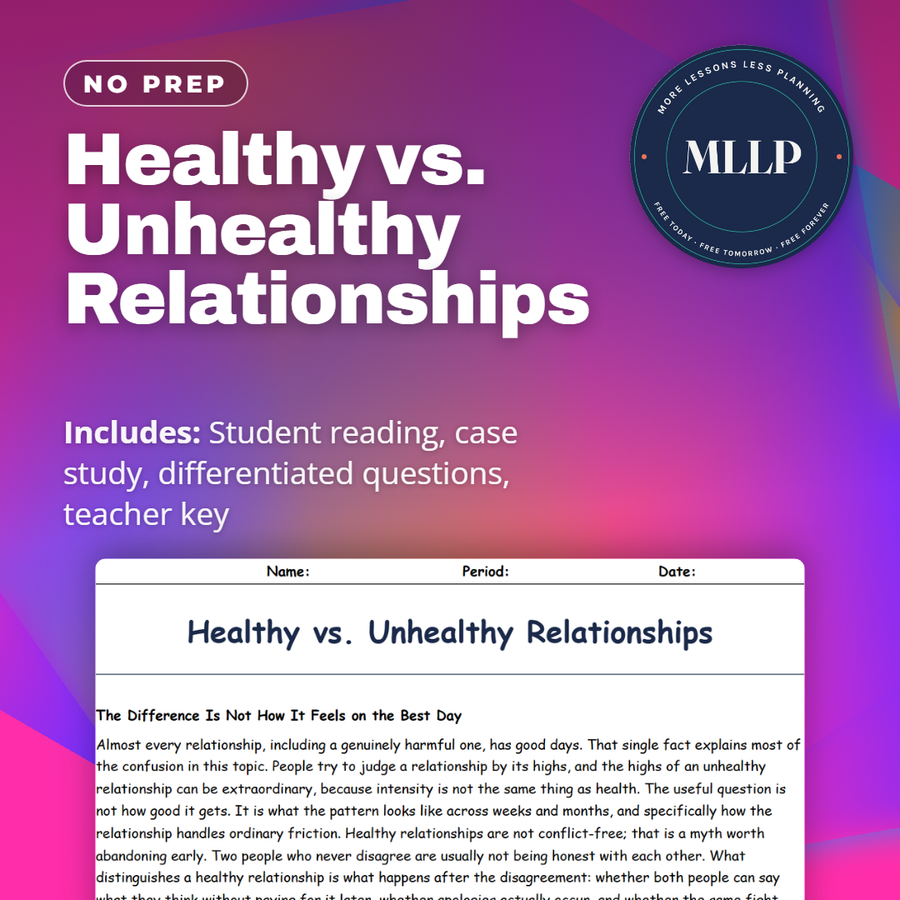
The Difference Is Not How It Feels on the Best Day
Almost every relationship, including a genuinely harmful one, has good days. That single fact explains most of the confusion in this topic. People try to judge a relationship by its highs, and the highs of an unhealthy relationship can be extraordinary, because intensity is not the same thing as health. The useful question is not how good it gets. It is what the pattern looks like across weeks and months, and specifically how the relationship handles ordinary friction. Healthy relationships are not conflict-free; that is a myth worth abandoning early. Two people who never disagree are usually not being honest with each other. What distinguishes a healthy relationship is what happens after the disagreement: whether both people can say what they think without paying for it later, whether apologies actually occur, and whether the same fight does or does not repeat identically for two years. Researchers who study couples focus on repair rather than on the absence of trouble. This framing matters for teenagers in particular, because early relationships are where people build their template for every relationship that follows. A pattern that goes unexamined at sixteen tends to be repeated at twenty-six. Learning to read patterns rather than moments is the actual skill in this unit, and it applies just as much to friendships, roommates, and family as it does to dating. The question is never whether today was good. It is whether the relationship, taken as a whole, leaves each person more themselves or less.
What Healthy Actually Looks Like
Relationship educators describe healthy relationships using a short and unglamorous list. Respect means treating the other person's opinions, time, body, and boundaries as real even when you disagree with them. Trust means not needing surveillance, which is different from blind faith; trust is built through consistency over time and it can be rebuilt after it breaks, though slowly. Honesty means the ordinary version, telling the truth about where you were and what you want, not a dramatic confessional. Equality means decisions get made together and neither person's preferences automatically win. Individuality may be the most overlooked item on the list: in a healthy relationship, both people keep their own friends, interests, family, goals, and time alone, and neither treats the other's separate life as a threat. Good communication means problems get raised directly rather than through hints, silence, or a third party. Support means each person wants the other to succeed, including at things they are not part of. Accountability means that when someone causes harm, they name it, change the behavior, and do not require the injured person to manage their guilt about it. Notice how modest that list is. Nothing on it involves grand gestures. A useful test is whether you can be honest and be safe at the same time, because in an unhealthy relationship honesty carries a cost, and people learn quickly to manage the other person instead of talking to them.
Warning Signs and Why They Are Hard to See
Unhealthy patterns almost never announce themselves. They arrive gradually and often disguised as care, which is exactly why people miss them from the inside while friends see them from the outside. Control is the central theme, and it shows up as decisions about clothing, spending, schedules, or who is allowed in the room. Isolation is control's most reliable tool: a partner discourages time with friends, picks fights before family events, or slowly makes it exhausting to maintain other relationships until there is no one left to compare notes with. Jealousy gets reframed as proof of love, which it is not; possessiveness and affection are different systems. Monitoring includes demanding passwords, tracking location, reading messages, and requiring immediate replies. Constant criticism erodes confidence, and the target usually starts agreeing with it. Unpredictability keeps a person managing moods instead of living a life. Pressure of any kind, including pressure about physical boundaries, money, or secrecy, is a warning sign in itself. Two things make these hard to name. First, escalation is gradual, so each step is only slightly worse than one already accepted. Second, unhealthy relationships usually alternate between the bad behavior and genuine warmth, which trains the person to interpret the warmth as the truth and the harm as an exception. The reverse is nearer the mark. Patterns are the truth, and good days do not cancel them.
Like what you read? The full reading, the case study, and every question set are in the free download below, along with the answer key.
Why this matters
The reading's central claim, that pattern matters more than any single good or bad day, is a genuinely useful lens for a teenager evaluating a first relationship, since intensity is easy to mistake for depth at that age. I think the list of what healthy actually looks like earns its place here precisely because it is unglamorous, respect, trust, and equality are not dramatic, and drama is exactly what teenagers are taught to expect from a serious relationship on screen. Learning to recognize gradual escalation, and to know that good days do not cancel a harmful pattern, is a skill that protects a student directly and also equips them to be the kind of friend Devin was for Bianca. Early relationships build a template that tends to repeat, which is the entire argument for teaching the pattern now instead of waiting.
From one teacher to another
Devin noticed the same pattern from a health class list showing up in his friend Bianca's relationship, monitoring, isolation, and jealousy reframed as love, months before she said anything about it herself. This reading argues that a relationship should be judged by its pattern across weeks and months rather than by its best days, since even a genuinely harmful relationship has good ones. This reading also touches on mandated reporting and points to national hotlines for support, and it is worth giving it a preview before you assign it, since the topic can prompt a student to disclose something personal. Students work through a specific and fairly unglamorous list of what healthy actually looks like, respect, trust, honesty, equality, individuality, support, and accountability, alongside the warning signs that arrive gradually and often disguised as care. A separate passage explains why the question why doesn't she just leave is the wrong one to ask, and replaces it with the concrete barriers that make leaving difficult. Devin's case study follows him choosing to stay in contact rather than deliver an ultimatum, and the questions ask students to explain why that choice was more likely to help.
What you get
Download
Where should I send the next one?
Everything here is free and it stays that way. Leave your email and I'll send you the new lessons as they go up. You can unsubscribe from any one of them.
Related resources
Aging Parents and the Sandwich Generation
Building Your Support Network
Communication Skills That Actually Work
Dating, Boundaries, and Consent
Divorce, Blended Families, and Change
Family Roles and Shared Responsibilities
Every lesson on this site is free to download and use. If one of them saved you a prep period, you can chip in a few bucks toward my three kids' daycare fund. That's genuinely where tips go.