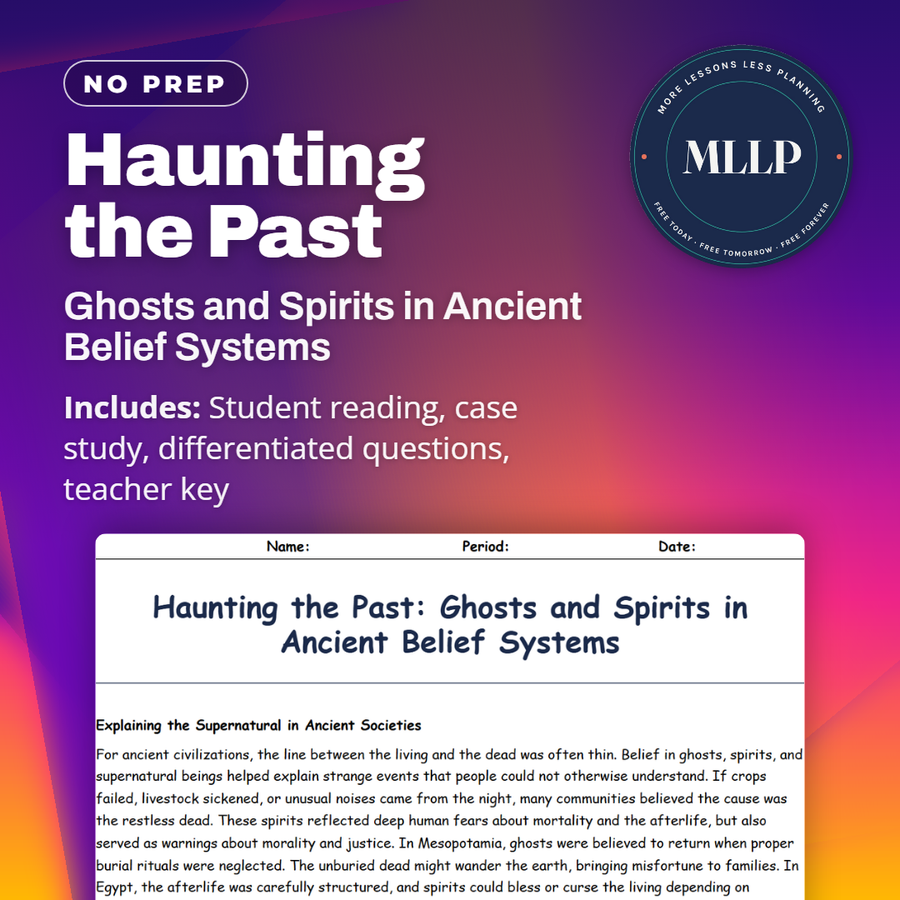
Haunting the Past: Ghosts and Spirits in Ancient Belief Systems
Quality reviewed September 2026
Facts verified September 9, 2026
- Subject
- Social Studies
- Grades
- Grades 9-12
- Length
- 6-page student worksheet
- Time
- About one 50-minute class period
- Great for
- Sub plans and independent work
- Includes
- Reading passage, comprehension questions + full answer key
- Format
- Print-and-go PDF
What students do
- Compare ghost beliefs across Mesopotamia, Egypt, Rome, China, and Celtic Europe
- Analyze the Lemuria festival and its spiritual and social purposes
- Examine how ghost beliefs enforced social and religious norms
- Evaluate similarities in death-related rituals across ancient cultures
What it covers
- Ancient supernatural beliefs and ghosts
- Lemuria and Roman festivals of the dead
- Cultural practices for honoring and appeasing spirits
Start reading this worksheet
Explaining the Supernatural in Ancient Societies
For ancient civilizations, the line between the living and the dead was often thin. Belief in ghosts, spirits, and supernatural beings helped explain strange events that people could not otherwise understand. If crops failed, livestock sickened, or unusual noises came from the night, many communities believed the cause was the restless dead. These spirits reflected deep human fears about mortality and the afterlife, but also served as warnings about morality and justice. In Mesopotamia, ghosts were believed to return when proper burial rituals were neglected. The unburied dead might wander the earth, bringing misfortune to families. In Egypt, the afterlife was carefully structured, and spirits could bless or curse the living depending on whether rituals were correctly performed. For the Romans, ghosts were not only possible but expected; they were thought to linger among the living and sometimes required appeasement through festivals and offerings. Each society used spirits as a way of connecting life with death, while also enforcing social and religious norms.
Festivals of the Dead and Spiritual Protection
To maintain balance between the living and the dead, many civilizations developed annual rituals to honor spirits. The Romans celebrated Lemuria, a festival in which households attempted to drive away restless ghosts. According to legend, families would walk barefoot through their homes at midnight, tossing black beans over their shoulders while chanting prayers. These acts were meant to pacify wandering spirits and keep households safe. In China, traditions developed around the Hungry Ghost Festival, in which offerings of food and incense were made to spirits believed to be roaming without descendants to care for them. Meanwhile, in Celtic lands, the festival of Samhain recognized the thinning of the veil between worlds, when spirits were believed to cross into the human realm. Bonfires, costumes, and offerings were used both to protect and to honor the dead. These examples show that ghost beliefs were not just about fear but also about maintaining social harmony and respect for ancestors.
Like what you read? The full reading, the case study, and every question set are in the free download below, along with the answer key.
Why this matters
Why did ancient Romans throw black beans over their shoulders at midnight and call it protection from the dead? Lemuria was how Roman families managed the fear that the dead would not stay dead, not entertainment. The same worry shows up in Mesopotamia, Egypt, China, and Celtic Europe.
Ghost belief usually gets filed away as a superstition until the same fear turns up across five unconnected cultures. Once students see ritual as a tool for managing an unsolvable fear rather than a mistake to correct, they read every other ancient practice in the unit differently too.
From one teacher to another
When I teach this, I start with the Roman habit of tossing black beans at midnight, students laugh, but then they realize something serious was happening. Lemuria wasn't theater; it was how communities managed their deepest fear, that the dead wouldn't stay dead. The worksheet traces that practice across five cultures, and by the end, students recognize a pattern: everywhere, societies created rituals around ghosts because the line between life and death needed ceremony.
What you get
Download
Where should I send the next one?
Everything here is free and it stays that way. Leave your email and I'll send you the new lessons as they go up. You can unsubscribe from any one of them.
Related resources
Every lesson on this site is free to download and use. If one of them saved you a prep period, you can chip in a few bucks toward my three kids' daycare fund. That's genuinely where tips go.