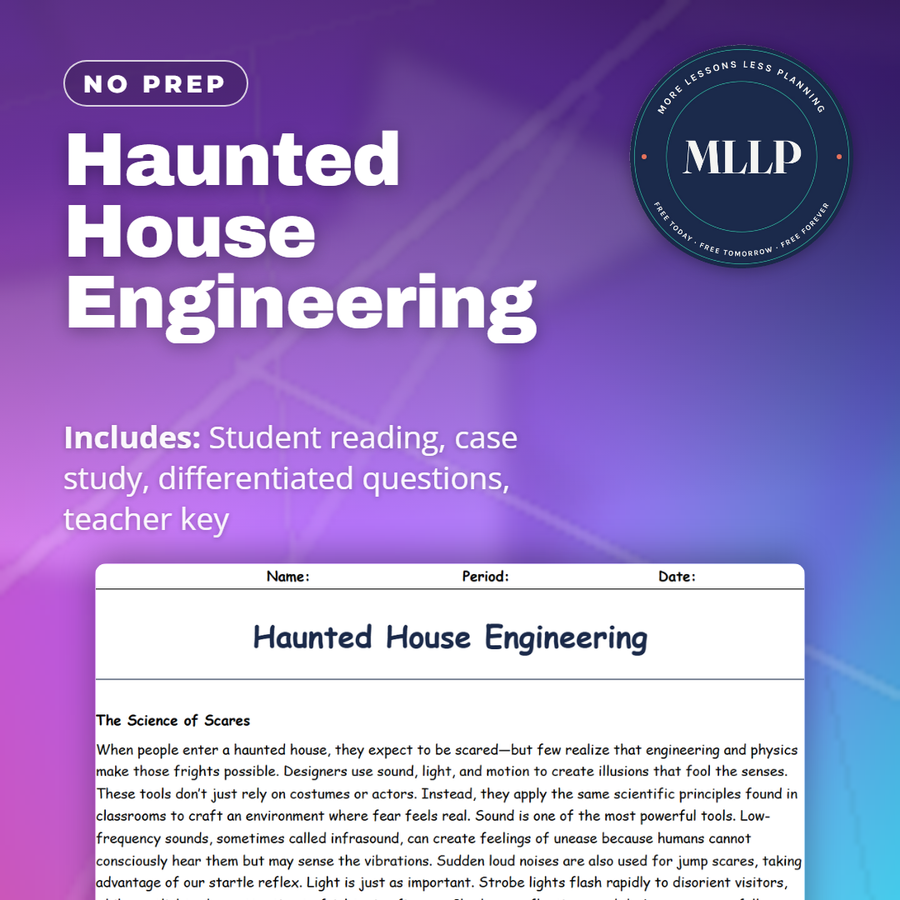
Haunted House Engineering
Quality reviewed September 2026
Facts verified September 9, 2026
- Subject
- Science
- Grades
- Grades 9-12
- Length
- 6-page student worksheet
- Time
- About one 50-minute class period
- Great for
- Sub plans and independent work
- Includes
- Reading passage, comprehension questions + full answer key
- Format
- Print-and-go PDF
What students do
- Explain how infrasound and strobe lights create fear responses
- Analyze pneumatic props and their underlying physics
- Examine the Pepper's Ghost illusion using light reflection
- Evaluate safety requirements in haunted house design
What it covers
- Sound and light in creating psychological fear
- Optical illusions and light reflection
- Physics principles applied to entertainment
Start reading this worksheet
The Science of Scares
When people enter a haunted house, they expect to be scared—but few realize that engineering and physics make those frights possible. Designers use sound, light, and motion to create illusions that fool the senses. These tools don’t just rely on costumes or actors. Instead, they apply the same scientific principles found in classrooms to craft an environment where fear feels real. Sound is one of the most powerful tools. Low-frequency sounds, sometimes called infrasound, can create feelings of unease because humans cannot consciously hear them but may sense the vibrations. Sudden loud noises are also used for jump scares, taking advantage of our startle reflex. Light is just as important. Strobe lights flash rapidly to disorient visitors, while spotlights draw attention to frightening figures. Shadows, reflections, and darkness are carefully controlled to hide surprises until the last second.
Building Illusions with Physics
Motion is another critical factor. Hidden air compressors can create sudden bursts of air, simulating ghostly touches. Pneumatic props use compressed air to make monsters leap out instantly. Mirrors and glass panels are used for optical illusions, making ghosts appear and disappear. These tricks rely on the physics of light reflection and refraction. Engineers must balance these effects with safety. Haunted houses follow strict fire codes, emergency exit rules, and structural requirements. The challenge is to design an experience that feels dangerous but is actually safe. This balance makes haunted houses excellent examples of how science can be applied to entertainment.
Like what you read? The full reading, the case study, and every question set are in the free download below, along with the answer key.
Why this matters
A pane of glass and a hidden lit figure is the entire secret behind Pepper's Ghost, a nineteenth century theater trick that still fools people who know a trick is coming. Modern haunted attractions use the same logic for every effect: infrasound and strobe timing to trigger a startle response, pneumatic props timed to surprise.
Loud noise and a dark room are what most students credit for a good scare, until they trace an effect back to the physics decision behind it. What holds their attention longest is the safety layer underneath the fear: exits, lighting, and fog limits that still have to work while everything else is built to disorient.
From one teacher to another
Pepper's Ghost is a nineteenth-century theater trick, a pane of glass and a hidden lit figure, and it still runs in modern haunted attractions. That is the hook for this worksheet. The reading breaks down how designers use infrasound, strobe timing, and pneumatic props to trigger a startle response, then asks students to trace the physics underneath each effect. My physics students like that the scare is engineered on purpose, with safety rules about exits and lighting that have to survive the fog. The questions end with students evaluating a design for both its scare value and its safety requirements.
What you get
Download
Where should I send the next one?
Everything here is free and it stays that way. Leave your email and I'll send you the new lessons as they go up. You can unsubscribe from any one of them.
Related resources
Every lesson on this site is free to download and use. If one of them saved you a prep period, you can chip in a few bucks toward my three kids' daycare fund. That's genuinely where tips go.