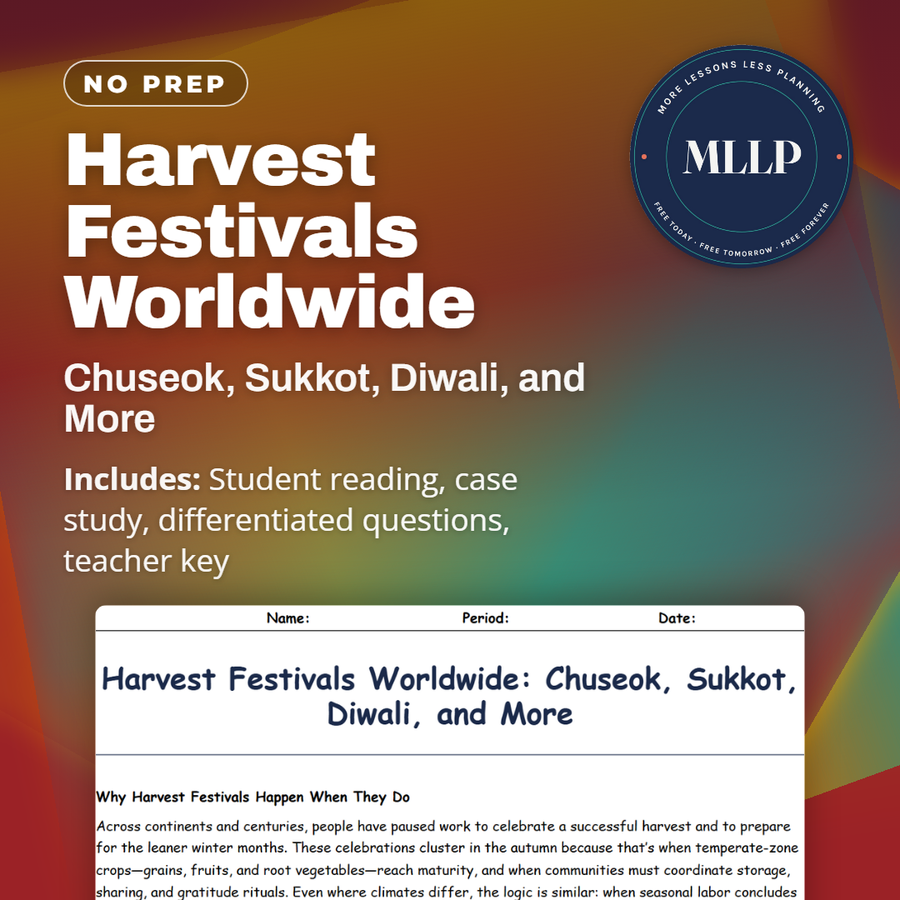
Harvest Festivals Worldwide: Chuseok, Sukkot, Diwali, and More
Quality reviewed September 2026
Facts verified September 9, 2026
- Subject
- Social Studies
- Grades
- Grades 9-12
- Length
- 8-page student worksheet
- Time
- About one 50-minute class period
- Great for
- Sub plans and independent work
- Includes
- Reading passage, comprehension questions + full answer key
- Format
- Print-and-go PDF
What students do
- Compare calendrical systems (lunisolar, solar) and explain how they anchor festivals to seasons while allowing date flexibility
- Analyze rituals (ancestor veneration, temporary shelters, oil lamps) as solutions to common problems of gratitude and vulnerability
- Trace how migration reshapes menus without erasing core meanings of festivals
- Identify regional ecologies encoded in signature dishes (rice, wheat, ghee, maize) and their meanings
What it covers
- Global harvest traditions and seasonal cycles
- Ritual meaning and cultural adaptation
- Food geography and diaspora cuisine
Start reading this worksheet
Why Harvest Festivals Happen When They Do
Across continents and centuries, people have paused work to celebrate a successful harvest and to prepare for the leaner winter months. These celebrations cluster in the autumn because that’s when temperate-zone crops, including grains, fruits, and root vegetables, reach maturity, and when communities must coordinate storage, sharing, and gratitude rituals. Even where climates differ, the logic is similar: when seasonal labor concludes and food supplies are secured, societies convert surplus into feasting, gift exchange, and acts of charity. Calendars help lock these patterns into culture. Lunisolar calendars (like the ones guiding Sukkot and Diwali) tie festivals to the moon’s phases as well as the solar year, keeping holidays seasonally anchored while allowing dates to shift each year. Solar calendars fix observances to consistent seasonal windows. These timekeeping systems do more than mark days: they coordinate migration for family visits, market cycles for specialty foods, and religious obligations such as offerings, prayer, and communal meals. The common thread from Seoul to Jerusalem to Mumbai to American dining rooms is a rhythm of gratitude, memory, and mutual support at the moment when stored calories become a community’s safety net.
Rituals, Foods, and Meanings: Chuseok, Sukkot, and Diwali
Korea’s Chuseok is often described as a “Korean Thanksgiving,” but its core is uniquely Korean: charye (ancestral memorial rites), journeys to family hometowns, and songpyeon, half-moon rice cakes filled with sesame, sweet beans, or chestnut. Families visit ancestral graves, tidy the grounds, and share foods that symbolize the year’s first fruits. In Judaism, Sukkot commemorates both the harvest and the Israelites’ sojourn in the wilderness. Families build a sukkah (temporary booth) outdoors, eat meals under a partially open roof that reveals the sky, and recite blessings over the four species (etrog, lulav, hadas, aravah). The structure’s vulnerability is part of the lesson: plenty is celebrated within a space that remembers fragility. In many Hindu communities, Diwali marks the victory of light over darkness and is linked to the conclusion of the kharif (monsoon) crop cycle. People clean homes, light diyas (oil lamps), exchange sweets, and perform Lakshmi puja seeking prosperity for the new financial year in some regions. Though distinct, these festivals share a grammar: special foods, ritual light, and acts of giving that convert agricultural success into social solidarity. In the United States, Thanksgiving layers a national narrative over older harvest customs (shared meals, travel-backed reunions, and symbolic dishes such as pumpkin pie and cranberry sauce), creating a civic ritual that blends history, myth, and migration.
Like what you read? The full reading, the case study, and every question set are in the free download below, along with the answer key.
Why this matters
One family in the case study builds a sukkah, performs a Lakshmi puja, visits a cemetery, and packs Thanksgiving boxes for a food pantry, all in a single weekend. Chuseok's rice cakes honor ancestors, Sukkot's open roofed shelter admits that plenty can vanish, and Diwali's lights mark a financial new start.
What surprises my students is realizing Thanksgiving is not the default once three other traditions run in the same week, on the same street. They come away naming the logic underneath all of them: when a harvest ends and scarcity looms, communities answer with ritual, not silence.
From one teacher to another
I teach this late in November to show that Thanksgiving is one entry in a global grammar of gratitude enacted through food and ritual when harvests end and winters near. Chuseok (Korea's autumn festival) centers on songpyeon (rice cakes) and visits to ancestral graves, tying the family dead to the year's first fruits. Sukkot (Jewish tradition) uses a fragile temporary booth to celebrate both harvest abundance and human fragility, with the roof deliberately open to remind people that plenty can vanish. Diwali lights mark the monsoon cycle's end and new financial beginnings in some regions. The case study follows one family in New Jersey observing three traditions in one weekend, building a sukkah, performing Lakshmi puja, visiting a cemetery, and finally loading Thanksgiving boxes for a food pantry, showing how traditions layer and adapt without losing their core. By the end, students see that harvest festivals are living practices that traveled with diaspora communities and transformed while keeping their logic intact: gratitude, light, and social solidarity when food security shifts from immediate to stored.
What you get
Download
Where should I send the next one?
Everything here is free and it stays that way. Leave your email and I'll send you the new lessons as they go up. You can unsubscribe from any one of them.
Related resources
Black Friday Forensics: Shoplifting, Organized Theft, and Crowd Violence
Black Friday Smart Shopper: Economics and Personal Finance in Action
Black Friday: Are the “Deals” Actually Good for Shoppers?
Black Friday’s Economic Impact: Who Gains, Who Pays, and What It Means for the Economy
Budget a Feast: Unit Prices, Deals, and Receipts
Colonial Foodways: Indigenous Knowledge and European Adaptation
Every lesson on this site is free to download and use. If one of them saved you a prep period, you can chip in a few bucks toward my three kids' daycare fund. That's genuinely where tips go.