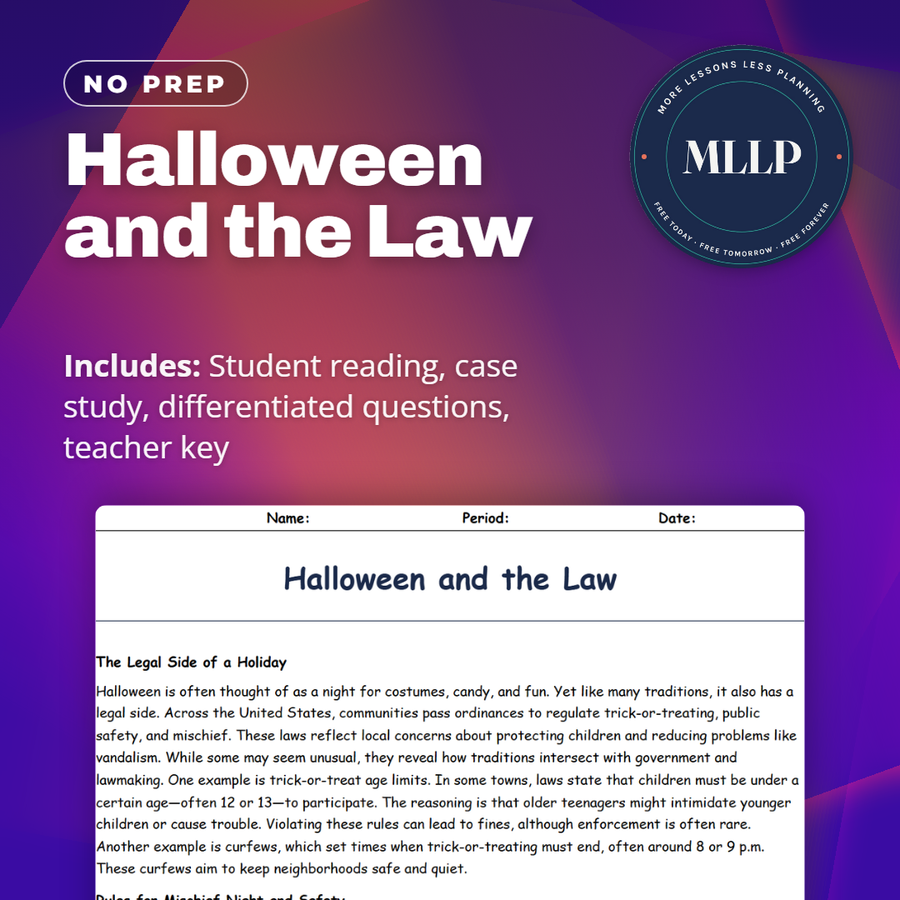
Halloween and the Law
Quality reviewed September 2026
Facts verified September 9, 2026
- Subject
- Social Studies
- Grades
- Grades 9-12
- Length
- 6-page student worksheet
- Time
- About one 50-minute class period
- Great for
- Sub plans and independent work
- Includes
- Reading passage, comprehension questions + full answer key
- Format
- Print-and-go PDF
What students do
- Analyze local Halloween ordinances and their stated purposes for public safety and order
- Evaluate the Chesapeake, Virginia ordinance restricting trick-or-treating by age limits
- Examine trade-offs between government regulation and personal freedom during holiday celebrations
- Assess how public pressure and changing community values can reshape local laws over time
What it covers
- Halloween safety regulations and age restrictions
- Mischief Night and property damage laws
- Balance between government authority and individual rights
Start reading this worksheet
The Legal Side of a Holiday
Halloween is often thought of as a night for costumes, candy, and fun. Yet like many traditions, it also has a legal side. Across the United States, communities pass ordinances to regulate trick-or-treating, public safety, and mischief. These laws reflect local concerns about protecting children and reducing problems like vandalism. While some may seem unusual, they reveal how traditions intersect with government and lawmaking. One example is trick-or-treat age limits. In some towns, laws state that children must be under a certain age, often 12 or 13, to participate. The reasoning is that older teenagers might intimidate younger children or cause trouble. Violating these rules can lead to fines, although enforcement is often rare. Another example is curfews, which set times when trick-or-treating must end, often around 8 or 9 p.m. These curfews aim to keep neighborhoods safe and quiet.
Rules for Mischief Night and Safety
In addition to trick-or-treating rules, some communities regulate “Mischief Night,” the evening before Halloween. This tradition, where teens sometimes toilet-paper houses or play pranks, can cross into vandalism. Laws against property damage and trespassing apply, but some towns add stricter rules near Halloween to discourage problems. Safety concerns also influence laws. Towns may require reflective clothing for children, ban certain masks in public, or restrict where people can set up haunted houses. These regulations show how governments balance fun with safety. They also raise debates about whether laws go too far in controlling traditions.
Like what you read? The full reading, the case study, and every question set are in the free download below, along with the answer key.
Why this matters
A hundred dollar fine or jail time was the actual penalty Chesapeake, Virginia set for anyone over twelve caught trick or treating, a rule meant to stop vandalism that ended up criminalizing ordinary teenagers. Families pushed back, and in 2019 the city revised it to allow trick or treating up to fourteen.
My students expect an old, symbolic law, so the recency of the Chesapeake ordinance and its reversal catches them off guard. Seeing a city council respond to real complaints on both sides, vandalism first, then families, local ordinances stop looking like fixed rules and start looking like arguments still being settled.
From one teacher to another
Government regulation of Halloween might sound silly until you're a town councilor fielding complaints about vandalism on October 30th. Chesapeake, Virginia took it to extremes: anyone over 12 trick-or-treating faced a $100 fine or jail time. But the city listened when families pushed back, and in 2019 they revised the law to allow teens up to 14. That reversal becomes the teaching moment. Sometimes laws change when communities demand it. This worksheet shows students how regulation works in the real world.
What you get
Download
Where should I send the next one?
Everything here is free and it stays that way. Leave your email and I'll send you the new lessons as they go up. You can unsubscribe from any one of them.
Related resources
Every lesson on this site is free to download and use. If one of them saved you a prep period, you can chip in a few bucks toward my three kids' daycare fund. That's genuinely where tips go.