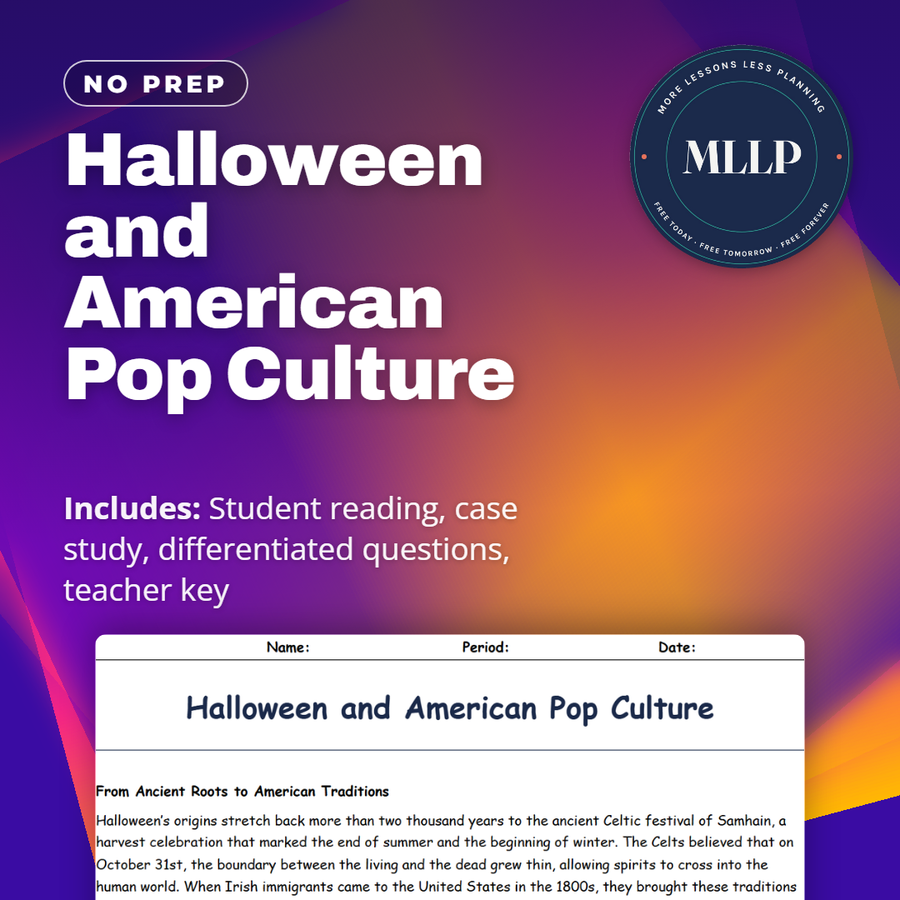
Halloween and American Pop Culture
Quality reviewed September 2026
Facts verified September 9, 2026
- Subject
- Social Studies
- Grades
- Grades 9-12
- Length
- 7-page student worksheet
- Time
- About one 50-minute class period
- Great for
- Sub plans and independent work
- Includes
- Reading passage, comprehension questions + full answer key
- Format
- Print-and-go PDF
What students do
- Trace how Irish immigration shaped American Halloween traditions and neighborhood practices
- Analyze how Hollywood and mass media transformed Halloween into a pop culture phenomenon
- Evaluate the role of the candy and costume industries in making Halloween commercially massive
- Examine the connection between pop culture icons and consumer spending on holiday celebrations
What it covers
- Evolution of Halloween from Celtic roots to American tradition
- Hollywood's influence on holiday symbols and entertainment
- Commercialization and consumer culture of modern holidays
Start reading this worksheet
From Ancient Roots to American Traditions
Halloween’s origins stretch back more than two thousand years to the ancient Celtic festival of Samhain, a harvest celebration that marked the end of summer and the beginning of winter. The Celts believed that on October 31st, the boundary between the living and the dead grew thin, allowing spirits to cross into the human world. When Irish immigrants came to the United States in the 1800s, they brought these traditions with them. Over time, Halloween transformed from a solemn festival into a uniquely American holiday blending folk customs, religion, and popular entertainment. By the early 20th century, Halloween began to evolve into the form we recognize today. Community parties replaced earlier rowdier pranks, and trick-or-treating emerged as a way to bring children into the festivities while reducing vandalism. Costumes expanded beyond ghosts and witches to include clowns, cowboys, and even political figures, showing how American society embraced Halloween as both a playful and reflective cultural practice. Today, Halloween is celebrated in all fifty states, making it one of the most widely recognized holidays in the United States.
Pop Culture and the Rise of Halloween Icons
Halloween’s popularity is closely tied to American popular culture. The rise of Hollywood and mass media gave Halloween an entire cast of recognizable icons: Dracula, Frankenstein, the Wolfman, witches, zombies, and ghosts. Each year, these figures reappear in films, television specials, and costume shops, reinforcing the link between pop culture and holiday tradition. For example, the 1966 TV special It’s the Great Pumpkin, Charlie Brown made Peanuts characters part of the holiday landscape, while horror films like Halloween (1978) cemented the association between October 31st and cinematic terror. Music and advertising also play a huge role. Radio stations run “monster mash” playlists in October, stores play spooky soundtracks, and candy companies release special editions of their products. Halloween has become a holiday that thrives on commercial creativity, where everything from costumes to decorations can reflect the latest movie franchise, celebrity trend, or internet meme.
Like what you read? The full reading, the case study, and every question set are in the free download below, along with the answer key.
Why this matters
Hershey's invented the fun size candy bar in the 1950s to turn trick or treating into something families bought every year, and costume makers followed with mass produced movie characters in the 1970s. Those two decisions are why a tradition Irish immigrants carried to America now pulls in roughly ten billion dollars annually.
My students assume Halloween has always looked like this, so I start with the fun size bar and ask who benefits from a decades old marketing decision. Tracing costumes back to specific movies makes the same point, and after we walk through it, they start asking the same question about other holidays.
From one teacher to another
Halloween reveals how commerce reshapes tradition faster than we notice. In the 1950s, candy companies like Hershey's created "fun size" bars to market the holiday, turning trick-or-treating into a consumption event. Costume manufacturers capitalized next, and by the 1970s, affordable mass-produced outfits based on movies made elaborate dressing accessible to everyone. Today Americans spend over $10 billion annually on Halloween. Students discover that what feels like tradition is often marketing strategy.
What you get
Download
Where should I send the next one?
Everything here is free and it stays that way. Leave your email and I'll send you the new lessons as they go up. You can unsubscribe from any one of them.
Related resources
Every lesson on this site is free to download and use. If one of them saved you a prep period, you can chip in a few bucks toward my three kids' daycare fund. That's genuinely where tips go.