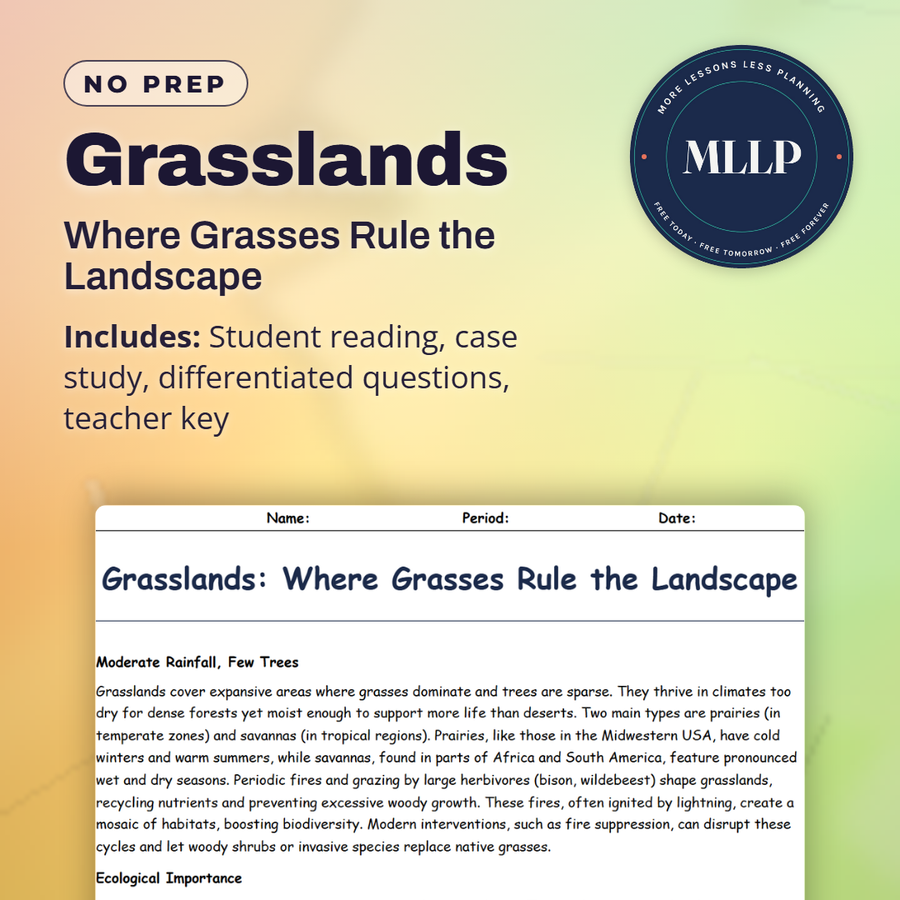
Grasslands: Where Grasses Rule the Landscape
Quality reviewed September 2026
Facts verified September 14, 2026
- Subject
- Social Studies
- Grades
- Grades 9-12
- Length
- 6-page student worksheet
- Time
- About one 50-minute class period
- Great for
- Sub plans and independent work
- Includes
- Reading passage, comprehension questions + full answer key
- Format
- Print-and-go PDF
What students do
- Match terms like Bison, Rotational Grazing, Wildebeest, Savanna, and Rainy Season to their correct definitions
- Fill in the blank sentences on prairies, fire's role in grasslands, and integrated land management
- Answer multiple choice questions on how prairies differ from savannas, the role of fire in grasslands, and the effects of overgrazing
- Write short answers on why grasslands are called breadbasket regions, how controlled burns benefit grassland ecosystems, and how pastoralists can graze without depleting the land
What it covers
- Prairies and savannas, how moderate rainfall and periodic fire keep grasslands from becoming forests, and the herbivores that shape them
- The ecological importance of grasslands as carbon sinks and farmland, plus the risks of overgrazing and soil degradation
- A case study on savanna conservation in Tanzania's Serengeti, where buffer zones and eco-tourism helped protect wildebeest migration routes
Start reading this worksheet
Moderate Rainfall, Few Trees
Grasslands cover expansive areas where grasses dominate and trees are sparse. They thrive in climates too dry for dense forests yet moist enough to support more life than deserts. Two main types are prairies (in temperate zones) and savannas (in tropical regions). Prairies, like those in the Midwestern USA, have cold winters and warm summers, while savannas, found in parts of Africa and South America, feature pronounced wet and dry seasons. Periodic fires and grazing by large herbivores (bison, wildebeest) shape grasslands, recycling nutrients and preventing excessive woody growth. These fires, often sparked by lightning, create a mosaic of habitats, boosting biodiversity. Modern interventions, such as fire suppression, can disrupt these cycles and let woody shrubs or invasive species replace native grasses.
Ecological Importance
Despite appearing simple, grasslands host diverse flora and fauna. The thick root networks of perennial grasses stabilize soils, reduce erosion, and help store carbon underground. This makes grasslands valuable carbon sinks, particularly when well-managed. Large herbivores graze on the grasses, while predators like lions, cheetahs, or wolves keep populations in check. Migratory birds often rely on grasslands for breeding and feeding, highlighting the biome’s global importance for avian species. Human activities have transformed many grasslands into agricultural regions, as the rich, fertile soils (like the mollisols of North American prairies) excel in crop production. Yet, over-plowing and overgrazing can degrade soil structure, triggering dust storms or desertification. Balancing productive agriculture with the conservation of native grassland ecosystems remains an ongoing challenge.
Like what you read? The full reading, the case study, and every question set are in the free download below, along with the answer key.
Why this matters
Most students picture a grassland as empty space between a forest and a desert, land waiting to become something else. This reading argues the opposite: periodic fire and grazing are what keep a prairie or savanna a grassland at all, and without them the biome drifts toward forest.
The Serengeti case study puts that to a real test: a wildebeest migration route survives because of buffer zones and eco-tourism, not despite the people living nearby. How pastoralists can graze without depleting the land is that same balance playing out at a larger scale.
From one teacher to another
I like this one for showing students that grasslands are more than empty fields between forests and deserts. The reading covers how fire and grazing actually keep the biome healthy, then moves into the tension between agriculture and conservation once humans get involved. The Serengeti case study gives a concrete example of how buffer zones and eco-tourism can protect migration routes without shutting out local communities. This pairs naturally with the biomes and ecosystems worksheet if you are building out a full unit on world biomes.
What you get
Download
Where should I send the next one?
Everything here is free and it stays that way. Leave your email and I'll send you the new lessons as they go up. You can unsubscribe from any one of them.
Related resources
Biomes & Ecosystems: Life Across Earth’s Habitats
Climate vs. Weather: Understanding the Difference

Convergent Boundaries: Where Plates Collide
Deserts: Survival in the Harshest Climates

Divergent Boundaries: Where Plates Pull Apart
Earth’s Layers: From Crust to Core
Every lesson on this site is free to download and use. If one of them saved you a prep period, you can chip in a few bucks toward my three kids' daycare fund. That's genuinely where tips go.