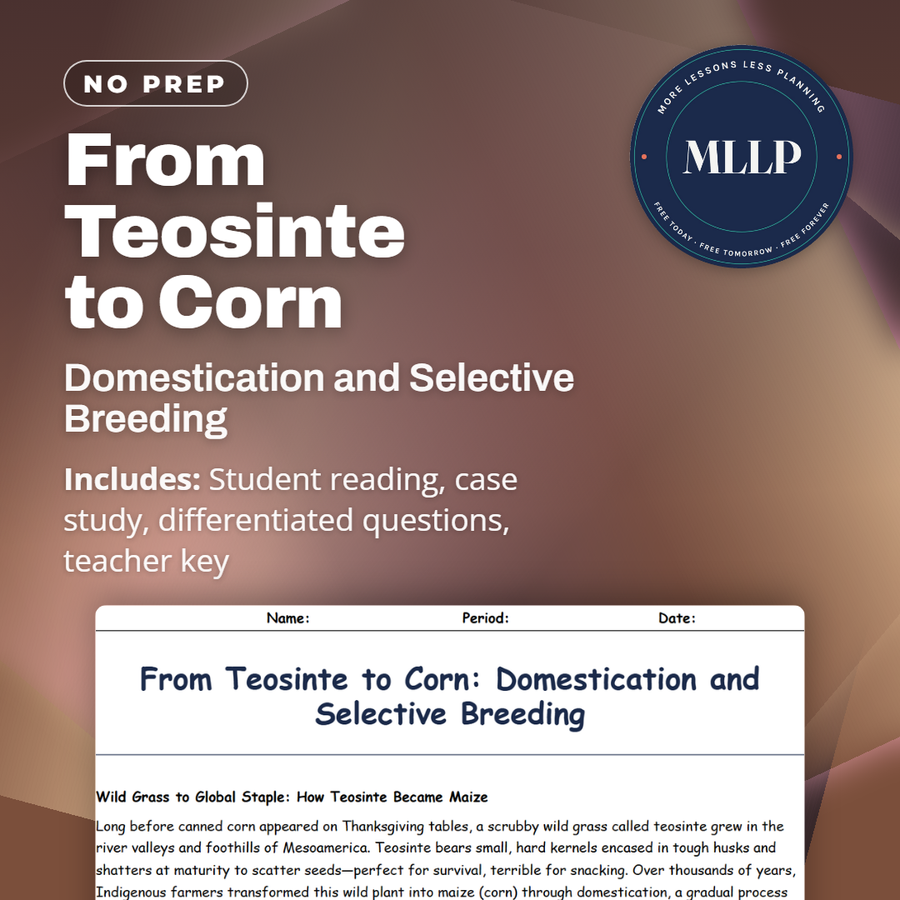
From Teosinte to Corn: Domestication and Selective Breeding
Quality reviewed September 2026
Facts verified September 9, 2026
- Subject
- Science
- Grades
- Grades 9-12
- Length
- 8-page student worksheet
- Time
- About one 50-minute class period
- Great for
- Sub plans and independent work
- Includes
- Reading passage, comprehension questions + full answer key
- Format
- Print-and-go PDF
What students do
- Identify domestication-syndrome traits (non-shattering, larger ears, softer seeds) that made teosinte harvestable
- Explain how the tb1 gene suppresses branching and channels energy into a central ear
- Compare ancient landrace diversity to modern hybrid vigor, weighing yield against resilience
- Analyze archaeological evidence (charred cobs, starch residues, lipid markers) as proof of nixtamalization and selective breeding
What it covers
- Plant domestication and selective breeding
- Mendelian genetics and heterosis in crops
- Archaeological evidence and archaeobotany methods
Start reading this worksheet
Wild Grass to Global Staple: How Teosinte Became Maize
Long before canned corn appeared on Thanksgiving tables, a scrubby wild grass called teosinte grew in the river valleys and foothills of Mesoamerica. Teosinte bears small, hard kernels encased in tough husks and shatters at maturity to scatter seeds. That trait was perfect for survival in the wild, but terrible for snacking. Over thousands of years, Indigenous farmers transformed this wild plant into maize (corn) through domestication, a gradual process of selecting plants with desirable traits. Early farmers likely saved seeds from ears that were slightly larger, less brittle, or easier to harvest, replanting them season after season. Those tiny preferences added up. The signature markers of domestication syndrome emerged as humans steadily shaped the gene pool: bigger ears, non-shattering seeds, softer seed coats, and reduced branching. This transformation wasn’t a single event or location, but a mosaic of experiments, exchanges, and local adaptations. As maize spread, it diversified into landraces: regionally adapted varieties selected for altitude, rainfall, soils, and culinary uses (tortillas, tamales, atole). In that diffusion, technology and cuisine co-evolved: nixtamalization (alkaline cooking with lime) released niacin and improved protein quality, while grinding stones and pottery scaled up maize-based diets. In other words, people didn’t just domesticate a plant; they domesticated an entire food system that would feed festivals, markets, and, centuries later, our holiday side dishes.
Genes That Rewrote a Plant: The Biology Behind Bigger Ears
What flipped teosinte’s architecture into maize’s iconic ear? Selection tweaked many genes, but a few loom large. The teosinte branched1 (tb1) gene alters plant architecture: higher tb1 expression suppresses tillering (side shoots), channeling energy into a central stalk with bigger ears. Changes near tga1 helped convert teosinte’s rock-hard fruitcase into the familiar naked kernel, making maize edible without hammering. Other loci tuned kernel row number, ear length, and sugar–starch balance that distinguishes sweet corn from field corn. None of these genes act alone; they interact with environment factors like sunlight, water, and soil fertility to produce the phenotype you see on the cob. Over time, farmers refined traits through mass selection (saving the best ears), family selection (saving seeds from the best plants and their relatives), and later controlled crossing. The 20th century layered in hybridization, where crossing inbred lines produces heterosis (hybrid vigor): taller plants, higher yields, stronger stalks. For Thanksgiving favorites like sweet corn, breeders selected for sugar-accumulating alleles (e.g., su, se, and sh2) that slow conversion of sugar to starch, keeping kernels tender and sweet. For flint and dent corns used in cornmeal and pie thickeners, selection emphasized starch type and kernel hardness. Whether ancient or modern, the principle stayed constant: variation exists, people select, and populations change.
Indigenous Innovation and the Spread of Maize
As maize traveled north and south from its Mesoamerican cradle, Indigenous farmers were the innovators. In highland valleys, they chose plants that tolerated cool nights; in tropical lowlands, they favored disease tolerance and ear rot resistance. Along river floodplains, they synchronized varieties with flood recession; on the Plains, they emphasized drought resilience and shorter seasons. Each community linked agronomy to culture: kernels slated for hominy needed nixtamalization performance; those for tortillas needed grindability; ceremonial colors such as blue, red, black, and white carried meaning beyond yield. The result is a living library of landraces whose genetic diversity still powers modern breeding. This geographic–cultural spread also shaped trade. Maize moved alongside beans and squash (the “Three Sisters”), creating nitrogen and canopy synergies in fields and protein complementarities on the plate. Storage innovations (cobs hung to dry, clay granaries) stabilized supply through lean seasons. When maize later entered European and global routes, its flexibility made it a staple crop on multiple continents: it could grow in short seasons, at high elevations, and in varied soils, even as cuisines adapted it to local tastes, from polenta to arepas.
Like what you read? The full reading, the case study, and every question set are in the free download below, along with the answer key.
Why this matters
Teosinte is a scrappy grass with kernels so small and hard that they shatter the moment they ripen. Getting from that plant to a modern ear took thousands of years of farmers favoring slightly bigger, sturdier ears and replanting only those seeds. Archaeologists trace the shift through charred cobs, starch residues, and lipid markers showing early cooks were already nixtamalizing maize.
Evolution usually gets described as something that only happens to a species, never something people steer on purpose. I put the tb1 gene, which suppresses branching and channels growth into a single ear, next to the timeline so my students get a concrete mechanism, not a vague description.
From one teacher to another
Teosinte is a weedy grass with tiny hard kernels that shatter at maturity, and this reading asks how it became the corn on a Thanksgiving table. The answer is thousands of years of farmers keeping the slightly bigger ears and replanting, which slowly reshaped the gene pool. I use it in my artificial selection unit because it puts a real gene on the board, the tb1 gene that cuts branching, next to the archaeology that proves the timeline. The case study follows an archaeologist reading charred cobs, starch granules on grinding stones, and lipid residues that show early cooks were already nixtamalizing their maize. Students come away seeing evolution as something people steered on purpose.
What you get
Download
Where should I send the next one?
Everything here is free and it stays that way. Leave your email and I'll send you the new lessons as they go up. You can unsubscribe from any one of them.
Related resources

Black Friday Forensics: Shoplifting, Organized Theft, and Crowd Violence

Black Friday Smart Shopper: Economics and Personal Finance in Action

Black Friday: Are the “Deals” Actually Good for Shoppers?

Black Friday’s Economic Impact: Who Gains, Who Pays, and What It Means for the Economy

Budget a Feast: Unit Prices, Deals, and Receipts
Colonial Foodways: Indigenous Knowledge and European Adaptation
Every lesson on this site is free to download and use. If one of them saved you a prep period, you can chip in a few bucks toward my three kids' daycare fund. That's genuinely where tips go.