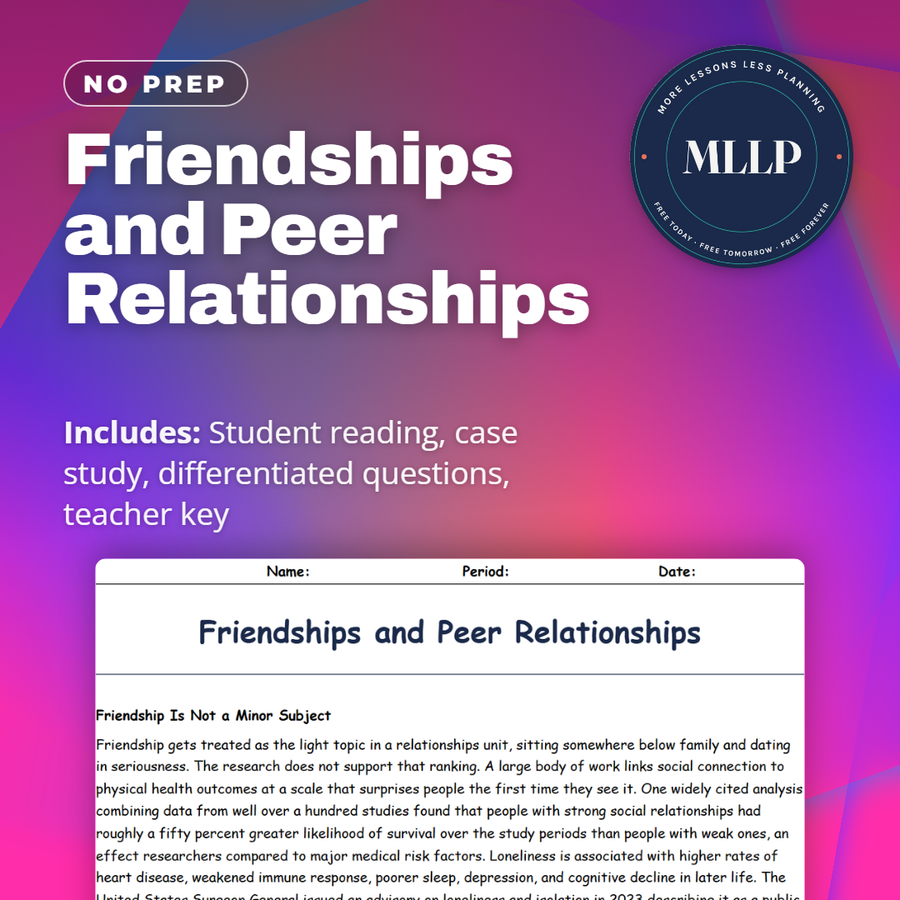
Friendships and Peer Relationships
Quality reviewed September 2026
Facts verified September 23, 2026
- Subject
- Career & Life Skills
- Grades
- Grades 9-12
- Length
- 9-page student worksheet
- Time
- About one 50-minute class period
- Great for
- Sub plans and independent work
- Includes
- Reading passage, comprehension questions + full answer key
- Format
- Print-and-go PDF
What students do
- Identify why most friendships end through drift rather than through an argument
- Kofi does the math on lunch hours and figures out why he felt friendless in a crowd
- Compare the peer pressure research with the quieter influence of everyday social norms
- Proximity, reciprocity, and self-disclosure get named as the actual ingredients of a friendship
What it covers
- How friendships actually form, and why most of them end through drift instead of conflict
- The research on loneliness, social ties, and the 2023 Surgeon General advisory on isolation
- Kofi's case study on counting hours to figure out why a full lunch table still felt lonely
Start reading this worksheet
Friendship Is Not a Minor Subject
Friendship gets treated as the light topic in a relationships unit, sitting somewhere below family and dating in seriousness. The research does not support that ranking. A large body of work links social connection to physical health outcomes at a scale that surprises people the first time they see it. One widely cited analysis combining data from well over a hundred studies found that people with strong social relationships had roughly a fifty percent greater likelihood of survival over the study periods than people with weak ones, an effect researchers compared to major medical risk factors. Loneliness is associated with higher rates of heart disease, weakened immune response, poorer sleep, depression, and cognitive decline in later life. The United States Surgeon General issued an advisory on loneliness and isolation in 2023 describing it as a public health concern, which is not language public health officials use casually. For adolescents specifically, friendship quality predicts school engagement, mental health, and the likelihood of finishing high school. None of this means a person needs a large number of friends. The research consistently finds that quality outperforms quantity, and that a small number of relationships where a person feels genuinely known produces most of the benefit. What it does mean is that treating friendship as optional, or as something that will simply take care of itself once life gets less busy, is a mistake with measurable consequences.
How Friendships Actually Form
Friendships look spontaneous and are in fact fairly predictable. Researchers identify a small set of ingredients. Proximity comes first, since people become friends with those they physically encounter over and over, which is why school, a team, a job, or a bus route generates friendships so efficiently. Repeated unplanned contact matters more than any single meeting, because familiarity itself increases liking. Similarity contributes, though the popular version overstates it; shared interests provide something to do together, but shared values matter more over the long run than shared hobbies. Reciprocity is essential and frequently missing, meaning that both people initiate, both invest, and neither is permanently the one who texts first. Self-disclosure is the ingredient that turns an acquaintance into a friend, as people gradually share things that carry some risk and find that the information is handled well. Time is the least glamorous ingredient. One study of how friendships develop estimated something like fifty hours of interaction to move from acquaintance to casual friend and roughly two hundred hours to reach close friendship, which explains why school friendships form so easily and why replacing them later is so much harder. Understanding these ingredients converts friendship from something that happens to you into something you can deliberately build, and the deliberate version is exactly what adult life ends up requiring.
Peer Influence Runs Both Directions
Peer influence has a bad reputation earned largely from a narrow slice of it. The pressure is real: adolescence is a period of heightened sensitivity to social reward, and research using driving simulators found that teenagers took significantly more risks when peers were watching than when alone, while adults showed no such effect. That is a genuine finding worth knowing about yourself. But the same mechanism operates in the other direction and receives far less attention. Teenagers whose friends value school attendance attend more. Friend groups shape exercise habits, substance use, volunteering, and college applications, all through the same social channel. Much of the influence is not pressure at all; it is norms, meaning the quiet assumption about what people around here normally do. Norm-based influence is powerful precisely because nobody experiences it as being pressured. Two practical implications follow. First, the most consequential decision a person makes about peer influence is usually the choice of who to spend time around, because that choice sets the norms that will operate on them without any conscious effort. Second, resisting direct pressure is a learnable skill with concrete techniques: a plain no with no explanation, an exit line prepared in advance, a code text to a parent, or simply leaving. Practicing the words before they are needed matters, because in the moment the difficulty is rarely deciding what is right. It is producing a sentence quickly.
Like what you read? The full reading, the case study, and every question set are in the free download below, along with the answer key.
Why this matters
Friendship gets treated as the easy relationship, the one that does not need explaining, and this reading pushes back on that directly with research that ties loneliness to measurable health risks. I like handing students the actual mechanics, since knowing that friendship takes roughly two hundred hours to become close turns a vague feeling of not clicking with anyone into a solvable math problem, the way it did for Kofi. The passage on adult friendship matters just as much, since school is quietly the last environment that manufactures friendships automatically, and almost nobody warns a graduating class about that before it happens. Naming the difference between pressure and quiet social norms also gives students a more accurate way to think about their own choices than the standard peer pressure lecture usually offers.
From one teacher to another
Kofi knew plenty of people at his new school and still could not think of anyone he would call on a Saturday, so he did the math the reading gave him and found the answer in the numbers. The reading treats friendship as a topic with real physical health consequences rather than the light unit before dating, citing research tying strong social ties to sharply better survival odds and pointing to the 2023 Surgeon General advisory on loneliness. It breaks down the actual ingredients that build a friendship, proximity, repeated contact, similarity, reciprocity, and self-disclosure, and gives a rough time estimate for each stage that explains why school friendships form so easily. A separate passage takes on peer influence directly, including the driving simulator research on teenagers and risk, and argues that quiet social norms do more shaping than obvious pressure ever does. Kofi's case study follows him counting his actual lunchroom hours across nine different people, and the questions ask students to name which ingredient his schedule was missing.
What you get
Download
Where should I send the next one?
Everything here is free and it stays that way. Leave your email and I'll send you the new lessons as they go up. You can unsubscribe from any one of them.
Related resources
Aging Parents and the Sandwich Generation
Building Your Support Network
Communication Skills That Actually Work
Dating, Boundaries, and Consent
Divorce, Blended Families, and Change
Family Roles and Shared Responsibilities
Every lesson on this site is free to download and use. If one of them saved you a prep period, you can chip in a few bucks toward my three kids' daycare fund. That's genuinely where tips go.