Fixed vs Variable Expenses - What You Can Actually Cut
Quality reviewed September 2026
- Grades
- Grades 9-12
- Time
- About two 50-minute class periods
- Includes
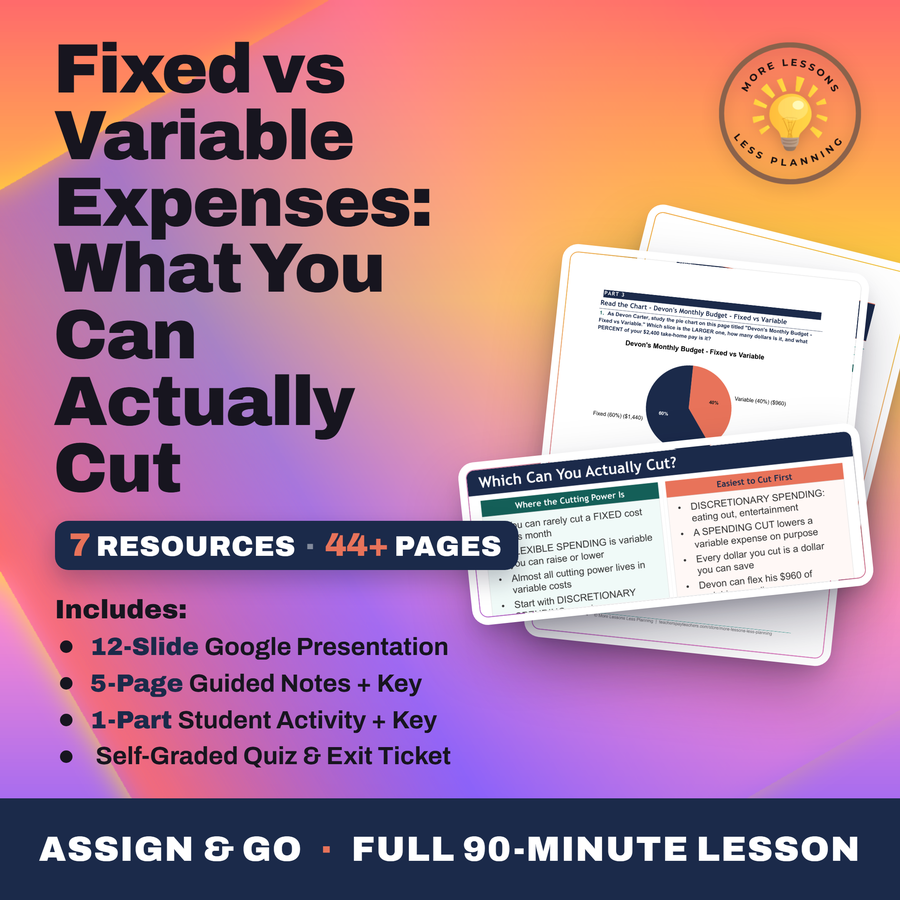
- 11 ready-to-teach files
- Format
- Word (.docx) · PowerPoint (.pptx)
- Slide deck
- Guided notes
- Guided notes teacher key
- Activity + answer key
- Quiz + answer key
- Exit ticket + answer key
- Teacher guide
- Teacher presentation notes
What students do
- Sort real expenses, including trick cases like a utility bill and a gym contract, into fixed, variable, or gray area
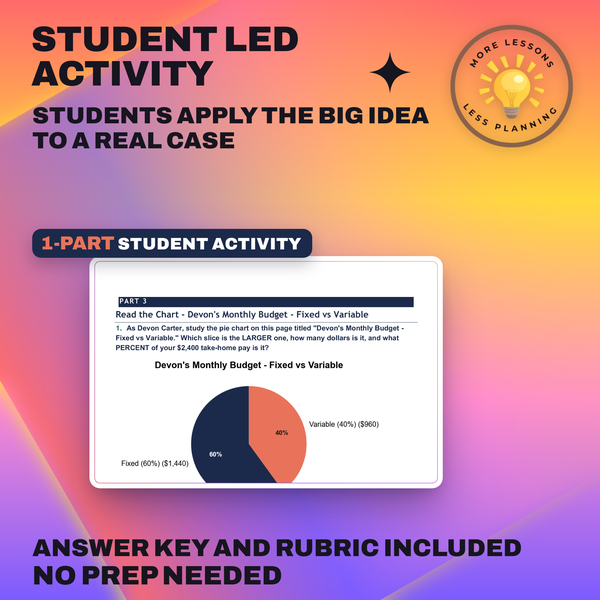
- Read a pie chart of a $2,400 paycheck to find the fixed and variable dollar amounts and percentages
- Calculate a specific dollar amount freed up by cutting two variable expenses
- Write a note explaining why variable spending, not fixed costs, is where real cutting power lives
What it covers
- The one test that sorts any expense, does the amount stay the same each month, or does it change
- Why a utility bill is variable even though it arrives every month, the most common student mistake
- A gym membership locked by a 12-month contract, fixed even though it feels optional
- A $2,400 monthly budget split 60% fixed and 40% variable, with a real spending-cut exercise
Learning targets
- Define fixed and variable expenses and tell them apart by whether the amount stays the same each month
- Sort real monthly expenses into fixed and variable, including gray-area items like a utility bill or a phone plan
- Read a pie chart to compare the fixed and variable shares of a budget
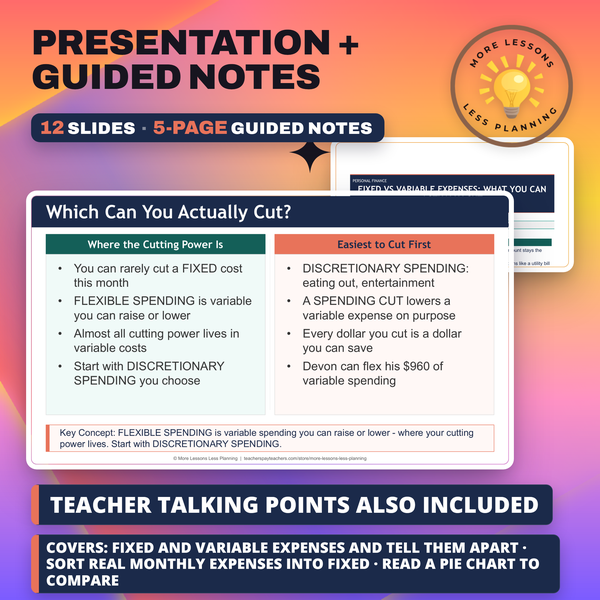
- Identify where spending can actually be cut by targeting variable (flexible) spending, not locked-in fixed costs
Peek inside
Why the Split Matters
Every expense is either FIXED or VARIABLE
TAKE-HOME PAY is your net income after taxes
A BUDGET splits your take-home pay across both
Knowing which is which tells you what you can cut
Why the Split Matters
Every expense is either FIXED or .
The split is about the , not whether you need it.
TAKE-HOME PAY is your net - the money actually deposited after taxes are taken out.
A BUDGET is a plan that splits your take-home pay across both kinds of .
Fixed vs Variable
1. A cost that stays the same amount every month, locked in by a contract or commitment - like rent, a car payment, or insurance - is a .
Why this matters
A utility bill shows up every month, so students assume it counts as fixed, and that single wrong assumption is the mistake this whole lesson is built to fix. A gym membership, on the other hand, feels optional but is locked in by a 12-month contract, which makes it fixed even though nobody thinks of it that way.
Once that test clicks, working a real $2,400 paycheck split 60 percent fixed and 40 percent variable stops being abstract, because students can point to exactly which slice of the pie chart they are actually allowed to touch this month. The real answer to where cutting power lives is never the rent, always the smaller variable slice sitting next to it.
From one teacher to another
Almost every class has a student who calls a utility bill "fixed" because it shows up every month, so this lesson makes them sit with the actual test: does the amount stay the same, or does it change? A utility bill changes with the season, so it's variable, while a gym membership on a 12-month contract feels optional but is locked in, so it's fixed, and once that distinction clicks, the card sort in Part 5 stops being guesswork. Students work a real $2,400 paycheck, splitting it into its fixed and variable slices on a pie chart, and I make the bigger point explicit: the bigger fixed slice is the one they can't touch this month, so all their real cutting power lives in the smaller variable side. They finish by calculating their own eating-out and entertainment cuts and writing a note explaining to a friend why that's where the money actually comes from.
Every file in this toolkit
-
Activity (Student)
Rent at $900 and a car payment at $260 sit in Devon Carter's fixed column, while a pie chart proves the 60/40 fixed-variable split before a card sort separates a locked gym contract from a grocery bill.
-
Activity (Answer Key)
Devon's $960 in variable spending drops to $800 once eating out and entertainment get trimmed by $160 total, a cut checked against a flat 25% alternative that would take the same $960 down to $720 instead.
-
Exit Ticket (Student)
A $2,400 paycheck splitting into $1,440 fixed and $960 variable spending becomes a percent calculation, before asking where actual cutting power lives in a budget. Fixed, variable, and cut run through the closing paragraph.
-
Exit Ticket (Answer Key)
The $960 pairing with Devon's variable spending is what this rubric rewards most, along with a correct fixed-versus-variable definition and the reasoning that his $1,440 in rent and a car payment is locked in and cannot be trimmed this month.
-
Guided Notes (Student)
Devon's $900 rent and $260 car payment sort as fixed expenses on this page, while his $360 grocery bill and a utility cost that surprises most students land on the variable side instead.
-
Guided Notes (Teacher Key)
$1,440 in fixed costs against $960 in variable costs make up the totals here, including the one call that trips up most students: a utility bill counts as variable because the amount changes.
-
Quiz (Student)
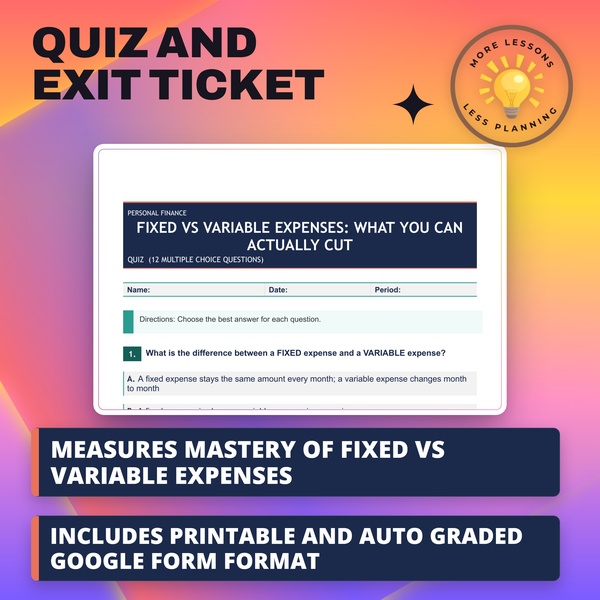
Whether a utility bill counts as fixed or variable drives one question, and Devon's $1,440 fixed slice against his $960 variable slice sets up the math in the rest of the set.
-
Quiz (Answer Key)
Sixty percent fixed and forty percent variable is the split marked correct on Devon's paycheck, and a utility bill lands in the variable column despite arriving every month.
-
Slides
Rent, a car payment, and three more locked-in bills add up to Devon's $1,440 in fixed costs on one slide, set against $960 of groceries, gas, and eating out on the next, before a pie chart splits his budget 60/40 fixed to variable.
-
Teacher Guide
Cutting $160 from eating out and entertainment is where Devon actually finds room to save, since his rent and car payment cannot move. This 50-point guide extends that test into sorting personal bills, auditing a gym contract, and hitting a savings target by trimming variable costs.
-
Teacher Presentation Notes
A utility bill gets mistaken for fixed more than any other line item on Devon's budget, the error corrected before his $2,400 splits into a $1,440 fixed slice and a $960 variable one that actually has room to cut.
Download
Where should I send the next one?
Everything here is free and it stays that way. Leave your email and I'll send you the new lessons as they go up. You can unsubscribe from any one of them.
Related resources
Budgeting Apps - Mint, YNAB and Your Phone
Building Your First Budget - From Paycheck to Plan
Banking Basics: Checking, Savings, and Debit Cards Explained
Big Purchase Planning: Save for Gadgets & More
Bonds - Lending to Governments and Companies
Budgeting Basics: How to Plan and Track Your Spending
Every lesson on this site is free to download and use. If one of them saved you a prep period, you can chip in a few bucks toward my three kids' daycare fund. That's genuinely where tips go.