Building Your First Budget - From Paycheck to Plan
Quality reviewed September 2026
- Grades
- Grades 9-12
- Time
- About two 50-minute class periods
- Includes
- 11 ready-to-teach files
- Format
- Word (.docx) · PowerPoint (.pptx)
- Slide deck
- Guided notes
- Guided notes teacher key
- Activity + answer key
- Quiz + answer key
- Exit ticket + answer key
- Teacher guide
- Teacher presentation notes
What students do
- Explain what a zero-based budget is and why every dollar of take-home pay gets a job
- List monthly income and every expense to set up a real budget worksheet
- Build a complete zero-based budget where income minus expenses equals zero
- Read an income-versus-expenses bar chart to confirm a budget is actually balanced
What it covers
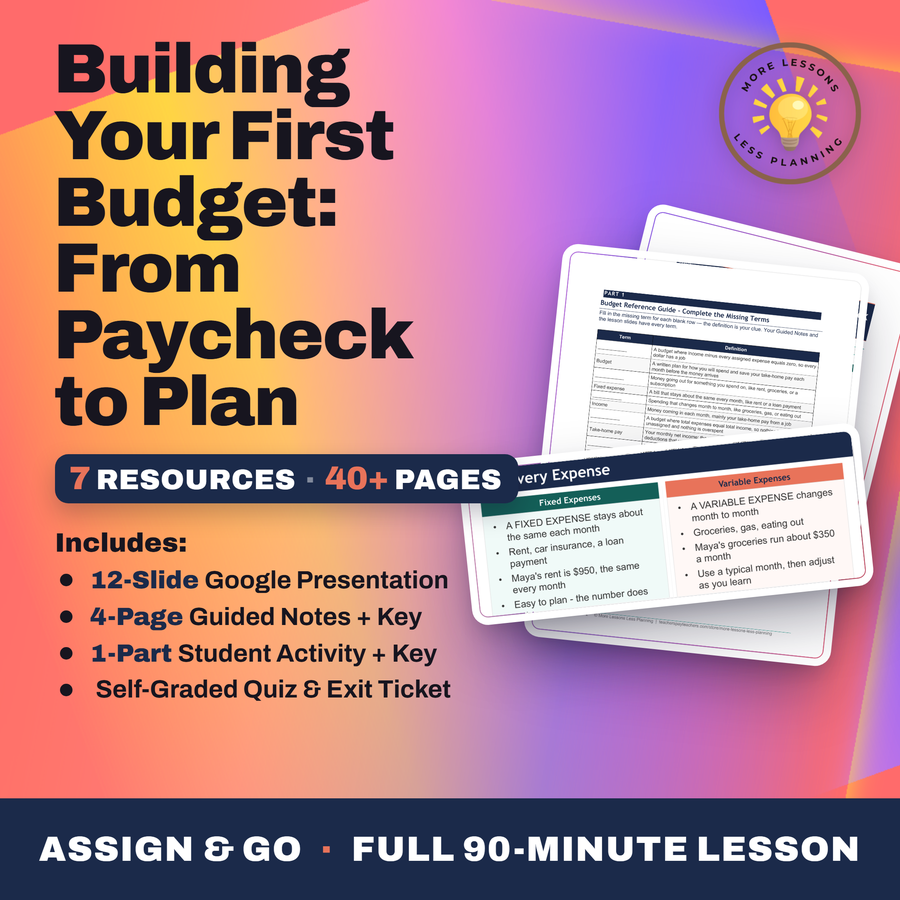
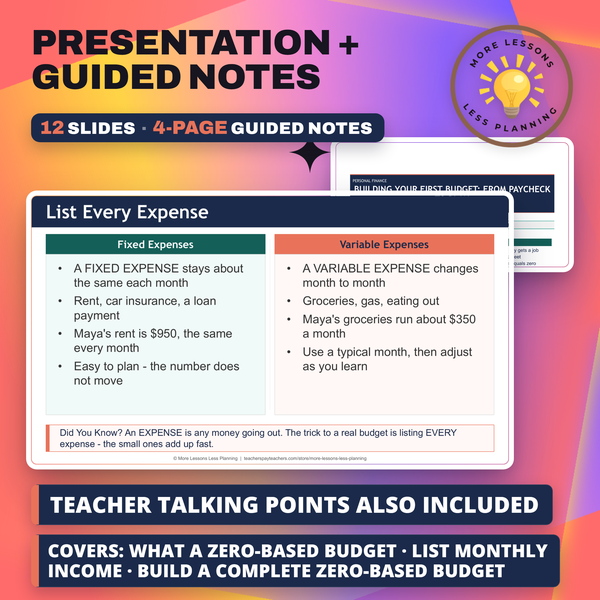
- Maya's real $2,600 take-home paycheck and the fixed and variable expenses she has to list before she can budget it
- Why zero in a zero-based budget doesn't mean broke, it means every dollar, including savings, has a job
- Fixing a first-draft budget that leaves $250 unassigned so it actually balances to zero
- Reading a bar chart where the income bar and the expense bar have to match exactly for a budget to count as balanced
Learning targets
- Explain what a zero-based budget is and why every dollar of take-home pay gets a job
- List monthly income and every monthly expense to set up a budget worksheet
- Build a complete zero-based budget where income minus total expenses equals zero
- Read an income-vs-expenses bar chart and confirm a budget is balanced
Peek inside
A Paycheck With No Plan
Money comes in, then just disappears
You hit the end of the month with nothing left
You cannot say where it all went
Surprise bills become a crisis every time
1. A budget where income minus every assigned expense equals zero, so every dollar has a job, is a .
Why this matters
Zero-based budget sounds like it means broke, and I let that assumption sit for a minute before showing students Maya Torres's real $2,600 paycheck, where zero actually means every dollar, savings included, has a job. The confusion is common enough that clearing it up early saves an entire class period of budgets built wrong.
The moment that actually teaches something is Maya's first draft, which leaves $250 sitting with nowhere to go, and students have to find that gap and fix it themselves instead of being handed a finished budget to admire. Watching the income bar and expense bar finally match on the chart is usually the first time a student believes a budget can actually balance.
From one teacher to another
Maya Torres just landed her first full-time job and takes home $2,600 a month, and this whole lesson is her building a real budget with that number instead of a made-up one. Students list her income and every expense the way she would, fixed costs like rent and car insurance next to variable ones like groceries and gas, and I make a point of separating those two because a variable expense is the one that sneaks up on a budget later. The moment that gets them is her first draft, which only assigns $2,350 of her $2,600 and leaves $250 floating with no job, and they have to fix it themselves before the budget counts as done. I like ending on the bar chart because it's a clean visual test, income and expenses have to hit the exact same height, and a shorter or taller bar tells you immediately something's still off.
Every file in this toolkit
-
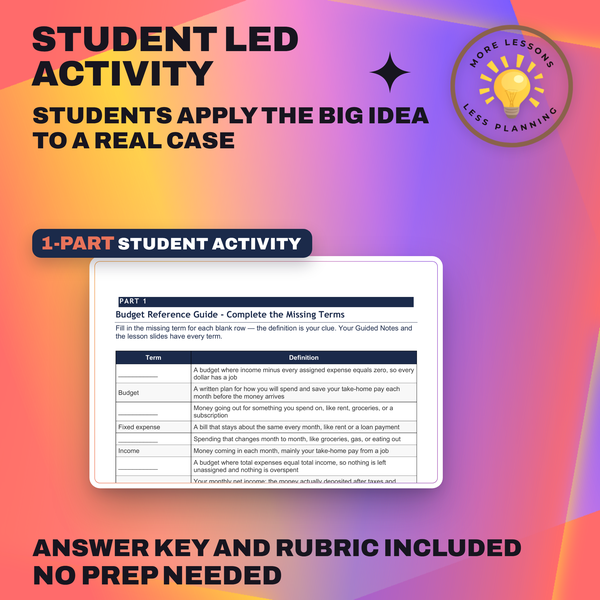
Activity (Student)
Maya Torres lists rent, groceries, and four more categories against a $2,600 paycheck until income minus expenses hits zero, then students find the $250 her first draft left unassigned and give it a job.
-
Activity (Answer Key)
$1,900 in needs is where Maya's $2,600 paycheck gets assigned first, with wants and savings each getting their own line, until a first draft leaving $250 unassigned gets fixed so the budget balances to zero.
-
Exit Ticket (Student)
A $2,600 take-home paycheck matched dollar for dollar by expenses becomes the zero-based test here, next to sorting unchanging rent by type. A short write leans on income, expense, and zero.
-
Exit Ticket (Answer Key)
Full credit on Maya's zero-based-budget answer needs income and expense used correctly, plus the reasoning that assigning every dollar of take-home pay a job, savings included, is what makes the total land on exactly zero.
-
Guided Notes (Student)
Maya's $2,600 take-home paycheck opens this worksheet, and her first budget draft comes up $250 short until every dollar, down to a $150 student loan payment, finally gets assigned a job.
-
Guided Notes (Teacher Key)
$250 is the gap in Maya's first budget draft that gets resolved line by line, tracing her $2,600 income down to the $150 student loan payment that brings the total to zero.
-
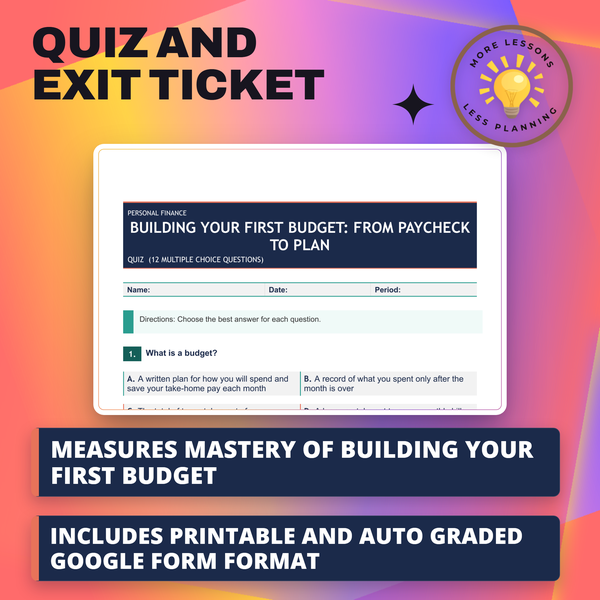
Quiz (Student)
Rent's status as a fixed cost gets tested alongside Maya's $2,600 paycheck, her $250 unassigned dollars in a zero-based plan, and what two matching bars on a chart prove.
-
Quiz (Answer Key)
Zero means every dollar has a job, and that rule marks several choices correct, including Maya's $250 unassigned balance and what a balanced income-expense chart looks like.
-
Slides
Out of Maya's $2,600 paycheck, her first budget draft leaves $250 unassigned, and these slides send it straight to an emergency fund so income minus every assigned dollar, rent through savings, finally lands on zero.
-
Teacher Guide
$250 left unassigned in Maya's first budget draft becomes her emergency fund, the fix this guide's zero-based model teaches. Extensions build a full personal budget, rescue a partly assigned $2,000 paycheck, and sort 12 to 15 expenses into needs, wants, and savings.
-
Teacher Presentation Notes
The emergency fund claims Maya's $250 unassigned balance from her first draft, proof a zero-based budget only works once income and every expense land on the same $2,600 line.
Download
Where should I send the next one?
Everything here is free and it stays that way. Leave your email and I'll send you the new lessons as they go up. You can unsubscribe from any one of them.
Related resources
Budgeting Apps - Mint, YNAB and Your Phone
Fixed vs Variable Expenses - What You Can Actually Cut
Banking Basics: Checking, Savings, and Debit Cards Explained
Big Purchase Planning: Save for Gadgets & More
Bonds - Lending to Governments and Companies
Budgeting Basics: How to Plan and Track Your Spending
Every lesson on this site is free to download and use. If one of them saved you a prep period, you can chip in a few bucks toward my three kids' daycare fund. That's genuinely where tips go.