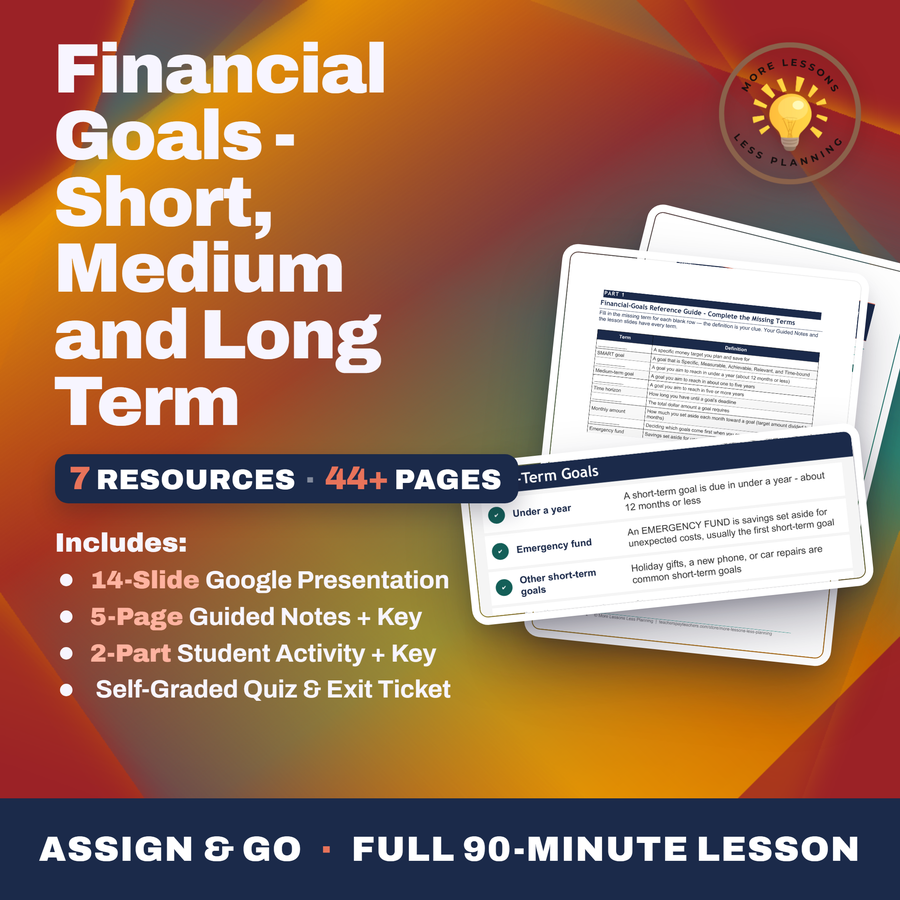

Financial Goals - Short, Medium and Long Term
Quality reviewed September 2026
- Grades
- Grades 9-12
- Time
- About two 50-minute class periods
- Includes
- 11 ready-to-teach files
- Format
- Word (.docx) · PowerPoint (.pptx)
- Slide deck
- Guided notes
- Guided notes teacher key
- Activity + answer key
- Quiz + answer key
- Exit ticket + answer key
- Teacher guide
- Teacher presentation notes
What students do
- Calculate the monthly amount a goal needs by dividing the target amount by months
- Sort three financial goals into short-, medium-, and long-term time horizons
- Read a bar chart to find why the biggest target isn't always the steepest monthly payment
- Prioritize goals that add up to more than a monthly budget can cover
What it covers
- What makes a goal SMART, specific, measurable, achievable, relevant, and time-bound
- The monthly-amount and goal-timeline formulas
- How to prioritize goals, starting with an emergency fund
Learning targets
- Explain what a financial goal is and set goals that are SMART (Specific, Measurable, Achievable, Relevant, Time-bound)
- Sort financial goals into short-term, medium-term, and long-term time horizons
- Calculate the monthly amount a goal needs (target amount divided by months) and the goal timeline (target divided by monthly amount)
- Prioritize goals you cannot fund all at once and build a plan to reach them
Why this matters
An $18,000 down payment sounds like the harder goal to save for than a $9,600 car, until students actually divide each target by its timeline and watch the down payment come out cheaper per month. That single surprise does more to teach the monthly-amount formula than any explanation I could give up front.
Sorting goals into short, medium, and long term is the easy part. The harder skill, and the one I spend the most time on, is prioritizing when a student's real goals add up to more than their real budget can cover in a month, starting with the emergency fund before anything else on the list gets touched.
From one teacher to another
A goal that stays a wish never turns into a number, so this lesson makes students do exactly that conversion for a car they actually want. They watch an $18,000 down payment come out cheaper per month than a $9,600 car, purely because of how many months it's spread across, and that surprise is what makes the math finally stick. By the end they can take any goal of their own, run it through the formula, and name exactly what to save this month.
Every file in this toolkit
-
Activity (Student)
Devon's only goal is to save more, so Priya Nair rewrites it as a $600 emergency fund due in six months, sizes a $1,500 laptop and a $2,400 vacation, then reads why his used car outpaces his down payment on the chart.
-
Activity (Answer Key)
$300 a month covers Devon's $1,500 laptop goal over five months, the same monthly split behind his $600 emergency fund at $100 a month, and the chart shows a bigger target is not always steeper, since his $18,000 down payment needs only $300 against a used car's $400.
-
Exit Ticket (Student)
Dividing a target amount by a number of months is the opening calculation, then a used car gets sorted into its own time horizon and a third item asks how a longer deadline changes the monthly number. SMART goal, time horizon, and monthly amount belong in the response.
-
Exit Ticket (Answer Key)
Naming what SMART stands for and sorting short, medium, and long horizons correctly earns points here, plus dividing a target amount by its number of months in an answer that also names time horizon and monthly amount.
-
Guided Notes (Student)
Devon's medium-term $9,600 car costs $400 a month across 24 months, more than his long-term $18,000 down payment at just $300 a month over five years, spread across nine sections building SMART goals.
-
Guided Notes (Teacher Key)
$400 and $300 a month are Devon's two goal payments, tied to SMART's five letters and the short, medium, and long-term horizons that decide how each target gets funded, starting with the emergency fund.
-
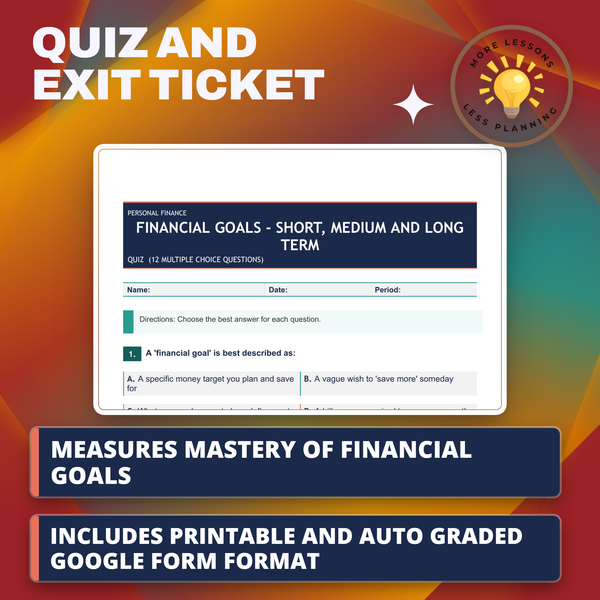
Quiz (Student)
A $9,600 car saved at $300 a month tests the goal-timeline formula, and a chart question asks students what the bar for Devon's $18,000 down payment, the biggest target on the list, shows about its monthly amount.
-
Quiz (Answer Key)
$400 for the car and $300 for the down payment are the two marked monthly figures on the chart, next to the formula that turns a $9,600 savings target into a 32-month timeline.
-
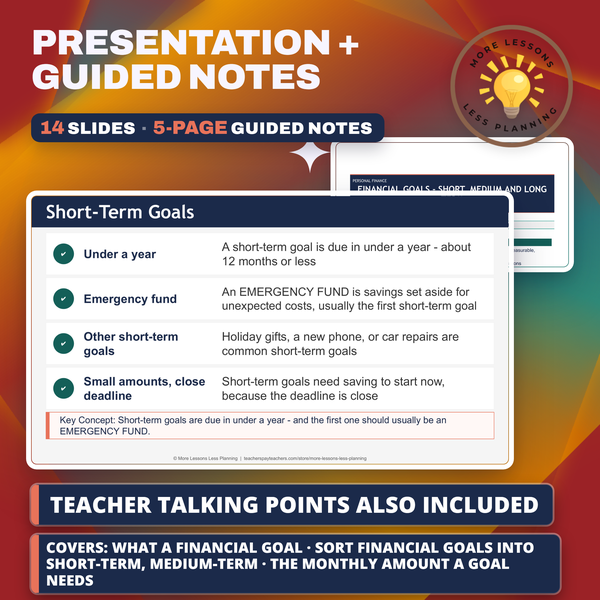
Slides
A vague wish to save more gets rebuilt into a SMART goal on these slides, sorted into short, medium, and long horizons, then run through the monthly-amount formula that turns a target and a deadline into a dollar figure to set aside.
-
Teacher Guide
An $18,000 house down payment needs only $300 a month spread across five years, less than Devon's medium-term car, the counterintuitive math coach Priya Nair teaches. The guide's extensions write personal SMART goals, stretch a timeline, and prioritize a tight budget.
-
Teacher Presentation Notes
A $300 monthly down-payment goal against a $400 car goal is the side-by-side math coach Priya Nair uses with Devon to show how a longer time horizon shrinks a SMART goal's monthly cost.
Download
Where should I send the next one?
Everything here is free and it stays that way. Leave your email and I'll send you the new lessons as they go up. You can unsubscribe from any one of them.
Related resources

Consumer Rights - When a Purchase Goes Wrong

Impulse Buying - How Stores Trick You
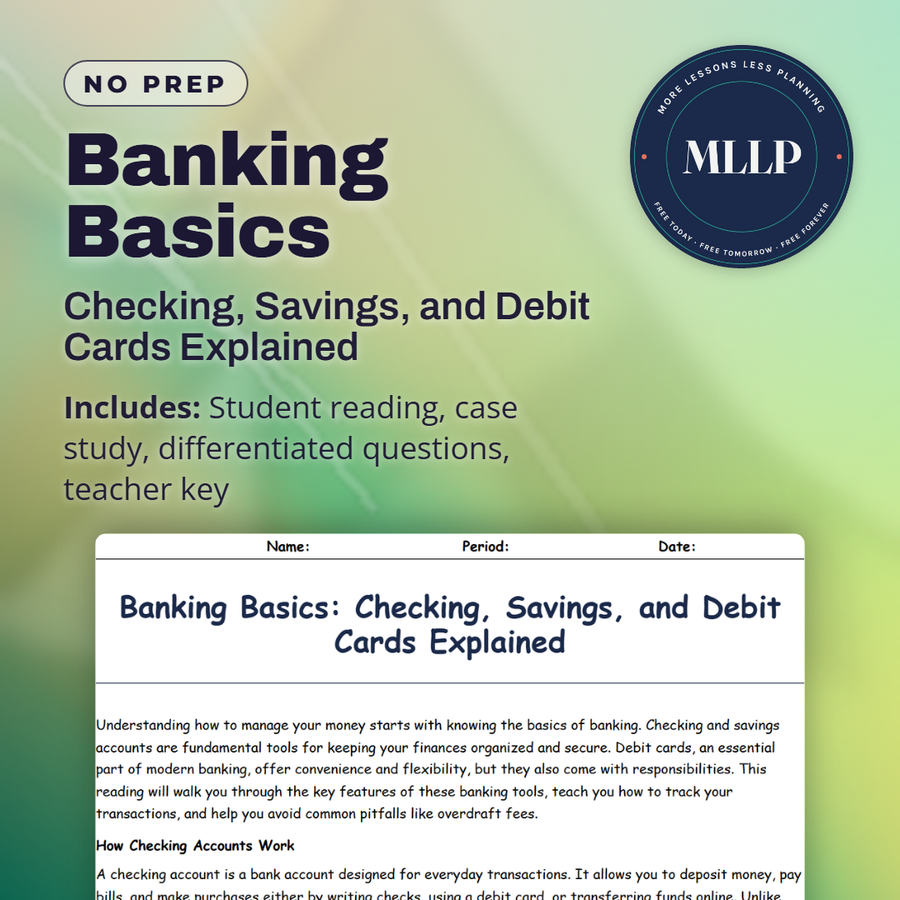
Banking Basics: Checking, Savings, and Debit Cards Explained

Big Purchase Planning: Save for Gadgets & More
Bonds - Lending to Governments and Companies
Budgeting Apps - Mint, YNAB and Your Phone
Every lesson on this site is free to download and use. If one of them saved you a prep period, you can chip in a few bucks toward my three kids' daycare fund. That's genuinely where tips go.