Consumer Rights - When a Purchase Goes Wrong
Quality reviewed September 2026
- Grades
- Grades 9-12
- Time
- About two 50-minute class periods
- Includes
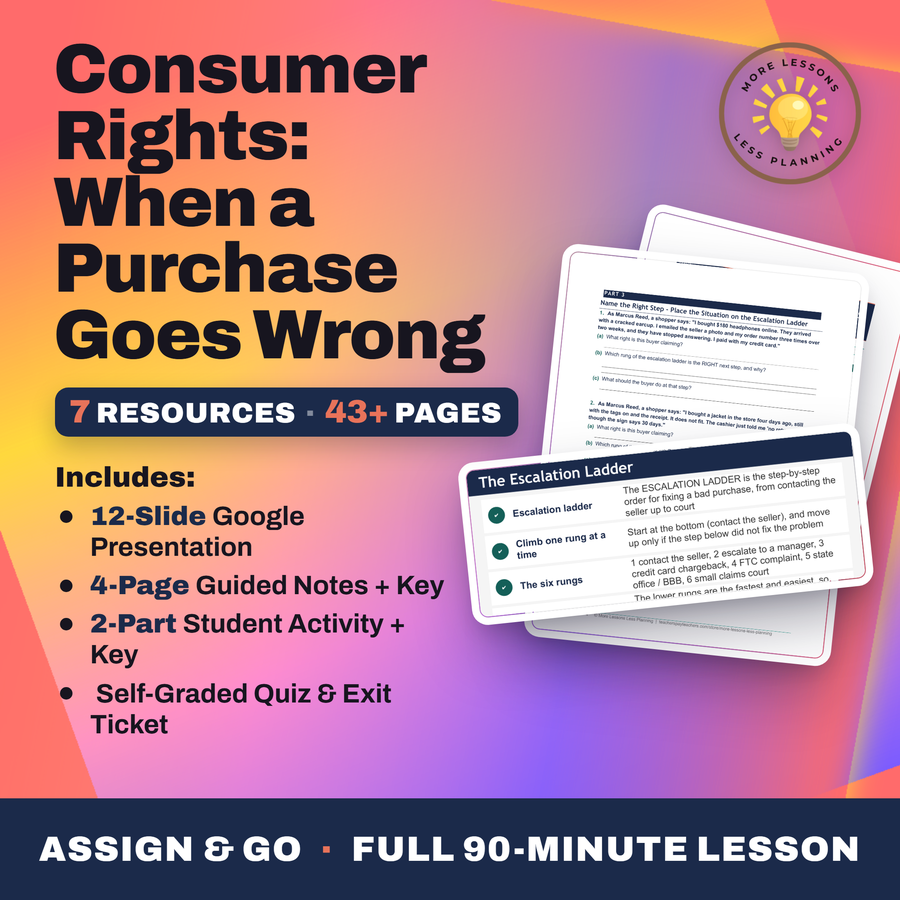
- 11 ready-to-teach files
- Format
- Word (.docx) · PowerPoint (.pptx)
- Slide deck
- Guided notes
- Guided notes teacher key
- Activity + answer key
- Quiz + answer key
- Exit ticket + answer key
- Teacher guide
- Teacher presentation notes
What students do
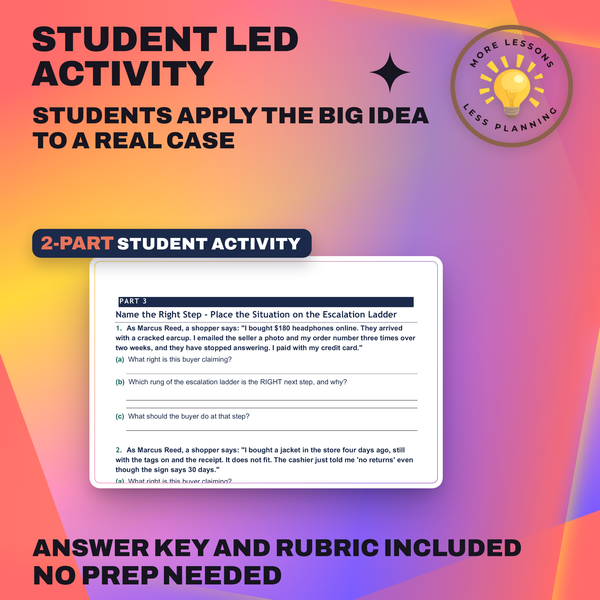
- Name the right rung of the escalation ladder for eight different bad-purchase situations
- Read a bar chart of typical days to resolve each step, from contacting the seller to small claims court
- Explain why a credit card gives chargeback protection that cash and debit often do not
- Write a consumer-advocate action plan covering the first step, the ladder, and which tool fits which problem
What it covers
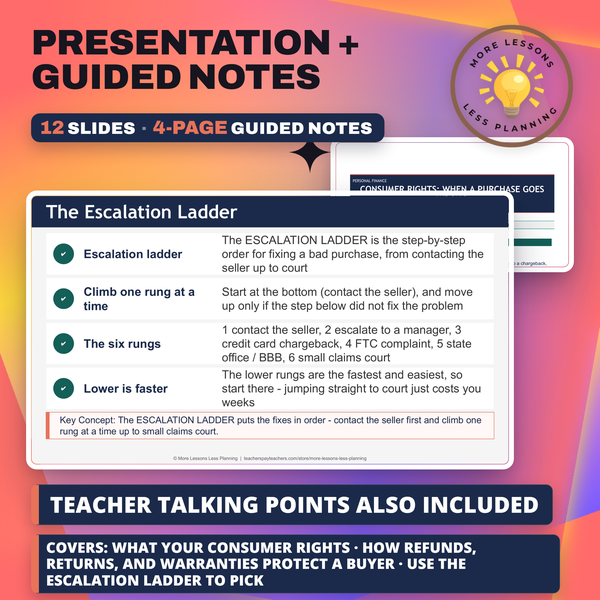
- The escalation ladder, from contacting the seller and escalating to a manager up through small claims court
- A bar chart showing contacting the seller resolves in about 3 days versus about 90 for small claims court
- When a chargeback is not available, such as a cash payment, and small claims court becomes the last resort
- Keeping receipts, order numbers, and messages as the proof that actually wins a dispute
Learning targets
- Explain what your consumer rights are when a purchase goes wrong
- Describe how refunds, returns, and warranties protect a buyer
- Use the escalation ladder to pick the right step, from contacting the seller to a chargeback, the FTC, or small claims court
- File a chargeback or an FTC complaint and know when small claims court is the last resort
Why this matters
A pair of $180 headphones cracks two days after purchase, and the instinct every year is the same: skip straight to threatening a lawsuit. An actual chart of how long each rung of the escalation ladder takes slows that instinct down, about three days to contact the seller versus roughly ninety for small claims court.
Paying in cash costs a shopper the chargeback safety net entirely, and the repair shop that closed owing someone a $300 deposit is proof. Escalating without a receipt or an order number can leave a shopper with nothing to point to. Once students see the ladder step by step, they stop reaching for the biggest tool first.
From one teacher to another
The instinct I have to talk students out of every year is skipping straight to "I'm suing them" over a $40 problem, so this lesson is built around the actual cost of that instinct: the bar chart shows contacting the seller resolves in about 3 days while small claims court takes about 90, and once students see that gap in days they stop reaching for the biggest tool first. They work through a set of case files, a cracked pair of $180 headphones, a repair shop that closed with a $300 deposit, a shopper who just changed their mind, and have to name the right rung of the ladder for each one, including the cases where a chargeback isn't even available because the person paid in cash. The whole thing ends with them writing a short action plan a real shopper could actually follow, which is the version of this skill I want them to remember after the quiz is long gone.
Every file in this toolkit
-
Activity (Student)
Cracked $180 headphones, a four-day-old jacket refused despite a posted 30-day policy, and a closed repair shop holding a $300 cash deposit are the three cases Marcus Reed places on the escalation ladder.
-
Activity (Answer Key)
Marcus sorts three real complaints onto the escalation ladder, sending $180 cracked headphones straight to a credit card chargeback, a four-day-old jacket back to a manager under its 30-day return policy, and a cash-paid $300 repair deposit all the way to small claims court.
-
Exit Ticket (Student)
A blender that quits two weeks after purchase tests what actually protects a buyer's right to a fix, beside the almost-always-first move when a deal goes wrong and what a chargeback reverses. The closing write leans on consumer rights, escalation ladder, and chargeback.
-
Exit Ticket (Answer Key)
Naming the seller as the correct first step earns one point, and the rubric grades climbing the escalation ladder one step at a time along with using all three required vocabulary words correctly.
-
Guided Notes (Student)
A cracked $180 headphone order and a repair shop that keeps a $300 deposit set up the escalation ladder, moving step by step from contacting the seller up through a chargeback to small claims court.
-
Guided Notes (Teacher Key)
$180 headphones and a $300 repair deposit carry the worked examples, spelling out each step of the escalation ladder from a first email to the seller through the FTC and small claims court.
-
Quiz (Student)
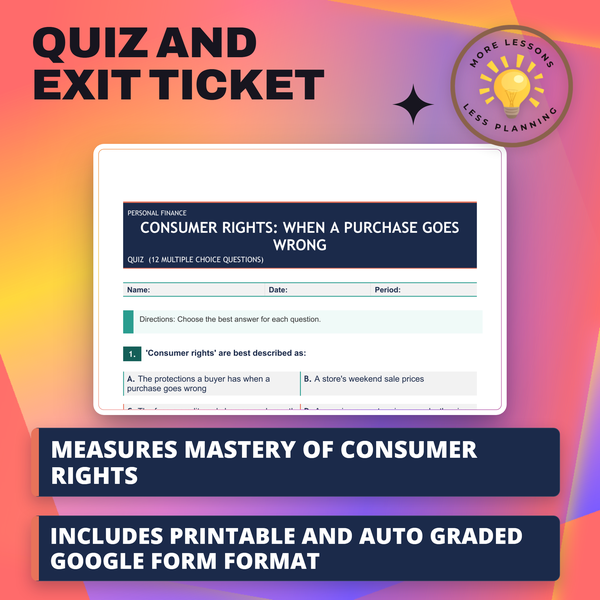
Credit card protection on a broken online order, plus a chart comparing a 3-day seller contact with a 90-day small claims filing, gives this quiz its math, alongside where each step sits on the escalation ladder.
-
Quiz (Answer Key)
Contacting the seller first, not filing an FTC complaint, is marked as the almost-always-right opening move, with the FTC confirmed as the agency that polices unfair and deceptive business practices.
-
Slides
A six-rung ladder guides this deck from contacting the seller up through a credit card chargeback and an FTC complaint to small claims court, and its resolution-time chart puts that first call at about three days against ninety for court.
-
Teacher Guide
Leah's $180 headphones arrive broken and her seller goes quiet, the case this guide's escalation ladder is built to fix. Extensions compare real store return policies, draft an actual chargeback letter, and map a real complaint onto the ladder's six rungs.
-
Teacher Presentation Notes
Contacting the seller takes about three days on the escalation ladder here, small claims court about ninety, the range covering refunds, chargebacks, and filing a complaint with the FTC.
Download
Where should I send the next one?
Everything here is free and it stays that way. Leave your email and I'll send you the new lessons as they go up. You can unsubscribe from any one of them.
Related resources
Financial Goals - Short, Medium and Long Term

Impulse Buying - How Stores Trick You
Banking Basics: Checking, Savings, and Debit Cards Explained

Big Purchase Planning: Save for Gadgets & More
Bonds - Lending to Governments and Companies
Budgeting Apps - Mint, YNAB and Your Phone
Every lesson on this site is free to download and use. If one of them saved you a prep period, you can chip in a few bucks toward my three kids' daycare fund. That's genuinely where tips go.