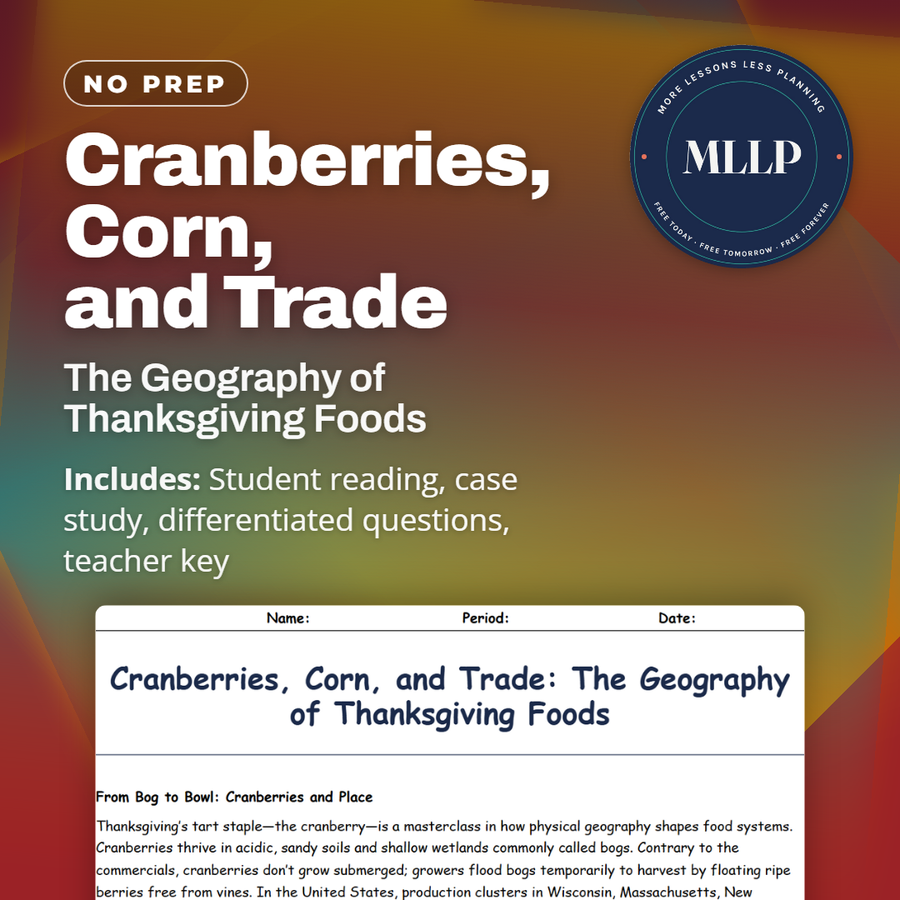
Cranberries, Corn, and Trade: The Geography of Thanksgiving Foods
Quality reviewed September 2026
Facts verified September 9, 2026
- Subject
- Social Studies
- Grades
- Grades 9-12
- Length
- 8-page student worksheet
- Time
- About one 50-minute class period
- Great for
- Sub plans and independent work
- Includes
- Reading passage, comprehension questions + full answer key
- Format
- Print-and-go PDF
What students do
- Map production clusters (Wisconsin cranberries, Iowa corn belt, Great Plains wheat) and explain why they concentrate
- Trace cold-chain routes from processor to retail, identifying vulnerabilities to weather and labor delays
- Calculate how just-in-time inventory saves money but increases risk during a fixed-date demand spike
- Propose mitigation strategies using buffer stock, supplier diversification, and secondary carriers
What it covers
- Food geography and regional specialization
- Supply chain logistics and risk management
- Seasonal demand forecasting and inventory planning
Start reading this worksheet
From Bog to Bowl: Cranberries and Place
Thanksgiving’s tart staple, the cranberry, is a masterclass in how physical geography shapes food systems. Cranberries thrive in acidic, sandy soils and shallow wetlands commonly called bogs. Contrary to the commercials, cranberries don’t grow submerged; growers flood bogs temporarily to harvest by floating ripe berries free from vines. In the United States, production clusters in Wisconsin, Massachusetts, New Jersey, Oregon, and Washington, where glacial soils, cool nights, and ample freshwater align. This geographic clustering reduces production costs through shared infrastructure, specialized labor, and nearby processing plants that transform berries into juice, dried fruit, and the iconic jellied sauce. At the same time, clustering concentrates risk: a late frost, drought, or pest outbreak in one region can squeeze national supply just as holiday demand spikes. Cranberries illustrate the role of seasonality and storage in food geography. Because berries are harvested in the fall, processors lean on cold storage, freezing, and just-in-time logistics to meet Thanksgiving orders weeks later. Retailers coordinate promotions with shipments so cans and bags appear exactly when shoppers build their menus. From a geographic lens, each can of sauce represents a chain: the bog’s coordinates, the nearest processing facility, the rail or truck corridor, and finally the supermarket shelf in your ZIP code. And because cranberries are so place-specific, even modest transport disruptions (storms over the Great Lakes, icy highways in the Upper Midwest) can ripple outward, reminding us that maps, not just recipes, shape Thanksgiving.
Corn, Sweet Potatoes, and the American Food Belt
Another Thanksgiving anchor, corn, links Indigenous agricultural genius to modern commodity geography. Domesticated from teosinte in Mesoamerica, corn spread north along trade routes and farming frontiers, becoming a pillar of diets and ceremonies. Today’s Corn Belt (Iowa, Illinois, Indiana, Nebraska, Minnesota, and neighbors) features deep mollisol soils, a continental climate, and vast mechanization, producing corn for feed, ethanol, sweeteners, and food. While your table may feature cornbread, corn pudding, or tortillas, much of the crop moves invisibly through supply chains as corn oil, starch, or HFCS in sauces and desserts. Thanksgiving also draws on sweet potatoes, heavily grown in North Carolina and Mississippi, and wheat from the Great Plains that becomes pies and rolls. These belts reflect comparative advantage: regions specialize where climate, soils, and infrastructure confer lower costs and reliable yields. Holiday timing amplifies logistics. Elevators load grain onto unit trains; processors schedule mill runs; and refrigerated trucks (the cold chain) shuttle perishables like fresh cranberries, greens, and dairy for pies. A storm over the Rockies can delay flour shipments to West-coast bakeries; a Mississippi River bottleneck can slow soy oil that would otherwise be in pie crust shortening. Because Thanksgiving is a national event pinned to a single week, suppliers build buffer inventory and redundant routes, but tight margins discourage excess slack. Students can trace their menus back through these networks and see a continental web of farms, feedlots, mills, warehouses, and highways humming to meet one dinner’s deadline.
Like what you read? The full reading, the case study, and every question set are in the free download below, along with the answer key.
Why this matters
A bag of cranberries on a store shelf hides a fragile supply chain. Wisconsin's bogs sit on acidic, glacier-carved soil few regions can match, so most of the harvest funnels through one part of the country before it reaches a truck. A rock slide on I-94 does not just delay one delivery; it ripples through a network already stretched thin for a date that will not move.
What students get wrong is picturing a reliable side dish as something that just shows up. Tracing a cranberry from a flooded bog through sorting, canning, and rail to a store endcap shows why a company builds buffer stock and books backup trucking months ahead. Efficiency and fragility come from the same clustering.
From one teacher to another
I use this when teaching supply chains and it works because students can literally trace their Thanksgiving plate back to places on a map. Wisconsin cranberry bogs need acidic soil and shallow water, conditions glaciers left behind, so production clusters there. A rock slide on I-94 doesn't just delay that one truck; it cascades through a retail network that's been primed for peak demand. The case study follows a cranberry from harvest (flooding the bog to float berries) through processor (sorting, canning, labeling) to rail to regional distribution centers to the store's endcap. Students learn that geographic clustering creates efficiency (shared labor, nearby mills) but also fragility. One regional frost in September can tighten national supply. We also show how retailers build buffer inventory months early and reserve backup trucking routes because Thanksgiving has a fixed date and no flexibility. By the end, students see that a "reliable side dish" depends on geography, logistics, and planning that's almost invisible.
What you get
Download
Where should I send the next one?
Everything here is free and it stays that way. Leave your email and I'll send you the new lessons as they go up. You can unsubscribe from any one of them.
Related resources
Black Friday Forensics: Shoplifting, Organized Theft, and Crowd Violence
Black Friday Smart Shopper: Economics and Personal Finance in Action

Black Friday: Are the “Deals” Actually Good for Shoppers?
Black Friday’s Economic Impact: Who Gains, Who Pays, and What It Means for the Economy
Budget a Feast: Unit Prices, Deals, and Receipts
Colonial Foodways: Indigenous Knowledge and European Adaptation
Every lesson on this site is free to download and use. If one of them saved you a prep period, you can chip in a few bucks toward my three kids' daycare fund. That's genuinely where tips go.