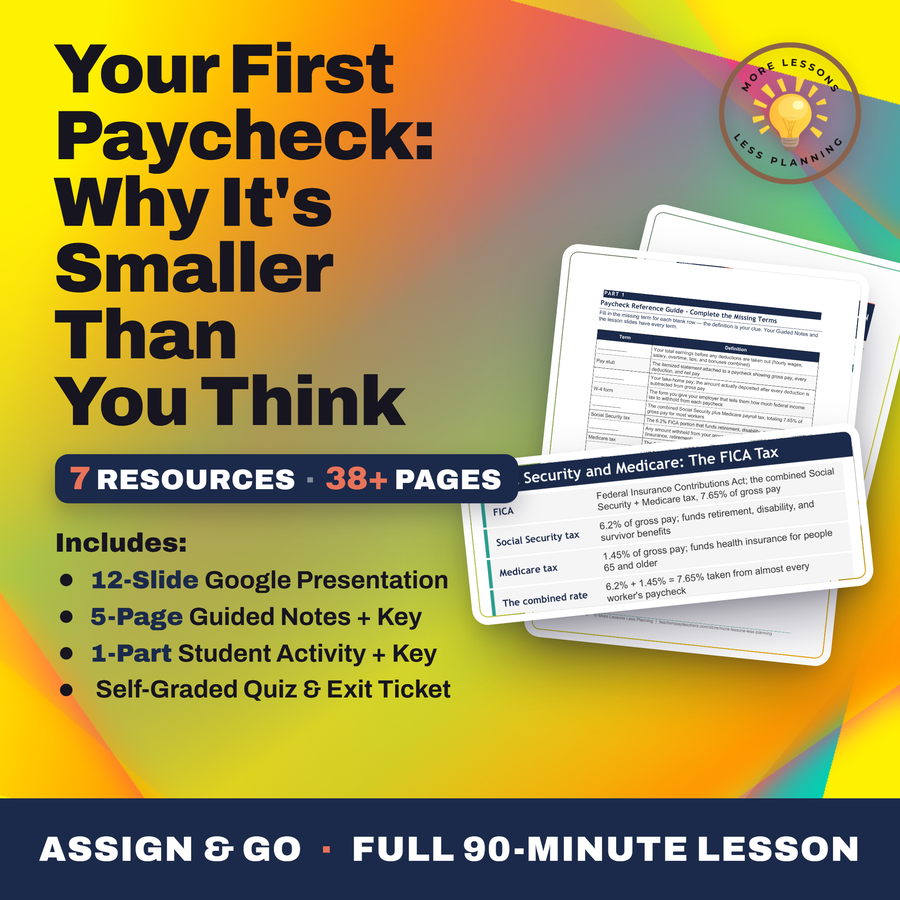
Your First Paycheck: Why It's Smaller Than You Think
Quality reviewed September 2026
- Grades
- Grades 9-12
- Time
- About two 50-minute class periods
- Includes
- 11 ready-to-teach files
- Format
- Word (.docx) · PowerPoint (.pptx)
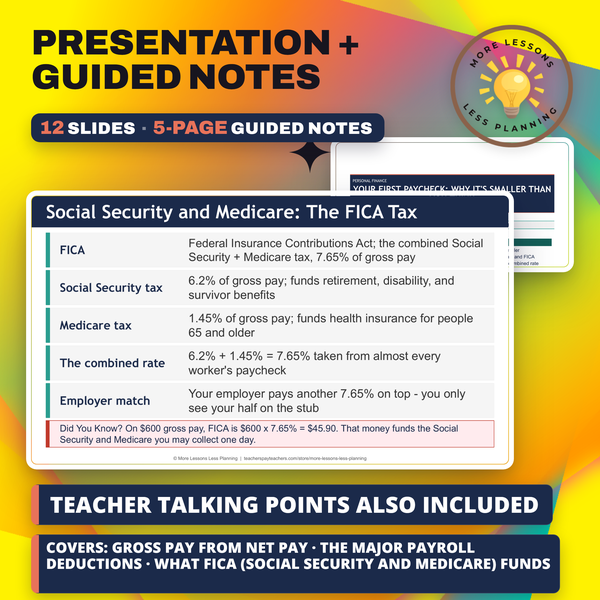
- Slide deck
- Guided notes
- Guided notes teacher key
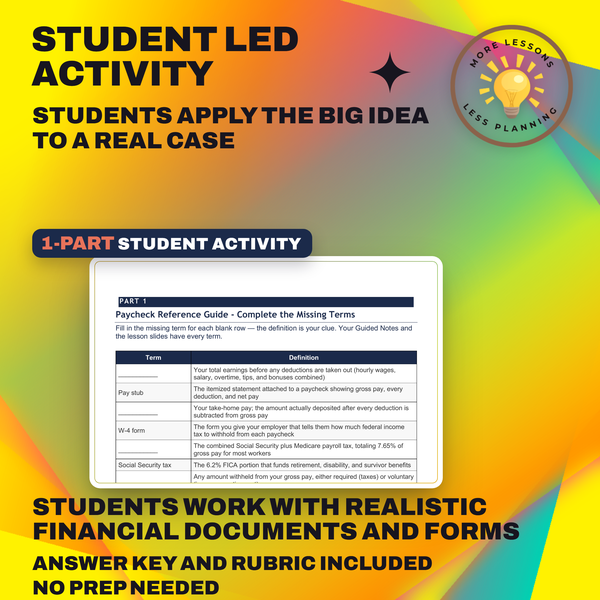
- Activity + answer key
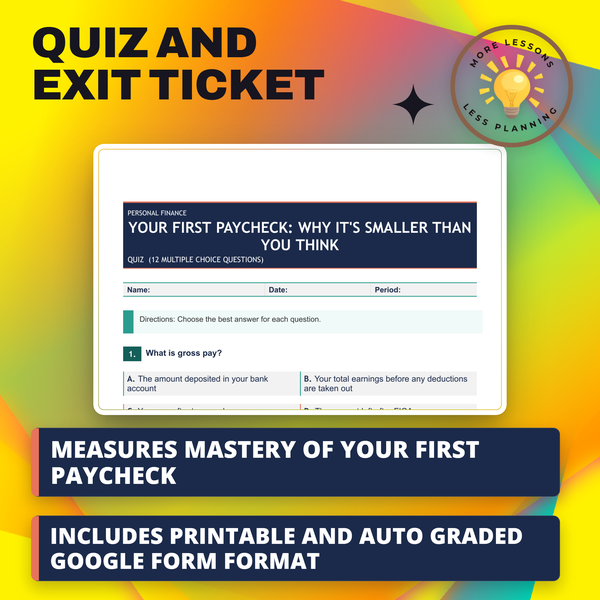
- Quiz + answer key
- Exit ticket + answer key
- Teacher guide
- Teacher presentation notes
What students do
- Distinguish gross pay from net pay and explain why the deposit is always smaller than the offer
- Identify federal income tax, state income tax, and FICA as the deductions eating into a paycheck
- Explain what the combined FICA rate actually funds and calculate it on a real paycheck
- Decode a real pay stub and calculate net pay by hand from gross pay and every deduction
What it covers
- Jordan's real $600 gross paycheck next to the roughly $103 that comes out before any of it reaches a bank account
- The line between a required deduction and a voluntary one, and where a W-4 form fits into how much gets withheld
- A pie chart of Jordan's exact $600 gross pay, broken into take-home, FICA, federal, and state slices
- The four-step formula for calculating net pay by hand from gross pay and every deduction on the stub
Learning targets
- Distinguish gross pay from net pay and explain why net pay is always smaller
- Identify the major payroll deductions: federal income tax, state income tax, and FICA
- Explain what FICA (Social Security and Medicare) funds and the 7.65% combined rate
- Calculate net pay by subtracting all deductions from gross pay
Peek inside
The Surprise
Your offer letter quotes GROSS pay
Your bank deposit is NET pay
The gap is deductions - mostly taxes
This catches almost every first-time earner
The Surprise
Your offer letter quotes pay (your total earnings before deductions).
Your bank deposit is pay (what is left after deductions).
The gap between gross and net is made up of - mostly taxes.
A Real Example
Offer: $15/hour x 40 hours = $ gross.
1. Your total earnings before anything is taken out - hourly wages, salary, overtime, tips, and bonuses combined - is your .
Why this matters
A $15-an-hour job sounds like a fixed number until the first deposit lands about $103 short of it. That gap between the offer and the bank app is the real first lesson of working, and most students meet it with zero warning about where the money actually went.
I built this around Jordan's real $600 stub because kids trust a specific dollar figure more than a rule. Once they have traced every deduction back to FICA, federal, and state withholding, the mystery of a first paycheck stops being annoying and starts being explainable, which is the whole point before they ever cash one of their own.
From one teacher to another
It's Jordan Rivera's first payday at a new part-time job paying $15 an hour, and the number on the bank app doesn't match the number from the offer letter, which is the exact moment every first-time earner hits and the one this whole lesson is built around. Students work through gross pay first, since you can't understand what's missing until you know what the full number was supposed to be, then chase every dollar of the gap through federal tax, state tax, and FICA, including what FICA actually pays for beyond just a smaller check. The pie chart is where it gets concrete, since it's Jordan's exact $600 broken into real slices instead of an abstract percentage, and I want students able to point to each slice and say what it's funding before they move on. They finish by calculating net pay by hand off a full pay stub, the same four steps a first paycheck actually takes them through.
Every file in this toolkit
-
Activity (Student)
Jordan Rivera's first $600 paycheck loses $45.90 to FICA alone, and a pie chart of that gap sets up decoding a real pay stub down to $497.10 net before warning a cousin why a $20-an-hour offer will not show up in full.
-
Activity (Answer Key)
Jordan's $600 gross paycheck shrinks to $497.10 in net pay, about 83%, once $45.90 in FICA, $45 in federal tax, and $12 in state tax come out, the same three deductions a rubric checks for in the explanation written for a cousin's first job.
-
Exit Ticket (Student)
Naming the pay stub line left after every deduction gets asked first, then an $800 paycheck with $80 federal, $30 state, and $61.20 in FICA becomes a take-home calculation. Gross pay, net pay, and deductions get folded into the write.
-
Exit Ticket (Answer Key)
Correct use of gross pay, net pay, and deductions defines full credit on this four-point rubric, checked against a sample response that separates $80 federal, $30 state, and $61.20 FICA, plus three answer letters, C, B, and D.
-
Guided Notes (Student)
A $15-an-hour, 40-hour week gives a $600 gross paycheck, and eight sections walk from FICA's 7.65 percent rate through every pay stub section to a formula that turns gross pay into an actual deposit.
-
Guided Notes (Teacher Key)
$45.90 in FICA, about $45 in federal tax, and $12 in state tax make up every deduction, landing on the four-step formula that lands at $497.10 net pay from a $600 gross check.
-
Quiz (Student)
The 7.65% FICA rate runs through this set, testing what Social Security and Medicare actually fund and using a $600 gross paycheck to calculate the exact dollar amount FICA takes out.
-
Quiz (Answer Key)
$45.90 gets the nod as the correct FICA taken out of a $600 gross paycheck, while the required-versus-voluntary call between FICA and a 401k contribution finishes out the set.
-
Slides
Fifteen dollars an hour for a 40-hour week comes to $600 gross, and these slides subtract $45.90 in FICA plus federal and state tax until the deposit lands near $497, then a pie chart slices that same $600 into its take-home and withheld pieces.
-
Teacher Guide
FICA takes 7.65% off Jordan Rivera's $600 paycheck before federal and state tax cut it down further, the gap this guide's pie chart breaks apart. Extensions build a net-pay calculator for three gross amounts, hunt three planted pay-stub errors, and compare take-home pay with and without state tax.
-
Teacher Presentation Notes
A $15-an-hour, 40-hour week comes to $600 gross pay, and the pie chart that follows shows where it actually goes: the biggest slice stays as net pay while federal tax, state tax, and a 7.65% FICA bite take the rest.
Download
Where should I send the next one?
Everything here is free and it stays that way. Leave your email and I'll send you the new lessons as they go up. You can unsubscribe from any one of them.
Related resources
Hourly vs Salary: Which Job Actually Pays More?
Your First Job: Onboarding, I-9 & Direct Deposit
Banking Basics: Checking, Savings, and Debit Cards Explained

Big Purchase Planning: Save for Gadgets & More
Bonds - Lending to Governments and Companies
Budgeting Apps - Mint, YNAB and Your Phone
Every lesson on this site is free to download and use. If one of them saved you a prep period, you can chip in a few bucks toward my three kids' daycare fund. That's genuinely where tips go.