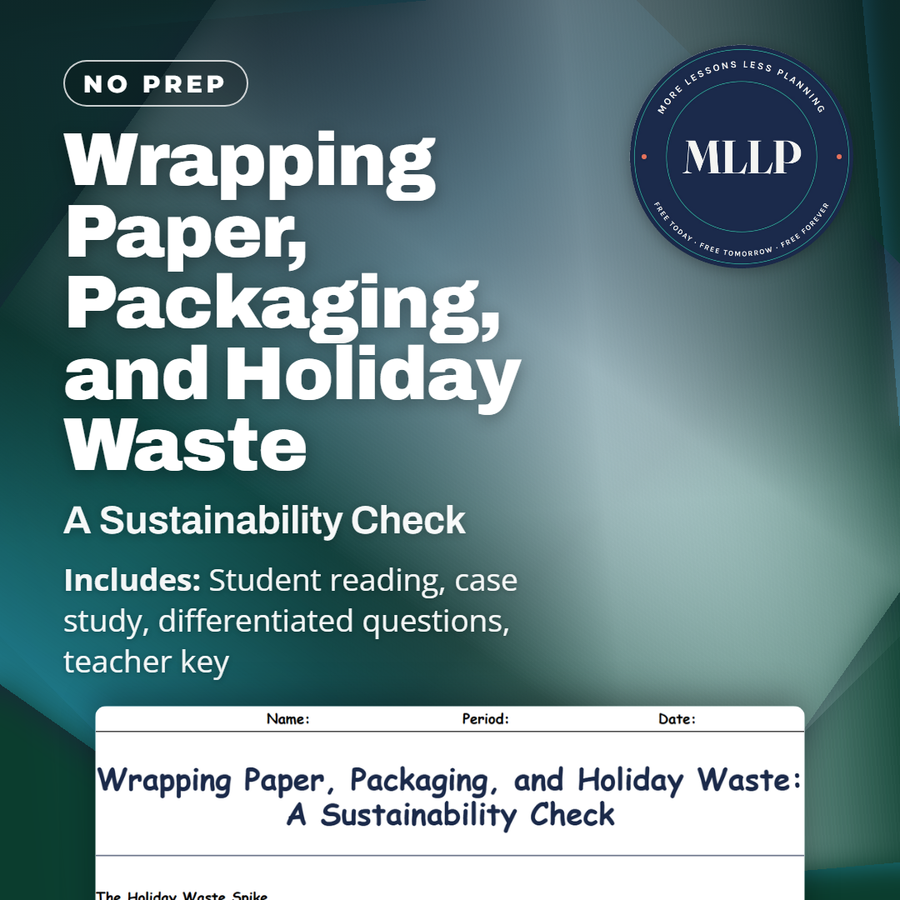
Wrapping Paper, Packaging, and Holiday Waste: A Sustainability Check
Quality reviewed September 2026
Facts verified September 9, 2026
- Subject
- Science
- Grades
- Grades 9-12
- Length
- 8-page student worksheet
- Time
- About one 50-minute class period
- Great for
- Sub plans and independent work
- Includes
- Reading passage, comprehension questions + full answer key
- Format
- Print-and-go PDF
What students do
- Distinguish between recyclable and non-recyclable holiday materials using a reference table
- Analyze how glitter, foil, and tape contaminate recycling streams
- Evaluate the environmental costs of packaging and product returns
- Explain wishcycling and propose solutions to reduce contamination
What it covers
- Holiday waste and municipal solid waste
- Single-stream recycling systems and contamination
- Sustainable alternatives to conventional gift wrapping
Start reading this worksheet
The Holiday Waste Spike
Every December, store shelves explode with wrapping paper, gift bags, ribbons, and boxes. At the same time, delivery trucks drop off piles of online orders, each wrapped in layers of cardboard, plastic air pillows, and foam. From the outside, the season looks colorful and generous. From the perspective of a landfill or recycling center, it looks like a sudden waste surge. In many communities, the amount of municipal solid waste (the everyday trash from homes and businesses) jumps noticeably between late November and early January. Why does this happen? One reason is simple volume. People buy more items, exchange more gifts, and receive more packages than at almost any other time of year. Another reason is packaging design. Many holiday products come with extra decorative boxes, plastic windows, or specialty inserts that make them look attractive on the shelf but are difficult to recycle. On top of that, many people host large gatherings, which means more disposable plates, cups, and food containers. All of those choices add extra bags to the curb on collection day. Environmental scientists are especially interested in what kind of waste increases. Paper products, cardboard, and certain types of plastic can be recycled, but only if they are clean, sorted correctly, and accepted by the local program. When holiday waste includes glittery paper, metallic foils, mixed materials, and food-covered containers, a big portion ends up in landfills or incinerators instead. Understanding the difference between what feels “recyclable” and what actually is recyclable is a key skill for anyone who wants to celebrate without creating quite so much trash.
What Really Happens to Wrapping Paper
At first glance, all wrapping paper looks like paper, so it must be recyclable, right? Unfortunately, the reality is more complicated. Standard, uncoated paper, like a simple printed tissue or a plain kraft paper roll, usually can be recycled if your community accepts mixed paper. But holiday wrapping often includes foil layers, plastic films, or heavy ink coatings that are difficult for paper mills to process. Some rolls even have a thin layer of plastic laminated to the surface to make them shiny and tear-resistant. That product still looks like “paper” to you, but to a recycling machine, it behaves more like a mixed material. Tape, ribbons, and glitter make things worse. When people leave long strips of tape or plastic bows attached to used paper, those non-paper materials can clog sorting equipment or weaken recycled pulp. Glitter and metallic inks introduce small plastic particles that don’t break down easily. From the perspective of a recycling center, this kind of wrapping becomes contamination: material that either has to be removed by hand or sent to the landfill. A lot of holiday waste also comes from gift bags and tissue paper. Many gift bags have plastic handles, metal grommets, or glossy coatings. Tissue paper is often dyed or so thin and low-quality that it doesn’t hold up well in the recycling process. Some communities accept it; others do not. Because rules vary, students and families need to check local guidelines instead of assuming that everything with a snowman on it belongs in the blue bin. Here is a simplified snapshot of common holiday materials and their typical recyclability (always check local rules):
Like what you read? The full reading, the case study, and every question set are in the free download below, along with the answer key.
Why this matters
A single recycling cart gets rejected at the curb, and the reason sits right on the tag: too much glitter and foil mixed in with the wrapping paper. That is Jordan's story, and it repeats on nearly every block for two weeks after the holidays.
Early January is when the blue bins in students' own neighborhoods are genuinely overflowing, which does most of the persuading before I say a word. After the materials table, I ask what happens if a whole town's holiday waste gets landfilled over one strip of foil and a piece of tape.
From one teacher to another
I save this worksheet for early January when blue bins are overflowing and collection trucks are backing up. Jordan's neighborhood and the rejected cart are real. Single-stream systems fail when too much glitter and plastic gets mixed in. Students fill out the materials table, then I ask them what would happen if their entire town's holiday waste got landfilled because of contamination. That question shifts their thinking from "I'm recycling" to "Am I recycling correctly?" They walk out ready to actually check local guidelines instead of guessing.
What you get
Download
Where should I send the next one?
Everything here is free and it stays that way. Leave your email and I'll send you the new lessons as they go up. You can unsubscribe from any one of them.
Related resources
Biology of Evergreen Plants: The Science Behind Christmas Trees
Body Clocks and Midnight Countdowns: Circadian Rhythms at New Year’s
Calendars, Orbits, and the Science of New Year’s Day
Christmas on the Home Front: WWII Rationing and Resilience
Colorful Chemistry: Holiday Lights, Fireworks, and the Science of Glow
Crowded Skies: Holiday Air Travel and the Environment
Every lesson on this site is free to download and use. If one of them saved you a prep period, you can chip in a few bucks toward my three kids' daycare fund. That's genuinely where tips go.