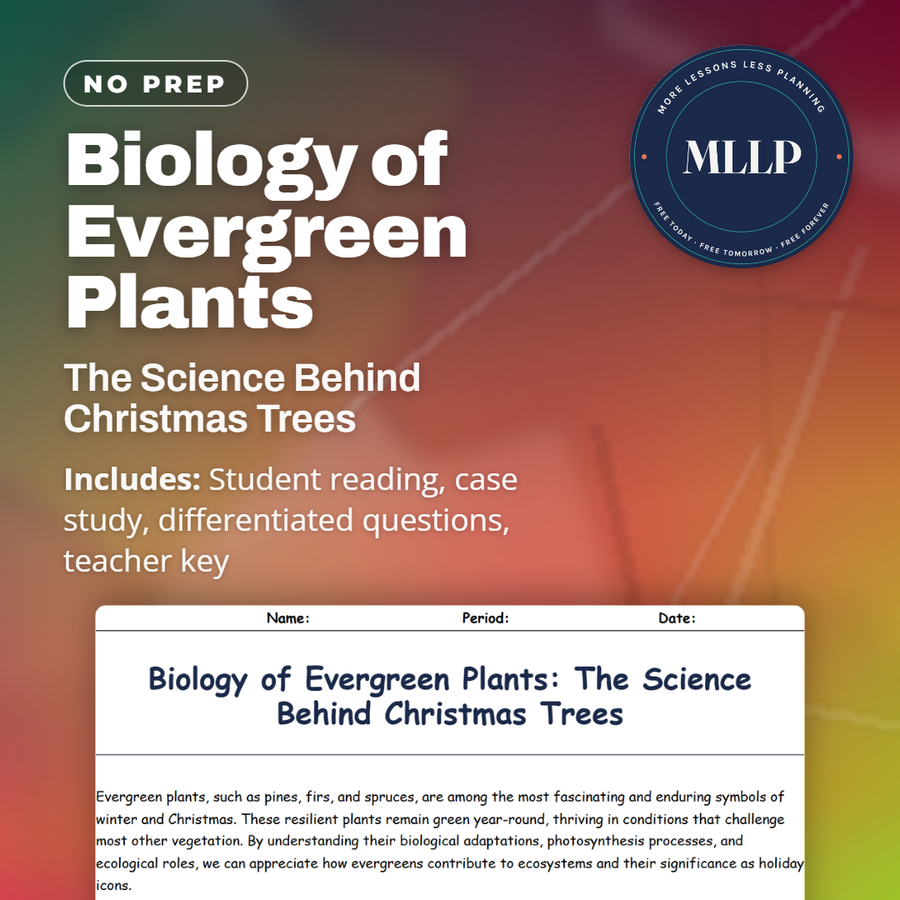
Biology of Evergreen Plants: The Science Behind Christmas Trees
Quality reviewed September 2026
Facts verified September 9, 2026
- Subject
- Science
- Grades
- Grades 9-12
- Length
- 7-page student worksheet
- Time
- About one 50-minute class period
- Great for
- Sub plans and independent work
- Includes
- Reading passage, comprehension questions + full answer key
- Format
- Print-and-go PDF
What students do
- Trace how evergreens use stored water and chlorophyll to photosynthesize during cold months
- Analyze adaptations like waxy coatings and conical shapes that help trees survive snow and dry winters
- Evaluate the ecological roles evergreens play as wildlife habitat and carbon absorbers
- Calculate and compare environmental benefits from urban trees using data from the case study
What it covers
- Evergreen plant biology and winter photosynthesis
- Structural and chemical adaptations to harsh climates
- Ecological services trees provide to ecosystems
Start reading this worksheet
Evergreen plants, such as pines, firs, and spruces, are among the most fascinating and enduring symbols of winter and Christmas. These resilient plants remain green year-round, thriving in conditions that challenge most other vegetation. By understanding their biological adaptations, photosynthesis processes, and ecological roles, we can appreciate how evergreens contribute to ecosystems and their significance as holiday icons.
Adaptations of Evergreen Plants
Evergreens have evolved to survive in some of the harshest climates, from snowy mountaintops to frigid boreal forests. Their needle-like leaves, coated in a waxy cuticle, minimize water loss during dry, cold winters. Unlike deciduous trees that shed leaves to conserve energy, evergreens rely on their durable needles to photosynthesize throughout the year. This continuous photosynthesis provides them with a steady energy supply, allowing them to stay alive and green. Another key adaptation is their slow growth rate. By conserving resources and growing gradually, evergreens maintain their structure and thrive in nutrient-poor soils. Additionally, the needles contain fewer stomata—small openings that allow for gas exchange—helping to prevent excess water loss and withstand freezing temperatures. Evergreens are also uniquely adapted to shed snow. Their conical shape and downward-sloping branches prevent heavy snow accumulation, reducing the risk of branch breakage. This design ensures they remain structurally sound, even during severe winters.
Photosynthesis in Winter
Photosynthesis is the process by which plants convert sunlight into energy, using carbon dioxide and water to produce glucose and oxygen. For evergreens, photosynthesis doesn’t stop during winter, though it slows significantly due to reduced sunlight and colder temperatures. This ability to continue photosynthesis gives them an edge in harsh climates where deciduous trees lie dormant. Evergreens utilize chlorophyll, the green pigment in their needles, to capture sunlight. While photosynthesis typically requires water, evergreens have adapted to use stored water in their needles during frozen conditions. Additionally, their needles' compact design helps retain heat and prevent frost damage, allowing the photosynthesis process to continue, albeit at a slower rate. During winter, evergreens prioritize survival over growth. This shift means they use the energy produced for maintenance rather than new tissue development. Their resilience in maintaining this process makes them a vital part of their ecosystems, particularly in supporting winter wildlife.
Like what you read? The full reading, the case study, and every question set are in the free download below, along with the answer key.
Why this matters
One mature Norway spruce in Vienna absorbs more than 35 pounds of carbon dioxide a year, making a Christmas tree a working organism long before anyone strings lights on it. Evergreens keep photosynthesizing through winter using stored water, waxy coatings, and a conical shape built to shed snow.
Trees get treated as scenery in most classrooms, something that just survives winter passively. Working with real air-filtration and respiratory-health data from the Vienna case study turns that picture active, a tree measurably filtering the air city residents breathe.
From one teacher to another
I use this worksheet right after students learn about plant survival strategies. The case study pulls from real research on Norway spruce trees in Vienna, showing how a single mature tree absorbs over 35 pounds of CO2 annually. Students get to work with actual data on air filtration and respiratory health impacts, which makes the connection between a Christmas tree and public health feel immediate and concrete.
What you get
Download
Where should I send the next one?
Everything here is free and it stays that way. Leave your email and I'll send you the new lessons as they go up. You can unsubscribe from any one of them.
Related resources

Body Clocks and Midnight Countdowns: Circadian Rhythms at New Year’s
Calendars, Orbits, and the Science of New Year’s Day
Christmas on the Home Front: WWII Rationing and Resilience
Colorful Chemistry: Holiday Lights, Fireworks, and the Science of Glow
Crowded Skies: Holiday Air Travel and the Environment
Environmental Science and the Holidays: Christmas Trees and Sustainability
Every lesson on this site is free to download and use. If one of them saved you a prep period, you can chip in a few bucks toward my three kids' daycare fund. That's genuinely where tips go.