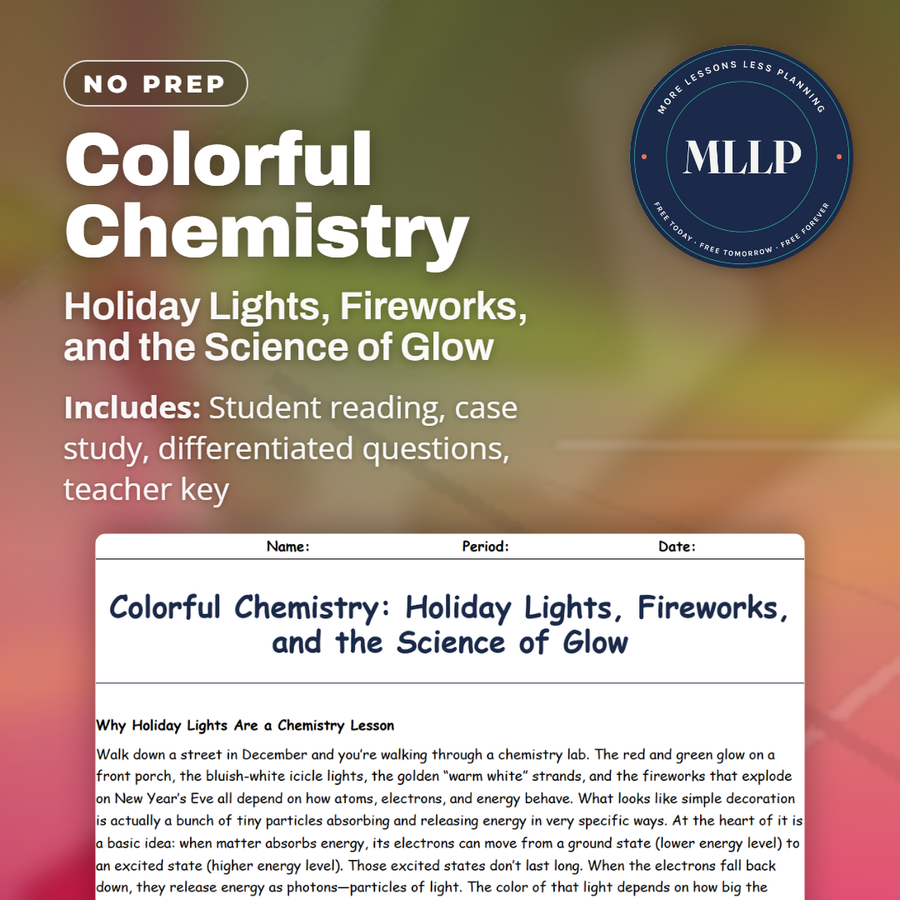
Colorful Chemistry: Holiday Lights, Fireworks, and the Science of Glow
Quality reviewed September 2026
Facts verified September 9, 2026
- Subject
- Science
- Grades
- Grades 9-12
- Length
- 8-page student worksheet
- Time
- About one 50-minute class period
- Great for
- Sub plans and independent work
- Includes
- Reading passage, comprehension questions + full answer key
- Format
- Print-and-go PDF
What students do
- Explain how electrons moving between energy levels produce the colors in LED lights and incandescent bulbs
- Compare blackbody radiation and semiconductor band gaps as two mechanisms for creating light
- Apply principles of metal ion chemistry to explain why different firework salts produce different colors
- Evaluate how temperature and chemical composition affected the students' firework design in the case study
What it covers
- Electron energy transitions and photon emission
- Chemistry of incandescent and LED lighting technology
- Metal ions, flame tests, and fireworks as applied chemistry
Start reading this worksheet
Why Holiday Lights Are a Chemistry Lesson
Walk down a street in December and you’re walking through a chemistry lab. The red and green glow on a front porch, the bluish-white icicle lights, the golden “warm white” strands, and the fireworks that explode on New Year’s Eve all depend on how atoms, electrons, and energy behave. What looks like simple decoration is actually a bunch of tiny particles absorbing and releasing energy in very specific ways. At the heart of it is a basic idea: when matter absorbs energy, its electrons can move from a ground state (lower energy level) to an excited state (higher energy level). Those excited states don’t last long. When the electrons fall back down, they release energy as photons, particles of light. The color of that light depends on how big the energy “drop” is. A large drop produces higher-energy, shorter-wavelength light (toward violet/blue). A smaller drop gives lower-energy, longer-wavelength light (toward red). Holiday technology uses this idea in different ways. Sometimes we heat a metal wire until it glows. Sometimes we use specially chosen metal ions that give off characteristic colors when excited. Sometimes we use semiconductors that release light when electrons move across a band gap. You don’t have to memorize every detail to appreciate the chemistry. But when you realize that each color on a tree or in the sky is tied to electron energy levels, you start to see holiday “magic” as carefully controlled science.
Incandescent Bulbs, LEDs, and the Nature of Light
Older strings of Christmas lights use incandescent bulbs. Inside each tiny bulb, a thin tungsten filament heats up when current flows through it. As it gets very hot, it emits a broad spectrum of light, a bit like a mini piece of the sun. This is called blackbody radiation. The hotter the filament, the more light it emits, and the color shifts slightly toward white or bluish-white. However, much of the energy is wasted as heat, which is why older lights feel hot to the touch and draw more electricity. Newer holiday lights mostly use LEDs (light-emitting diodes). LEDs don’t work by heating a filament. Instead, they use semiconductor materials. When a voltage is applied, electrons move across a p–n junction and “fall” across a band gap. Each fall releases a photon with a specific amount of energy. Because the band gap is carefully chosen, the LED can be designed to emit mainly one wavelength, such as red, green, or blue. “Warm white” LEDs often combine different colors or use a coating called a phosphor that absorbs high-energy light and re-emits lower-energy light to create a softer glow. From a chemistry standpoint, both types of bulbs are about converting electrical energy into light energy, but the efficiency is very different. Incandescents waste a lot of energy as infrared radiation and heat. LEDs are much more efficient because they target specific electronic transitions. That’s why a long string of LED lights can run for hours without getting hot or blowing out bulbs. When you compare them, you have a nice real-world example of how changing the underlying chemistry of a device can change its performance and its impact on your electric bill.
Firework Colors: Metal Ions and Electron Excitation
Fireworks are basically chemistry demonstrations launched into the sky. A typical aerial firework shell contains oxidizers (to provide oxygen), fuels, binders, and pellets called stars. Each star is a compact mix of metal salts and other ingredients. When the shell explodes, stars catch fire and heat up. As the metal ions in the stars are excited and then fall back to lower energy levels, they emit light at specific wavelengths, which our eyes see as distinct colors. Different metals give different colors because they have different electron configurations and energy level spacings. Strontium salts (like strontium carbonate) produce bright red. Barium compounds give green. Copper compounds can produce blue, although blue is tricky because it requires just the right temperature: too cool and the light is weak; too hot and the color washes out. Sodium salts produce an intense yellow, so strong that they can overwhelm other colors if you’re not careful with the formula. Extra ingredients can modify brightness, sparkle, and burn time. All of this happens in a fraction of a second as the star burns. Underneath the show, though, the same concepts you learn when you do a flame test in chemistry class are at work. In a flame test, a tiny bit of salt placed in a burner flame gives off a characteristic color. That is just a smaller, safer version of what’s happening in the sky. Fireworks simply scale up the process, pack it into stars, and choreograph it with timing fuses so multiple shells burst in patterns.
Like what you read? The full reading, the case study, and every question set are in the free download below, along with the answer key.
Why this matters
A blue and green firework sounds like one mixture, but it is two chemical problems in the same shell. Copper compounds burn at a lower temperature to show blue, while barium salts need more heat to glow green, so a chemistry team keeps them in separate layers or loses one color. The same electron transitions explain why an LED and an old bulb make light differently.
I teach this one in December, when students already walk past lit displays every night without a second thought. Once they know a firework's color comes down to which metal ion is burning and at what temperature, a light show stops being scenery and becomes a chemistry problem somebody had to solve on purpose.
From one teacher to another
This worksheet lands best in December. Students walk past holiday displays every day, and suddenly they can read the science in them. The case study is tight. The chemistry team had to separate blue and green into different layers because copper compounds decompose at temperatures where barium salts glow best. It's a real problem-solving arc that shows how chemistry drives engineering.
What you get
Download
Where should I send the next one?
Everything here is free and it stays that way. Leave your email and I'll send you the new lessons as they go up. You can unsubscribe from any one of them.
Related resources

Biology of Evergreen Plants: The Science Behind Christmas Trees
Body Clocks and Midnight Countdowns: Circadian Rhythms at New Year’s
Calendars, Orbits, and the Science of New Year’s Day

Christmas on the Home Front: WWII Rationing and Resilience

Crowded Skies: Holiday Air Travel and the Environment

Environmental Science and the Holidays: Christmas Trees and Sustainability
Every lesson on this site is free to download and use. If one of them saved you a prep period, you can chip in a few bucks toward my three kids' daycare fund. That's genuinely where tips go.