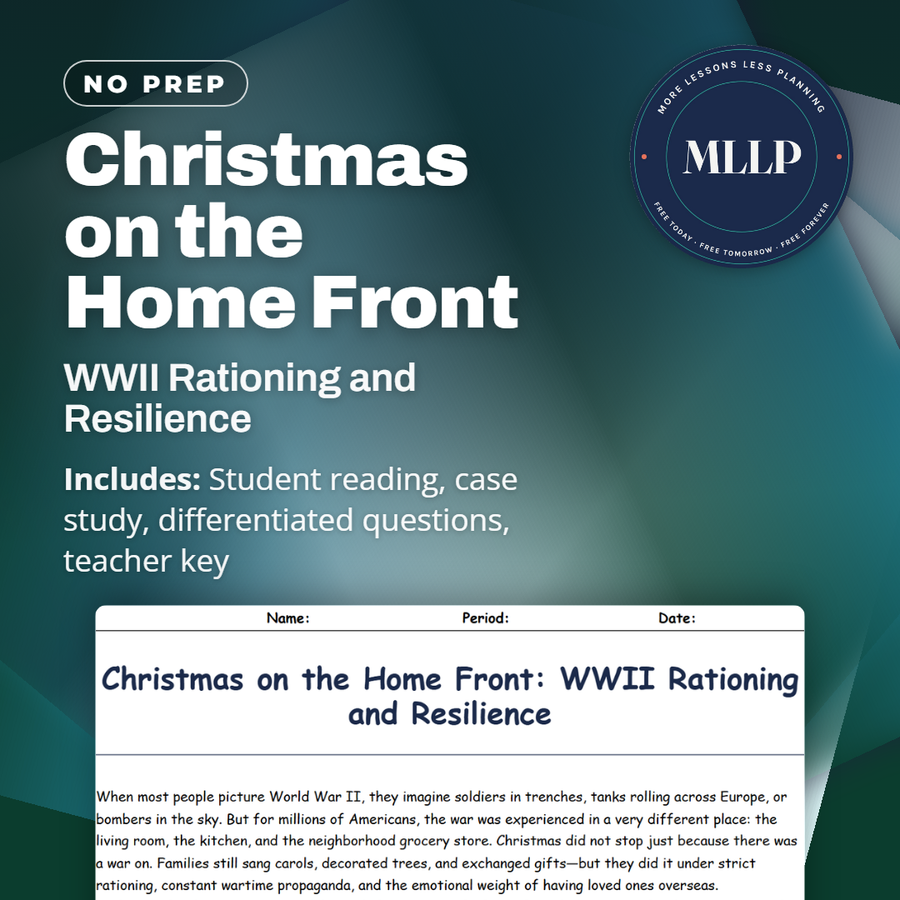
Christmas on the Home Front: WWII Rationing and Resilience
Quality reviewed September 2026
Facts verified September 9, 2026
- Subject
- Social Studies
- Grades
- Grades 9-12
- Length
- 9-page student worksheet
- Time
- About one 50-minute class period
- Great for
- Sub plans and independent work
- Includes
- Reading passage, comprehension questions + full answer key
- Format
- Print-and-go PDF
What students do
- Analyze how ration coupons changed holiday meals and gift-giving traditions during WWII
- Evaluate how the government used Christmas imagery and propaganda to reinforce wartime sacrifice
- Trace the connections between home front decisions and soldier morale in the case study letter
- Compare pre-war and wartime Christmas celebrations using specific examples from the passages
What it covers
- Home front rationing and economic constraints during World War II
- Wartime propaganda and civic messaging through holiday traditions
- Family and community adaptation to collective national goals
Start reading this worksheet
When most people picture World War II, they imagine soldiers in trenches, tanks rolling across Europe, or bombers in the sky. But for millions of Americans, the war was experienced in a very different place: the living room, the kitchen, and the neighborhood grocery store. Christmas did not stop just because there was a war on. Families still sang carols, decorated trees, and exchanged gifts. They did it under strict rationing, constant wartime propaganda, and the emotional weight of having loved ones overseas. Understanding how Americans celebrated Christmas on the home front helps us see that history is not only about battles and leaders; it is also about ordinary people adapting their traditions when the world changes. In late 1941, after the attack on Pearl Harbor, the United States fully entered WWII. Overnight, the economy shifted toward total war, and the federal government began asking citizens to “do their part.” By Christmas of 1942 and 1943, Americans were learning to balance festive traditions with wartime sacrifice. Sugar, butter, meat, and gasoline were limited. New toys made of metal or rubber were rare because factories were producing tanks, planes, and tires instead of dolls and bicycles. Yet many families refused to give up the holiday. They found creative ways to make Christmas feel special even when store shelves were half-empty and the news from overseas was frightening.
Ration Books, Coupons, and Creative Cooking
One of the biggest changes to daily life, and to Christmas, was the system of ration books. The government issued ration coupons for items like sugar, meat, coffee, canned goods, and gasoline. You could have enough money to buy a ham, but if you didn’t have the right stamps, the butcher couldn’t sell it to you. That meant Christmas dinner required planning months in advance. Families saved sugar coupons for holiday baking and traded recipes that used fewer restricted ingredients. Instead of large, meat-heavy feasts, some households focused on vegetable dishes, simple potato recipes, or smaller cuts of meat. Cookbooks and newspapers published “war recipes” that substituted ingredients: honey or corn syrup in place of sugar, or margarine instead of butter. Children grew up learning that every bit of fat, flour, and sugar mattered for the war effort. Gift-giving also changed. Instead of mass-produced metal toys, parents made homemade gifts: hand-sewn dolls, wooden toys, knitted scarves and mittens. Older kids sometimes received war bonds instead of toys: pieces of paper that promised a financial return in the future, but immediately helped fund the military. On the surface, this might not have felt as exciting as a new bike, but it tied children directly into the national effort. The message was clear: being a good citizen sometimes meant giving up personal wants for a shared goal.
Work, War Bonds, and Holiday Propaganda
Christmas on the home front didn’t just happen at home. It showed up in factories, offices, schools, and movie theaters. Millions of women stepped into jobs in war industries as “Rosie the Riveter” workers, building planes, ships, and ammunition. For them, Christmas might be squeezed in between long shifts at the factory. Employers sometimes organized simple parties with coffee, donuts, and small gifts, but there was no long vacation. Production quotas didn’t pause for the holidays. The government used Christmas as a powerful moment for propaganda. Posters and films reminded people to “Use it up, wear it out, make it do, or do without.” Cartoons and newsreels shown before movies told Americans to buy war bonds as the perfect patriotic gift. Even Santa was recruited: ads showed him arriving not in a sleigh full of toys, but with a bag of war stamps and bonds, urging children and parents to support the troops. At the same time, radio programs and newspapers highlighted stories of soldiers celebrating Christmas overseas with small trees, simple meals, and letters from home. This coverage had a double effect. It reminded civilians of the sacrifices being made far away, and it encouraged them to accept shortages and rationing without complaining. If soldiers could have a cheerful Christmas in a muddy foxhole, the logic went, Americans at home could handle a few missing luxuries.
Like what you read? The full reading, the case study, and every question set are in the free download below, along with the answer key.
Why this matters
Rationing changed what a Christmas gift or dinner could be during the war, not whether either happened. Families saved sugar coupons for weeks to bake one batch of cookies, and toys got built from scrap wood instead of bought off a shelf. The holiday did not disappear under wartime shortages. It got rebuilt out of less.
Students who read Joe's letter to his brother stop treating ration coupons as rules on paper and start seeing how far home front sacrifice reached, all the way to a soldier overseas. Several ask, by the end, why we don't talk about that kind of sacrifice this way anymore.
From one teacher to another
My students are surprised by this one. They expect Christmas during the war to have "disappeared," but the passage shows families getting creative instead. Saving sugar coupons for one precious batch of cookies, making toys from scrap wood. The letter from Joe to his brother carries real weight. By the time students finish the case study questions, they're asking why we don't talk about wartime sacrifice in quite that way anymore.
What you get
Download
Where should I send the next one?
Everything here is free and it stays that way. Leave your email and I'll send you the new lessons as they go up. You can unsubscribe from any one of them.
Related resources
Biology of Evergreen Plants: The Science Behind Christmas Trees
Body Clocks and Midnight Countdowns: Circadian Rhythms at New Year’s
Calendars, Orbits, and the Science of New Year’s Day
Colorful Chemistry: Holiday Lights, Fireworks, and the Science of Glow
Crowded Skies: Holiday Air Travel and the Environment
Environmental Science and the Holidays: Christmas Trees and Sustainability
Every lesson on this site is free to download and use. If one of them saved you a prep period, you can chip in a few bucks toward my three kids' daycare fund. That's genuinely where tips go.