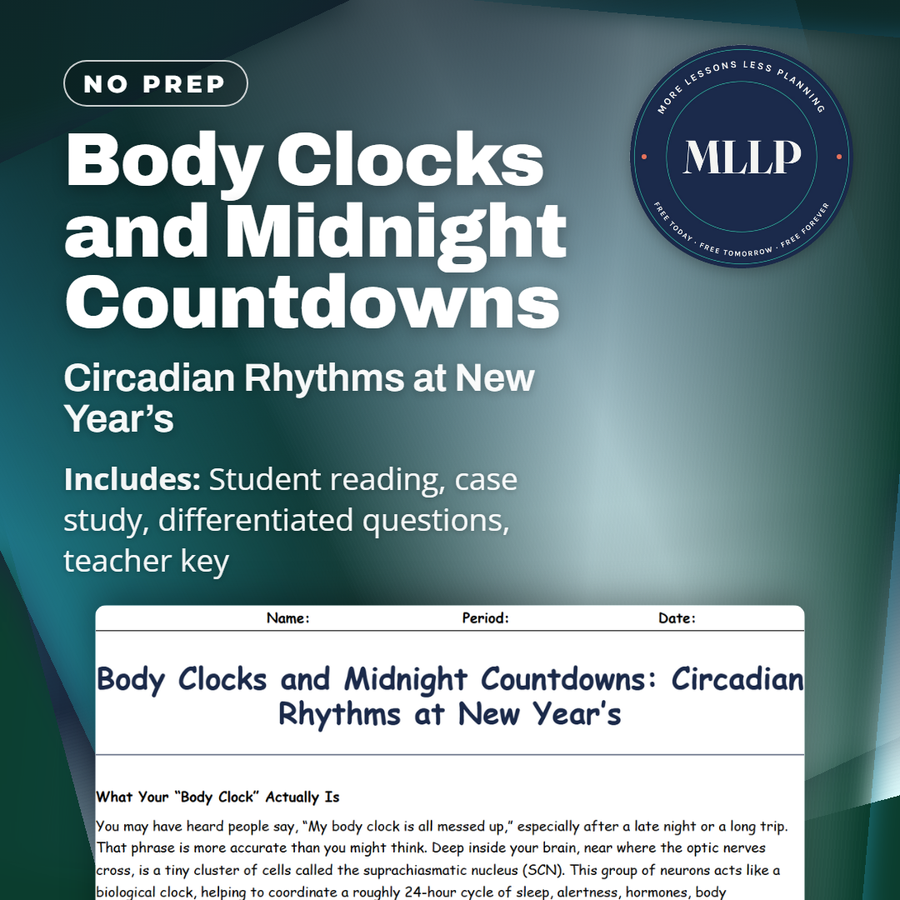
Body Clocks and Midnight Countdowns: Circadian Rhythms at New Year’s
Quality reviewed September 2026
Facts verified September 9, 2026
- Subject
- Science
- Grades
- Grades 9-12
- Length
- 8-page student worksheet
- Time
- About one 50-minute class period
- Great for
- Sub plans and independent work
- Includes
- Reading passage, comprehension questions + full answer key
- Format
- Print-and-go PDF
What students do
- Explain how the suprachiasmatic nucleus uses light to time melatonin release
- Analyze which of Amir's New Year's Eve choices delayed his body clock
- Apply the idea of social jet lag to a schedule that shifts by several hours
- Match terms like circadian rhythm, melatonin, and blue light to their definitions
What it covers
- What the body clock is and how light sets it
- Late nights, screens, and the New Year's time warp
- Habits that reset a rhythm after the holiday
Start reading this worksheet
What Your “Body Clock” Actually Is
You may have heard people say, “My body clock is all messed up,” especially after a late night or a long trip. That phrase is more accurate than you might think. Deep inside your brain, near where the optic nerves cross, is a tiny cluster of cells called the suprachiasmatic nucleus (SCN). This group of neurons acts like a biological clock, helping to coordinate a roughly 24-hour cycle of sleep, alertness, hormones, body temperature, and even digestion. Scientists call this daily rhythm your circadian rhythm (from Latin roots meaning “about a day”). Your circadian system is strongly influenced by light, especially natural daylight. In the morning, light entering your eyes signals the SCN to quiet down the production of melatonin, a hormone that helps you feel sleepy. As evening approaches and light levels drop, melatonin rises, making it easier to fall asleep. This rhythm doesn’t just affect whether you feel tired; it also influences your reaction time, mood, and even how well your immune system functions. When your body clock and your schedule are aligned, you generally feel more alert in the day and more ready to sleep at night. However, the clock is not a rigid machine. It can shift in response to your habits. Staying up late, sleeping in, or staring at bright screens at night can push your rhythm later, especially if you repeat those behaviors often. Teenagers are already naturally wired for a slightly later schedule due to changes in melatonin timing during adolescence. That’s one reason early school start times can feel brutal: your biology and your alarm clock are quietly arguing every morning.
Late Nights, Blue Light, and the New Year’s “Time Warp”
New Year’s Eve combines several perfect ingredients for circadian disruption: staying up past midnight, using phones and TVs late into the night, eating and drinking at unusual hours, and sometimes waking up much later the next day. None of these behaviors is automatically harmful in a one-time dose, but together they can throw off your internal timing, especially if your sleep is already inconsistent. Electronic screens emit blue light, which your eyes and brain treat a bit like daylight. When you scroll through social media at 11:30 p.m. waiting for the countdown, that light tells your SCN, “It’s still daytime, stay awake.” As a result, melatonin release can be delayed, making it harder to fall asleep even after the fireworks are over. If you then sleep until noon, your body receives an even stronger message to shift later. Students sometimes experience what researchers call social jet lag, a mismatch between their biological clock and their school or work schedule, similar to traveling across time zones without ever leaving town. You might notice the effects of these shifts in the days after New Year’s: trouble falling asleep at your usual bedtime, grogginess in the morning, low motivation, or feeling “off” in your mood. These are not just personality issues; they’re signs that your circadian rhythm is trying to re-sync. Here’s a summary of how common New Year’s habits interact with your body clock: Understanding these patterns doesn’t mean you can never celebrate. It does mean you can make more informed choices about how extreme you want your “time warp” to be, and how quickly you’ll be able to reset afterward.
Body Clocks, Health, and Long-Term Patterns
Scientists are increasingly interested in how chronic circadian disruption, not just one late night but repeated schedule shifts, affects health. Studies suggest that people whose schedules regularly conflict with their body clocks (such as night-shift workers) may have higher risks of sleep disorders, metabolic problems, and mood disturbances. For students, the most noticeable effects are usually short-term: lower alertness, poorer memory on tests, and more difficulty regulating emotions when stressed. Your body’s systems are interconnected. When your circadian rhythm is stable, hormones like cortisol and melatonin follow predictable patterns, helping you wake up, stay alert, and wind down. When your timing is chaotic, with bedtimes changing by several hours from weekday to weekend plus irregular light exposure, those hormone patterns become noisy. You might find yourself craving sugar and caffeine to wake up, then struggling to fall asleep later, creating a loop that is hard to break. The good news is that body clocks can be nudged back into balance. Morning light exposure, regular wake-up times (even on weekends), and winding down without screens before bed all help your SCN reset. This doesn’t mean you must live like a robot. It means that the more consistent your baseline habits are, the more easily you can handle an occasional late-night celebration, like New Year’s, without dragging your foggy brain through the entire first week of January.
Like what you read? The full reading, the case study, and every question set are in the free download below, along with the answer key.
Why this matters
Why does one late night wreck an entire week? Amir stays up until 3 a.m. on New Year's Eve, sleeps until noon, then can't fall asleep the next night at his normal time. By Monday he feels like he's coming down with a cold, and that's social jet lag, not a coincidence.
Every student I teach has lived some version of Amir's week but can't name what happened inside his body. Learning how the suprachiasmatic nucleus uses light to time melatonin release lets them point to the exact choices, the screens, the late bedtime, that pushed his clock later, and plan a smarter countdown night.
From one teacher to another
Amir goes to bed at 3 a.m. on New Year's Eve, sleeps until noon, and then cannot fall asleep the next night at his normal time. By Monday morning he feels like he has a cold. That case study is the whole lesson in miniature, because students have all lived it and none of them can explain it. The reading gives them the suprachiasmatic nucleus, melatonin timing, and the term social jet lag, then asks them to point at the exact choices that pushed his clock later. The last questions have them plan a countdown night that does not cost them the first week of January.
What you get
Download
Where should I send the next one?
Everything here is free and it stays that way. Leave your email and I'll send you the new lessons as they go up. You can unsubscribe from any one of them.
Related resources
Biology of Evergreen Plants: The Science Behind Christmas Trees
Calendars, Orbits, and the Science of New Year’s Day
Christmas on the Home Front: WWII Rationing and Resilience
Colorful Chemistry: Holiday Lights, Fireworks, and the Science of Glow
Crowded Skies: Holiday Air Travel and the Environment
Environmental Science and the Holidays: Christmas Trees and Sustainability
Every lesson on this site is free to download and use. If one of them saved you a prep period, you can chip in a few bucks toward my three kids' daycare fund. That's genuinely where tips go.