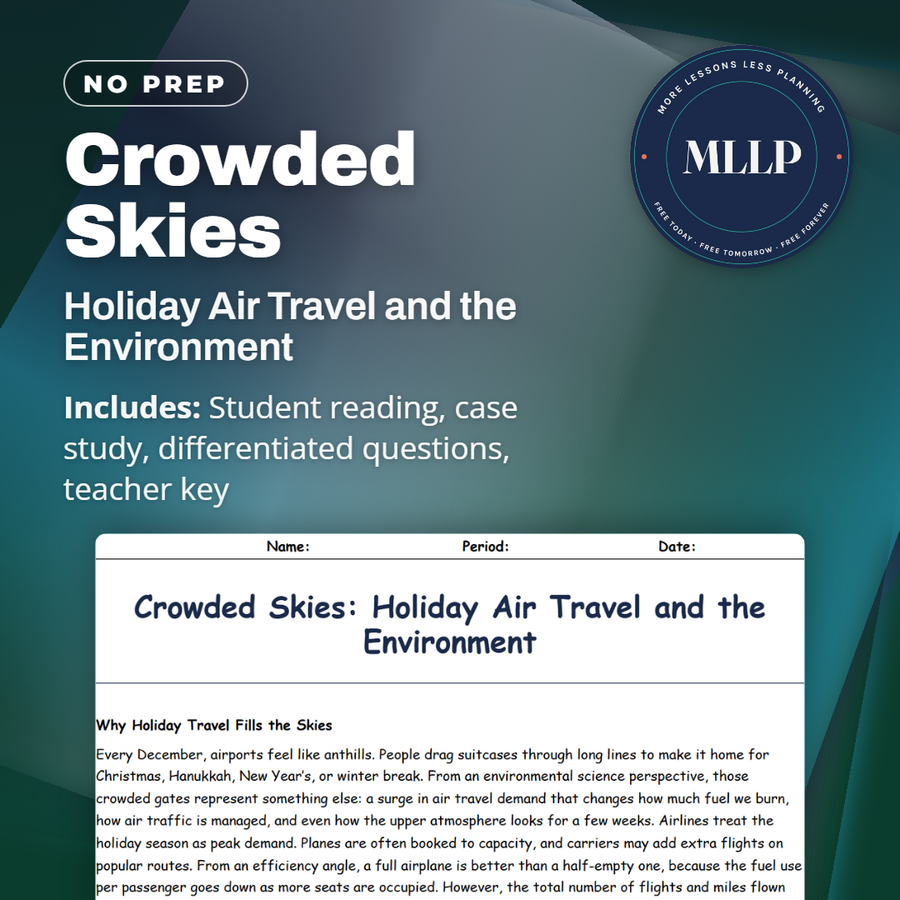
Crowded Skies: Holiday Air Travel and the Environment
Quality reviewed September 2026
Facts verified September 9, 2026
- Subject
- Science
- Grades
- Grades 9-12
- Length
- 8-page student worksheet
- Time
- About one 50-minute class period
- Great for
- Sub plans and independent work
- Includes
- Reading passage, comprehension questions + full answer key
- Format
- Print-and-go PDF
What students do
- Explain how jet fuel combustion and contrail formation contribute to climate change and radiation balance
- Analyze the connection between holiday flight demand and increased total emissions during peak travel seasons
- Evaluate trade-offs between personal travel choices and larger airline systems and climate policy
- Calculate environmental impacts using carbon footprint data from the Rivera family case study
What it covers
- Aviation emissions, greenhouse gases, and atmospheric chemistry
- Contrails and cirrus clouds as human-influenced climate factors
- Individual decisions within large transportation systems
Start reading this worksheet
Why Holiday Travel Fills the Skies
Every December, airports feel like anthills. People drag suitcases through long lines to make it home for Christmas, Hanukkah, New Year’s, or winter break. From an environmental science perspective, those crowded gates represent something else: a surge in air travel demand that changes how much fuel we burn, how air traffic is managed, and even how the upper atmosphere looks for a few weeks. Airlines treat the holiday season as peak demand. Planes are often booked to capacity, and carriers may add extra flights on popular routes. From an efficiency angle, a full airplane is better than a half-empty one, because the fuel use per passenger goes down as more seats are occupied. However, the total number of flights and miles flown usually rises during the holidays, so the overall carbon dioxide (CO₂) emissions from air travel also increase. Most commercial jets burn jet fuel, a type of kerosene. When it burns, it releases CO₂, water vapor, nitrogen oxides (NOₓ), and small particles into the upper troposphere and lower stratosphere. These emissions don’t just vanish; they interact with the atmosphere in ways that affect climate, air quality, and even the appearance of the sky. Understanding what happens above the clouds helps us see the difference between a simple family trip and the global footprint of holiday travel.
Contrails, Clouds, and Climate
If you’ve ever looked up on a clear winter day and seen white streaks crisscrossing the sky, you’ve seen contrails, short for “condensation trails.” They form when hot, moist exhaust from jet engines mixes with very cold air high in the atmosphere. The water vapor in the exhaust condenses and freezes around tiny particles, creating line-shaped ice clouds. Contrails can fade quickly or spread out into wider cirrus-like clouds. These artificial clouds matter for climate because they interact with radiation. During the day, they can reflect some incoming sunlight back to space, slightly cooling the surface. At night, they can trap outgoing infrared radiation, acting a bit like a blanket and contributing to warming. Overall, scientists think contrails and the clouds they help form have a net warming effect, especially on busy flight corridors. Winter and nighttime flights are particularly important. A contrail that persists after sunset can trap heat when there is no sunlight to reflect. Holiday travel peaks often include many evening and red-eye flights, creating more opportunities for these long-lasting contrail clouds. While a single flight’s effect is tiny, the combined impact of thousands of planes flying similar routes can be large enough for climate scientists to study, and for policymakers to consider when discussing aviation’s role in climate change. This table shows that the “environmental cost” of a holiday trip isn’t just the flight itself. It includes what happens around airports, in the atmosphere above flight paths, and in the climate system as a whole.
Delays, Weather, and Extra Fuel Burn
Holiday travel is famous for delays: snowstorms, fog, de-icing, runway backups, and long security lines. From an environmental perspective, delay often means extra fuel burn. If planes are forced into holding patterns, circling near the airport while waiting for a landing slot, they burn more fuel than originally planned. On the ground, aircraft may idle in long lines waiting for takeoff clearance, emitting pollutants near densely populated areas. Winter conditions create additional challenges. De-icing uses chemicals sprayed on aircraft surfaces to remove ice and prevent new ice from forming before takeoff. While necessary for safety, these chemicals can wash off and enter surrounding soil and water, so airports must manage runoff carefully. Weather-related re-routing, sending planes around storms, can increase total flight distance, further raising emissions. It’s easy to see a delayed flight only as a personal inconvenience: missed connections, long hours in uncomfortable chairs, cold pizza in the terminal. Environmental science pushes us to ask another question: how does this disruption change the actual emissions profile of holiday air travel? When many flights are delayed at once, small additions in fuel burn can add up across an entire region.
Like what you read? The full reading, the case study, and every question set are in the free download below, along with the answer key.
Why this matters
A student flying home for the holidays rarely thinks about the math behind that flight. Elena, the student in this case study, did the calculation anyway: one round trip flight per person comes out to roughly a metric ton of CO2, and that number sat with her longer than she expected. Contrails from that same flight add to the climate impact too.
My students expect this reading to end with a guilt trip about canceling travel, and it doesn't. What changes is how they weigh a decision, a nonstop flight against one with a layover, transit to the airport against a car left in long-term parking. By the end they hold both truths, that travel matters and that it carries a real cost.
From one teacher to another
The case study features Elena, a student who got uncomfortable with the math: one round-trip flight per person, roughly one metric ton of CO2. That discomfort is honest. The worksheet doesn't ask kids to cancel travel; it asks them to think clearly about the footprint and consider real alternatives like nonstop flights and public transit to the airport.
What you get
Download
Where should I send the next one?
Everything here is free and it stays that way. Leave your email and I'll send you the new lessons as they go up. You can unsubscribe from any one of them.
Related resources
Biology of Evergreen Plants: The Science Behind Christmas Trees
Body Clocks and Midnight Countdowns: Circadian Rhythms at New Year’s
Calendars, Orbits, and the Science of New Year’s Day
Christmas on the Home Front: WWII Rationing and Resilience
Colorful Chemistry: Holiday Lights, Fireworks, and the Science of Glow
Environmental Science and the Holidays: Christmas Trees and Sustainability
Every lesson on this site is free to download and use. If one of them saved you a prep period, you can chip in a few bucks toward my three kids' daycare fund. That's genuinely where tips go.