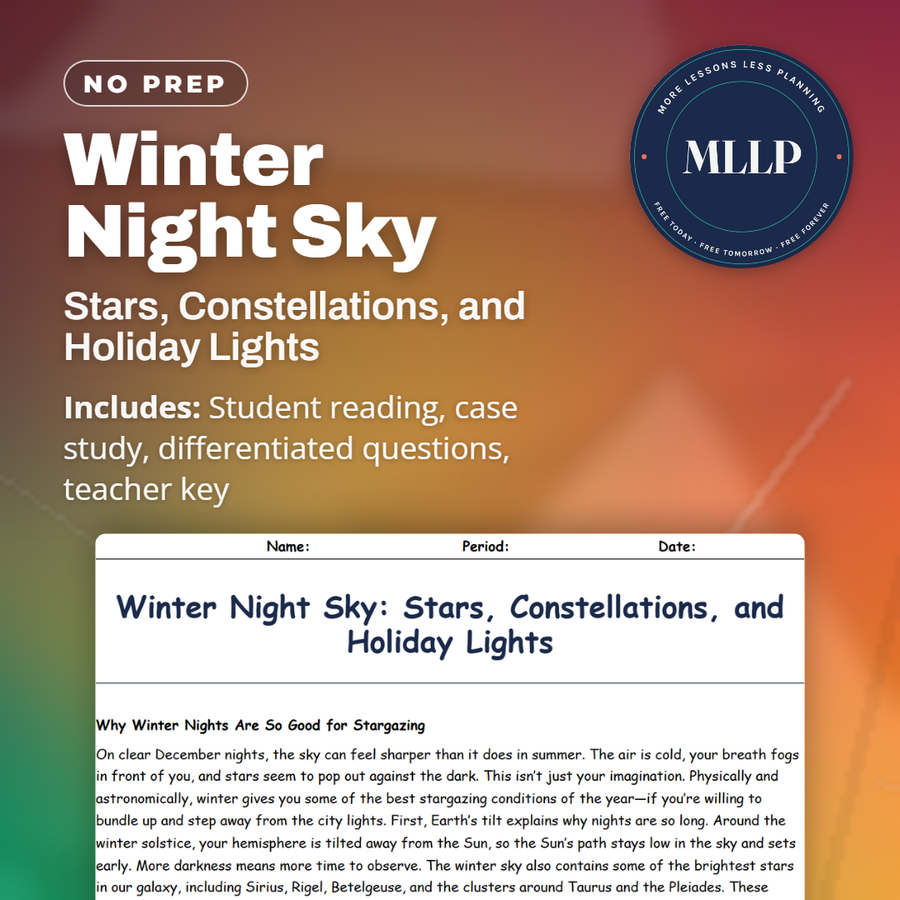
Winter Night Sky: Stars, Constellations, and Holiday Lights
Quality reviewed September 2026
Facts verified September 9, 2026
- Subject
- Science
- Grades
- Grades 9-12
- Length
- 8-page student worksheet
- Time
- About one 50-minute class period
- Great for
- Sub plans and independent work
- Includes
- Reading passage, comprehension questions + full answer key
- Format
- Print-and-go PDF
What students do
- Identify winter constellations and use Orion as a navigation guide
- Explain how Earth's tilt and orbit determine which stars are visible in December
- Evaluate the trade-off between holiday lights and dark-sky observing
- Analyze light pollution effects on astronomy, energy, and wildlife
What it covers
- Winter constellations and bright stars
- Earth's rotation and seasonal sky views
- Light pollution and environmental impact
Start reading this worksheet
Why Winter Nights Are So Good for Stargazing
On clear December nights, the sky can feel sharper than it does in summer. The air is cold, your breath fogs in front of you, and stars seem to pop out against the dark. This isn’t just your imagination. Physically and astronomically, winter gives you some of the best stargazing conditions of the year, if you’re willing to bundle up and step away from the city lights. First, Earth’s tilt explains why nights are so long. Around the winter solstice, your hemisphere is tilted away from the Sun, so the Sun’s path stays low in the sky and sets early. More darkness means more time to observe. The winter sky also contains some of the brightest stars in our galaxy, including Sirius, Rigel, Betelgeuse, and the clusters around Taurus and the Pleiades. These stars belong to patterns called constellations, which humans have used for navigation, storytelling, and calendars long before modern telescopes existed. Cold air can also improve seeing (how steady the atmosphere is) because it tends to hold less moisture than warm, humid air. Less moisture can mean crisper stars and fewer hazy halos around bright objects. Of course, winter clouds, storms, and early bedtimes can get in the way, but on the right night, the combination of long darkness and bright constellations makes December and January an excellent “lab” for an astronomy lesson. This is especially true when people are talking about the “Star of Bethlehem” or counting down to New Year’s under the sky.
Orion, Sirius, and the Geometry of the Winter Sky
If you walk outside on a clear winter evening and look toward the southern sky (in the Northern Hemisphere), one constellation almost always steals the show: Orion the Hunter. Orion is easy to recognize. Three stars in a short line form Orion’s belt. Above the belt are two bright stars marking his shoulders: Betelgeuse, a red supergiant, and Bellatrix. Below the belt are two more stars for his knees and feet, including Rigel, a blue-white supergiant. Orion is not just pretty; it’s a useful navigation tool. If you follow the line of the belt down and to the left, it points almost directly at Sirius, the brightest star in the night sky, located in the constellation Canis Major (the Great Dog). If you trace the belt the other way, up and to the right, it leads toward Aldebaran in Taurus, and near it the Pleiades star cluster, often called the “Seven Sisters.” With just Orion’s belt, you can hop from constellation to constellation across the winter sky. Astronomers also pay attention to how high a constellation appears. This depends on your latitude and the time of night. Orion is best placed in the evening during winter because of Earth’s orbit around the Sun. As Earth moves, the nighttime side of the planet faces different directions in space, revealing different “backgrounds” of stars. That’s why winter constellations are seasonal: you can’t see Orion at midnight in July because that part of the sky is turned toward the Sun in summer. The geometry of Earth’s tilt and orbit quietly controls which stars become the “cast” of your holiday sky. Learning to “read” this table in the field can turn a cold walk to a holiday party into an informal astronomy lab. Instead of just seeing “a bunch of stars,” you’ll recognize patterns, directions, and distances that tell you where Earth is in its orbit and what time of year it must be.
Like what you read? The full reading, the case study, and every question set are in the free download below, along with the answer key.
Why this matters
A power outage is the worst thing that happens to Maya's evening and the best thing that happens to her view of the sky. With the streetlights out, Orion and the Pleiades appear in a way holiday lights normally wash out completely.
The sky outside the window matches the page every time I assign this, since December is when Orion and the Pleiades are actually up there to find. Spotting the Pleiades with averted vision turns into a real argument about whether dim streetlights are worth losing half the visible sky.
From one teacher to another
I teach this worksheet in December when the evening sky is full of Orion and the Pleiades, and the timing does half the work. Maya's power-outage story resonates because students realize that the holiday lights they love are also washing out half the sky. We talk about how to observe the Pleiades using averted vision, what constellations appear only in winter, and whether dim streetlights are worth the cost. It's astronomy and environmental science rolled together in a way that feels immediate and personal.
What you get
Download
Where should I send the next one?
Everything here is free and it stays that way. Leave your email and I'll send you the new lessons as they go up. You can unsubscribe from any one of them.
Related resources
Biology of Evergreen Plants: The Science Behind Christmas Trees
Body Clocks and Midnight Countdowns: Circadian Rhythms at New Year’s
Calendars, Orbits, and the Science of New Year’s Day
Christmas on the Home Front: WWII Rationing and Resilience
Colorful Chemistry: Holiday Lights, Fireworks, and the Science of Glow
Crowded Skies: Holiday Air Travel and the Environment
Every lesson on this site is free to download and use. If one of them saved you a prep period, you can chip in a few bucks toward my three kids' daycare fund. That's genuinely where tips go.