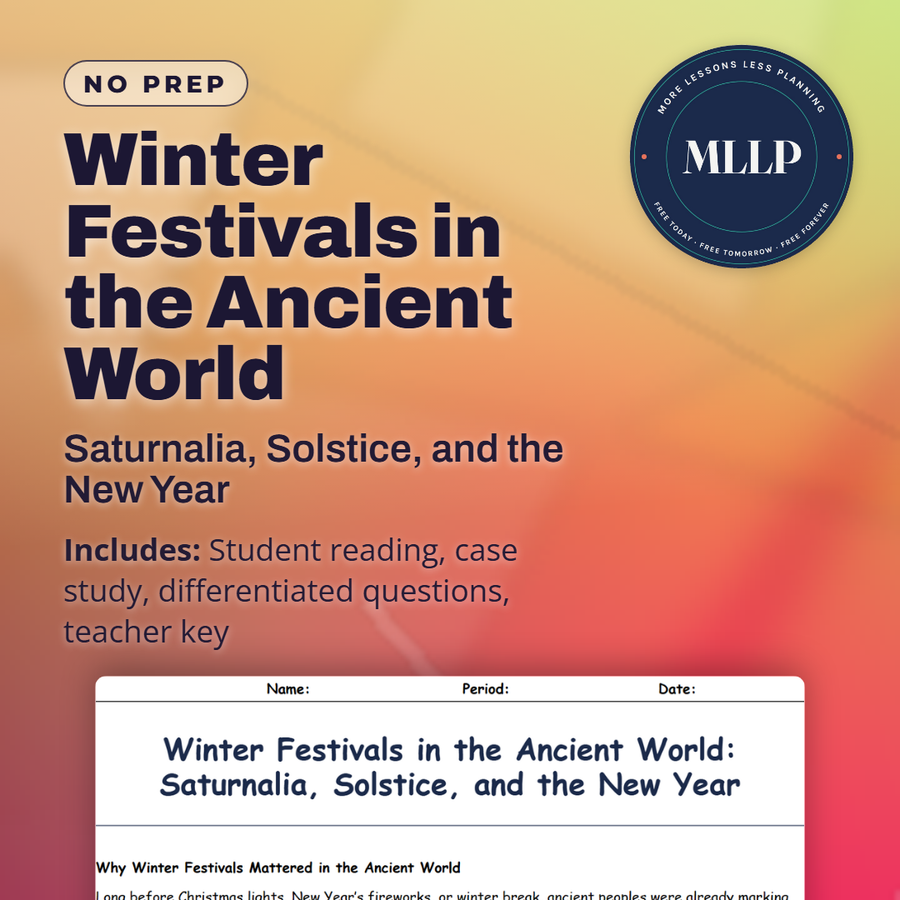
Winter Festivals in the Ancient World: Saturnalia, Solstice, and the New Year
Quality reviewed September 2026
Facts verified September 9, 2026
- Subject
- Social Studies
- Grades
- Grades 9-12
- Length
- 8-page student worksheet
- Time
- About one 50-minute class period
- Great for
- Sub plans and independent work
- Includes
- Reading passage, comprehension questions + full answer key
- Format
- Print-and-go PDF
What students do
- Analyze why ancient societies held festivals around the winter solstice
- Compare role reversal in Saturnalia to modern holiday customs
- Evaluate how Roman rulers used festivals to maintain social order
- Trace cultural diffusion of winter festival traditions across ancient civilizations
What it covers
- Saturnalia and Roman winter celebrations
- Religious and political purposes of festivals
- Ancient New Year traditions across cultures
Start reading this worksheet
Why Winter Festivals Mattered in the Ancient World
Long before Christmas lights, New Year’s fireworks, or winter break, ancient peoples were already marking the darkest days of the year with festivals, feasts, and rituals. For farming societies, winter was a time of real risk: shorter days, colder temperatures, and limited food stores. Watching the Sun sink lower on the horizon could feel like watching life itself fade. Festivals around the winter solstice (the shortest day and longest night of the year) were a way to cope with fear, celebrate survival, and hope for the Sun’s return. Winter celebrations were never just about astronomy. They pulled together religion, politics, and community life. Rulers used festivals to reward loyalty, distribute food, and show generosity. Priests and priestesses used rituals to honor gods and ask for protection. Ordinary people used them as rare breaks from hard work. When we look at modern Christmas and New Year’s traditions (gift-giving, parties, and ideas of “new beginnings”), we can still see traces of these ancient winter festivals in the background. Studying them gives us a richer sense of how people across time have faced the same basic questions: How do we get through the dark part of the year? And how do we mark the moment when light begins to return?
Saturnalia: Role Reversal and Roman Joy
In ancient Rome, the most famous winter festival was Saturnalia, honoring the god Saturn. Originally tied to the agricultural calendar, Saturnalia began as a single day but eventually expanded into a multi-day celebration in December. Romans decorated their homes with evergreen branches, lit candles, and wore bright clothing instead of the dark, formal togas used for serious business. One of the most striking features of Saturnalia was role reversal. Social rules relaxed. Masters served meals to their slaves, and everyone, at least in theory, was allowed to speak more freely. People greeted each other with the phrase “Io Saturnalia!” and exchanged gifts, especially small items like candles and figurines. Gambling, usually frowned upon, was tolerated. Even schools and courts often closed, giving students and workers a break. For the Roman state, Saturnalia had political advantages. A festival that allowed temporary disorder could actually help maintain order the rest of the year. Letting people blow off steam in December made it easier to ask for obedience in January. For everyday Romans, the festival offered warmth, humor, and a chance to imagine a more equal world, even if only for a few days. When historians and students compare Saturnalia to modern winter holidays, they often notice familiar themes: gift-giving, time off work, and moments when strict routines are softened in the name of celebration.
Sol Invictus, Calendars, and the Solstice
Later in Roman history, another winter celebration rose in importance: the festival of Sol Invictus, the “Unconquered Sun.” As the empire expanded, Rome absorbed gods and rituals from many cultures. Sun worship was common across the Mediterranean world. A festival near the winter solstice fit naturally with the idea that the Sun, after “losing” to darkness, was now beginning to win again as days slowly lengthened. At the same time, Romans were adjusting their calendar. The older lunar calendar, based on the cycles of the Moon, often drifted away from the seasons unless officials added extra days. Reforms under Julius Caesar created the Julian calendar, which followed the Sun’s apparent path more closely. Placing important celebrations around the solstice helped anchor the year and connect political life to cosmic order. Later, as Christianity spread through the empire, church leaders debated when to celebrate the birth of Jesus. The Bible does not give a precise date, but by the 300s CE, December 25 had become associated with Christmas in parts of the Christian world. Some historians argue that choosing a date near Sol Invictus and Saturnalia made it easier for people to shift from old festivals to new ones without giving up winter celebrations altogether. Whether or not that was the main reason, it is clear that ancient solstice traditions helped shape the calendar of holidays many people still use today.
Like what you read? The full reading, the case study, and every question set are in the free download below, along with the answer key.
Why this matters
Romans gave themselves the day off and swapped presents during Saturnalia two thousand years before Secret Santa had a name. For one stretch of days, masters served their own slaves, a reversal unthinkable any other week of the year.
Students split into two camps over why a society would flip its own power structure for a few days: a genuine safety valve, or a controlled release that kept rulers safer the rest of the year. Marcus's letter reads like an actual teenager complaining about chores, which usually convinces the skeptics.
From one teacher to another
When I teach Saturnalia, I watch students realize that Romans were doing Secret Santa and giving themselves the day off over two thousand years ago. The role reversal part, masters serving slaves, hits hard. We talk about why a society would deliberately flip power for a few days, and students defend both the social safety valve argument and the cynical idea that it just lets people blow off steam so rulers stay safe. Marcus's letter in the case study is written like an actual teen, so they buy in. This worksheet makes the ancient world feel immediate, not distant.
What you get
Download
Where should I send the next one?
Everything here is free and it stays that way. Leave your email and I'll send you the new lessons as they go up. You can unsubscribe from any one of them.
Related resources
Biology of Evergreen Plants: The Science Behind Christmas Trees
Body Clocks and Midnight Countdowns: Circadian Rhythms at New Year’s
Calendars, Orbits, and the Science of New Year’s Day
Christmas on the Home Front: WWII Rationing and Resilience
Colorful Chemistry: Holiday Lights, Fireworks, and the Science of Glow
Crowded Skies: Holiday Air Travel and the Environment
Every lesson on this site is free to download and use. If one of them saved you a prep period, you can chip in a few bucks toward my three kids' daycare fund. That's genuinely where tips go.