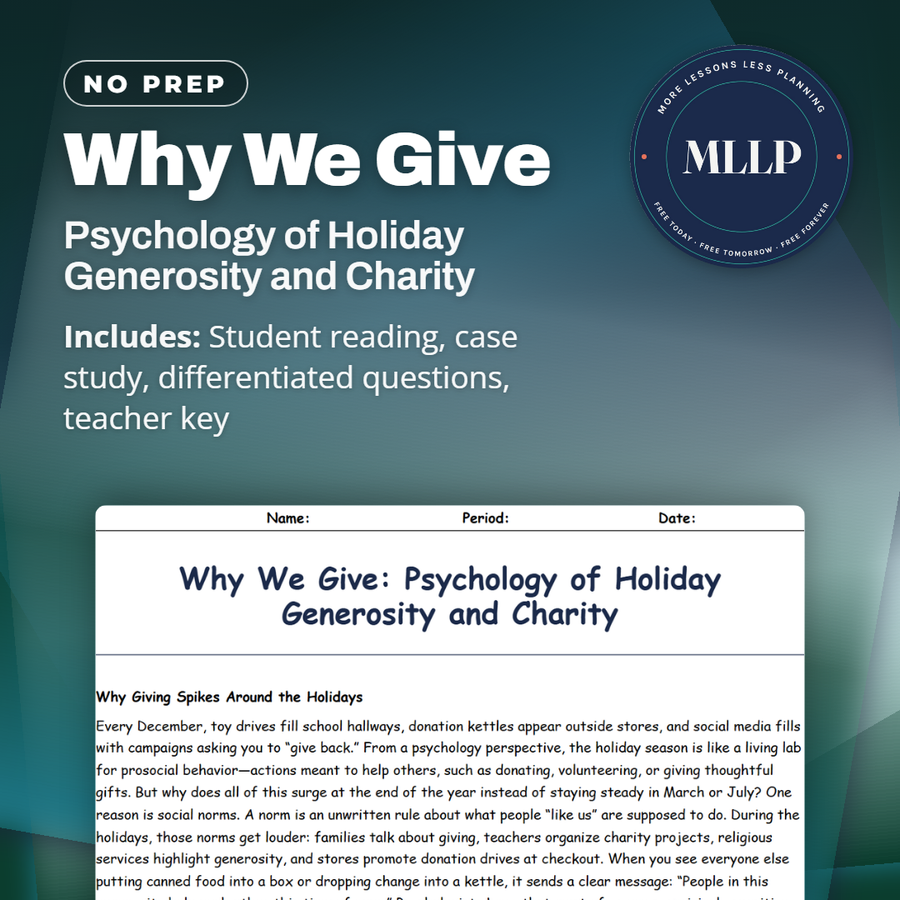
Why We Give: Psychology of Holiday Generosity and Charity
Quality reviewed September 2026
Facts verified September 9, 2026
- Subject
- Social Studies
- Grades
- Grades 9-12
- Length
- 7-page student worksheet
- Time
- About one 50-minute class period
- Great for
- Sub plans and independent work
- Includes
- Reading passage, comprehension questions + full answer key
- Format
- Print-and-go PDF
What students do
- Identify social norms and empathy as drivers of holiday giving behavior
- Analyze the "warm glow" effect and how reward pathways influence generosity
- Evaluate biases in how people choose charities and identifiable victims
- Apply concepts of reciprocity and identity to real fundraising scenarios
What it covers
- Social norms and prosocial behavior
- Empathy and emotional motivation
- Cognitive biases in charitable giving
Start reading this worksheet
Why Giving Spikes Around the Holidays
Every December, toy drives fill school hallways, donation kettles appear outside stores, and social media fills with campaigns asking you to “give back.” From a psychology perspective, the holiday season is like a living lab for prosocial behavior: actions meant to help others, such as donating, volunteering, or giving thoughtful gifts. But why does all of this surge at the end of the year instead of staying steady in March or July? One reason is social norms. A norm is an unwritten rule about what people “like us” are supposed to do. During the holidays, those norms get louder: families talk about giving, teachers organize charity projects, religious services highlight generosity, and stores promote donation drives at checkout. When you see everyone else putting canned food into a box or dropping change into a kettle, it sends a clear message: “People in this community help each other this time of year.” Psychologists know that most of us are surprisingly sensitive to these cues, even if we think of ourselves as completely independent. Another reason is tradition and meaning. Many winter holidays include stories of sacrifice, kindness, and hospitality: people making room at the table, sharing what they have, or caring for strangers. When those stories are repeated every year, they shape how we see ourselves. We’re not just individuals; we’re part of a culture that says generosity is one of the ways we show who we are. For some people, giving is also tied to gratitude. Looking back at the year and noticing what went right can make people more willing to support those who had a harder time.
Warm Glow, Empathy, and What’s in It for the Giver
If you’ve ever felt oddly good after dropping a few dollars into a collection jar, you’ve experienced what psychologists call the “warm glow” of giving. Helping someone else can activate the brain’s reward system, releasing chemicals that are also involved in pleasure and learning. In plain language: doing something kind can feel good, and your brain remembers that feeling. This doesn’t mean people are selfish for enjoying generosity. It simply shows that human motivation is often a mix of caring about others and responding to internal rewards. Another key factor is empathy: the ability to understand and share another person’s feelings. Seeing a family struggle to afford gifts, or hearing about a local shelter running low on supplies, can trigger an emotional response: you can imagine yourself in their situation. Empathy can be especially strong when the person in need feels similar to you in some way (same age, same school, same town), or when their story is vivid and specific instead of just a number in a statistic. At the same time, not all giving is purely altruistic. Social psychologists talk about reputation and impression management. People may donate publicly to seem generous, win social approval, or feel like a “good person.” Gift exchanges can slip into reciprocity pressure: the sense that if someone gives you something, you “owe” them something of equal value. Real life is complicated: a single holiday donation might contain empathy, warm glow, a desire for approval, and habit, all packaged together in one action.
Charity, Fairness, and Who We Choose to Help
Holiday generosity is not just about whether we give, but where we direct our help. Psychology research shows that people often favor identifiable victims (a single person or family with a clear story) over large, abstract groups. A flyer with one child’s photo can sometimes raise more donations than a chart showing thousands of people in need. Our brains are better at responding to concrete stories than to statistics. We’re also influenced by ideas of fairness and deservingness. Many people feel especially motivated to help when they believe someone “doesn’t deserve” their hardship, such as kids dealing with homelessness or families hit by disasters. That can be compassionate, but it can also create blind spots. Groups that are stereotyped or misunderstood may receive less support, even if their needs are severe. Understanding these biases is part of becoming a more thoughtful giver. Another important idea is effective giving: thinking about impact, not just intention. Two charities might spend the same amount of money in very different ways. One might put most resources into direct services (like food or shelter), while another might spend heavily on advertising or overhead. As students, you won’t always have time to research every organization, but asking simple questions (What does this group do? Who does it help? How transparent are they?) can sharpen your critical thinking and turn holiday generosity into a skill, not just a seasonal habit.
Like what you read? The full reading, the case study, and every question set are in the free download below, along with the answer key.
Why this matters
One video of a kid shivering at a bus stop is enough to flip a class's decision about donating a coat. That reaction is not random. It runs on empathy and social proof, the same forces behind every giving spike that hits every December.
Before this reading, students treat a donation drive as background noise. The warm glow effect changes that: they start asking whether giving feels good because it helps someone or because it feels generous. The identifiable victim bias sticks longest, since it explains why one photo raises more money than a statistic ever could.
From one teacher to another
My students walk into December surrounded by donation drives and never ask why giving spikes this time of year. The coat drive case study answers it for them. One video of a kid shivering at a bus stop flips a whole class's decision, and that is empathy and social proof doing the work. From there we get into why donating feels good, whether public generosity counts as selfish, and how to judge a charity by more than the ad. Students leave with a sharper eye for the next fundraising pitch they see.
What you get
Download
Where should I send the next one?
Everything here is free and it stays that way. Leave your email and I'll send you the new lessons as they go up. You can unsubscribe from any one of them.
Related resources
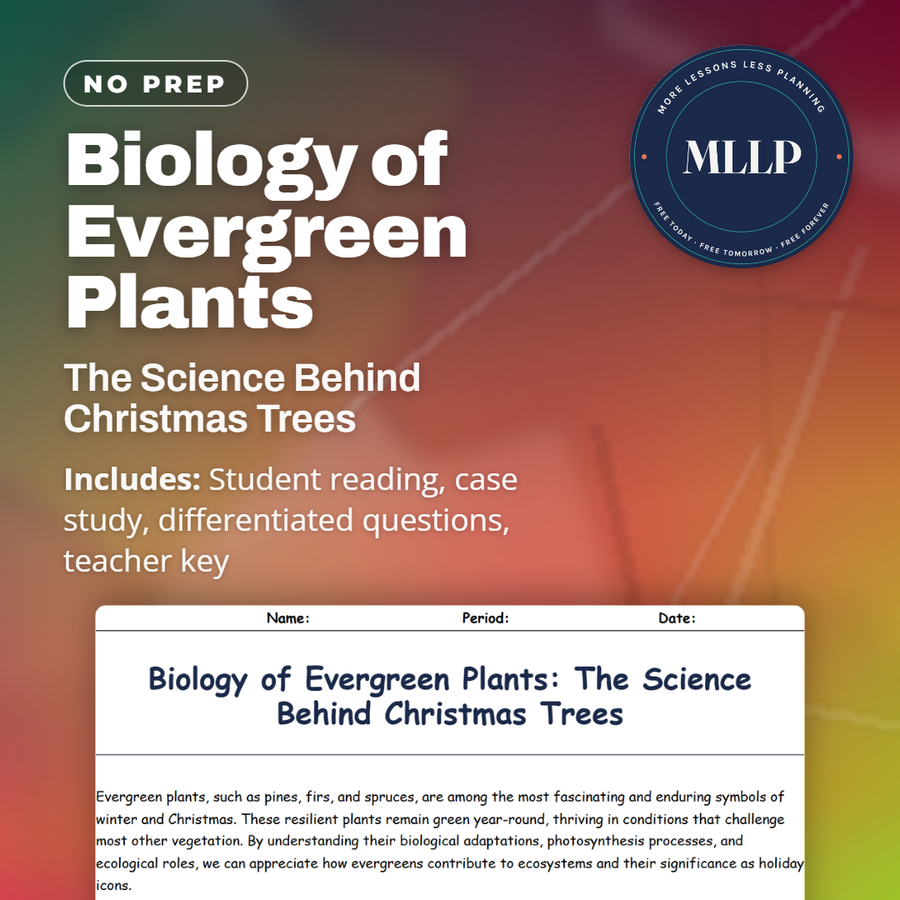
Biology of Evergreen Plants: The Science Behind Christmas Trees
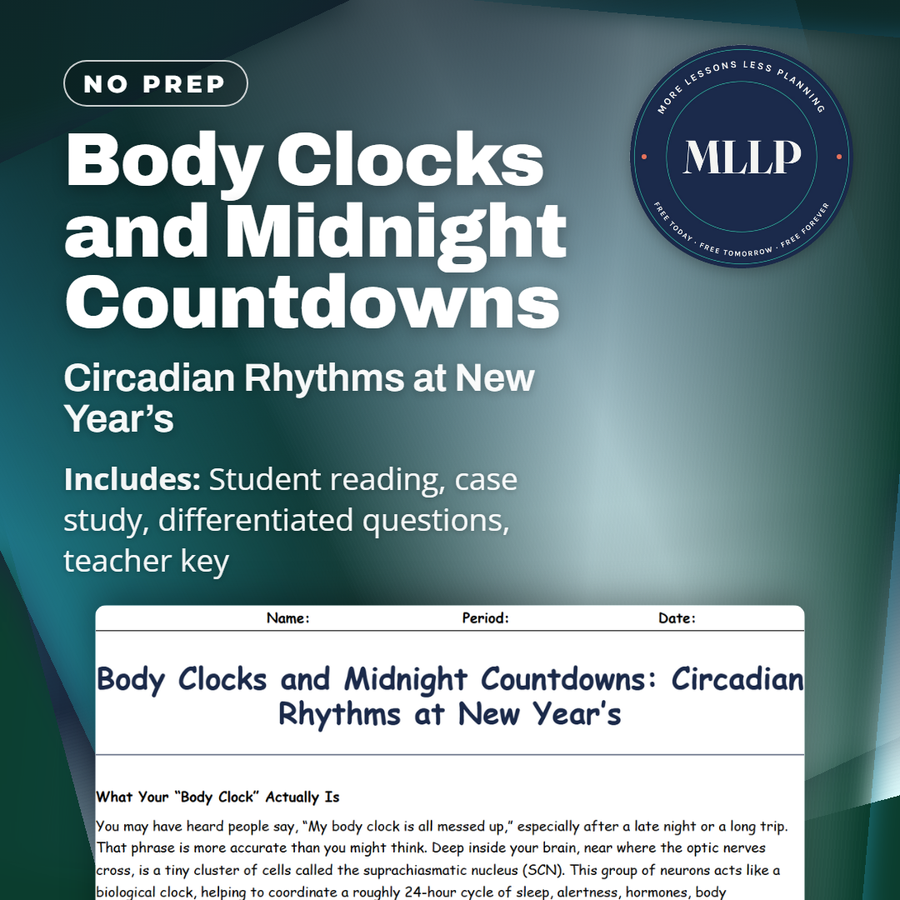
Body Clocks and Midnight Countdowns: Circadian Rhythms at New Year’s
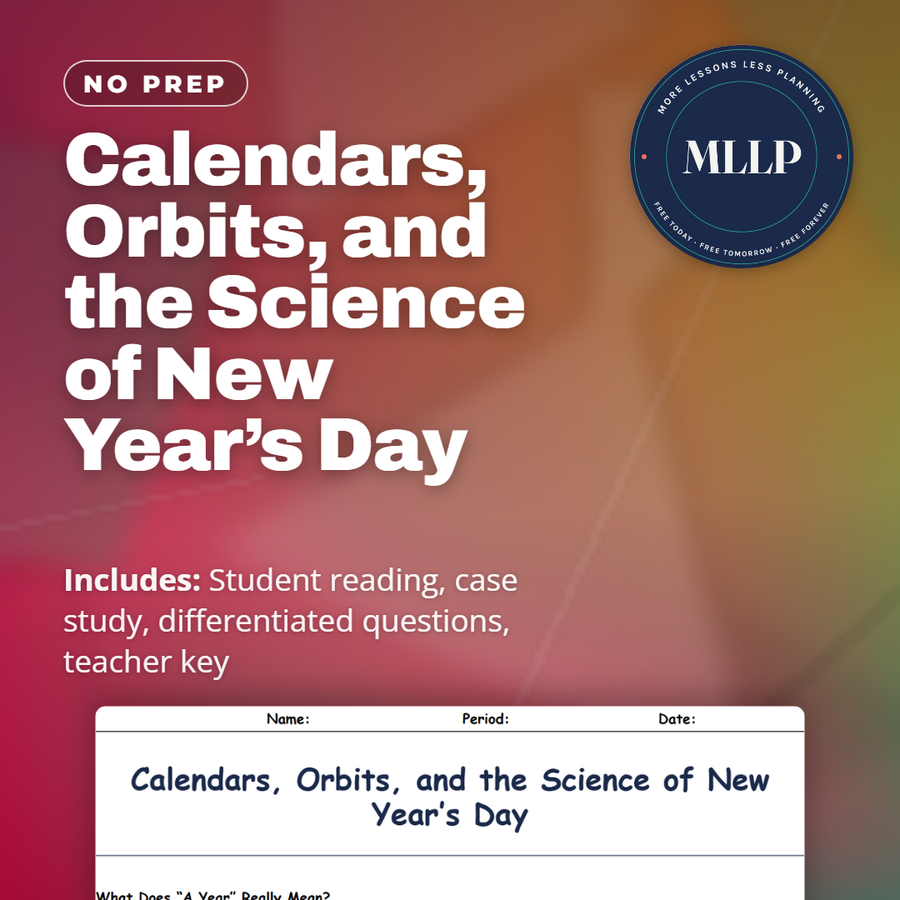
Calendars, Orbits, and the Science of New Year’s Day
Christmas on the Home Front: WWII Rationing and Resilience
Colorful Chemistry: Holiday Lights, Fireworks, and the Science of Glow
Crowded Skies: Holiday Air Travel and the Environment
Every lesson on this site is free to download and use. If one of them saved you a prep period, you can chip in a few bucks toward my three kids' daycare fund. That's genuinely where tips go.