Why Play Is a Child's Real Work
Quality reviewed September 2026
Facts verified September 23, 2026
- Subject
- Career & Life Skills
- Grades
- Grades 9-12
- Length
- 8-page student worksheet
- Time
- About one 50-minute class period
- Great for
- Sub plans and independent work
- Includes
- Reading passage, comprehension questions + full answer key
- Format
- Print-and-go PDF
What students do
- Trace Parten's six categories of play, from unoccupied behavior through genuinely cooperative play
- Aiden holding still as the baby in the block corner restaurant shows exactly how pretend play builds self-control
- Compare physical, constructive, dramatic and rule-based play using what each one specifically builds
- The block corner's play gets identified by type, and the difference between associative and cooperative play gets spelled out
What it covers
- Mildred Parten's six categories of play, from unoccupied behavior through genuinely cooperative play
- Why a role in pretend play builds real self-control instead of just compliance
- What is squeezing play out of childhood, and what the American Academy of Pediatrics says about it
Start reading this worksheet
Not a Break From Learning
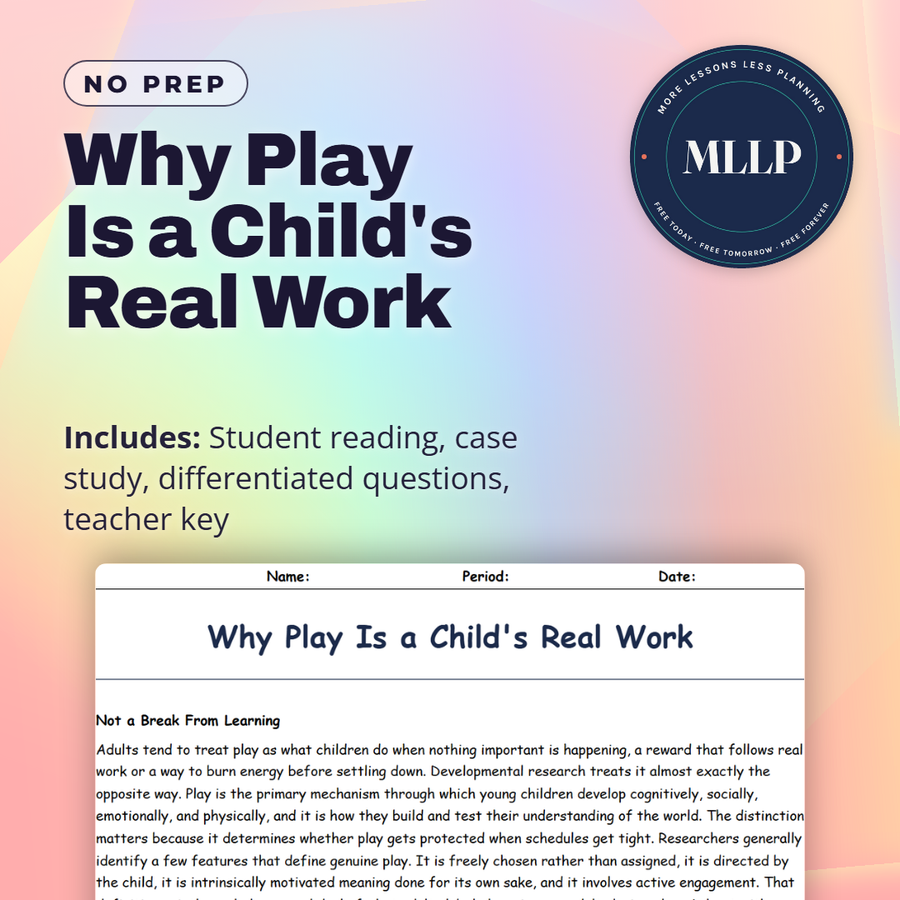
Adults tend to treat play as what children do when nothing important is happening, a reward that follows real work or a way to burn energy before settling down. Developmental research treats it almost exactly the opposite way. Play is the primary mechanism through which young children develop cognitively, socially, emotionally, and physically, and it is how they build and test their understanding of the world. The distinction matters because it determines whether play gets protected when schedules get tight. Researchers generally identify a few features that define genuine play. It is freely chosen rather than assigned, it is directed by the child, it is intrinsically motivated meaning done for its own sake, and it involves active engagement. That definition quietly excludes a good deal of what adults label play, since an adult-designed worksheet with a cartoon border is not play, and neither is an activity where the child is following instructions toward an outcome the adult selected. This does not make structured activities worthless, and children need both. It does mean that when adults replace child-directed play with adult-directed instruction and call it enrichment, something specific is being lost. The United Nations recognizes play as a right of every child, which is an unusual status for something so routinely treated as optional. The distinction also settles a common argument. Asking whether a child should play or learn assumes the two are separate activities, and for a young child that assumption is simply inaccurate.
Playing Alone, Beside, and Together
Researcher Mildred Parten described a progression in how children play with others, and the sequence remains a useful observation tool. Unoccupied behavior involves a child who is not playing in any organized way, watching whatever catches their attention. Solitary play involves a child playing alone, absorbed in their own activity, with no interest in what nearby children are doing. Onlooker play involves watching other children play, often asking questions, without joining in, and it is genuine participation rather than avoidance. Parallel play involves playing beside other children with similar materials but without real interaction, and it dominates toddlerhood. Associative play involves interacting, sharing materials, and talking while pursuing separate goals, so children build side by side and comment on each other's work without a common plan. Cooperative play involves genuinely organized joint activity with shared goals, assigned roles, and rules, and it usually emerges in the preschool years. The important qualification is that these are not stages a child graduates from and abandons. Older children and adults still play alone and still watch, and the later forms are additions to the repertoire rather than replacements. What changes with development is the range of options available and how quickly a child can move into the more complex forms when a situation calls for them. Read as a ladder, the sequence produces bad conclusions. A five-year-old playing alone is not regressing to toddler behavior, since solitary play remains a legitimate and often preferred choice at any age.
The Kinds of Play and What Each Builds
Play also gets categorized by what the child is actually doing, and each type carries its own developmental work. Physical play, including running, climbing, jumping, and rough-and-tumble, builds gross motor skill, strength, coordination, and body awareness, and it also builds the ability to judge risk. Constructive play, meaning building with blocks, sand, or craft materials, builds fine motor control, spatial reasoning, planning, and persistence. Dramatic or pretend play, in which children take on roles and act out scenarios, is often described as the most developmentally rich, since it requires symbolic thought, builds language, rehearses social roles, and demands ongoing negotiation with other children. Games with rules, arriving mostly in the school-age years, require understanding that rules are shared agreements, and they build turn-taking, strategy, and the substantial skill of managing losing. The connection between pretend play and self-regulation deserves particular emphasis because it is counterintuitive. Free play looks like the opposite of discipline, yet research finds it builds self-control, and the mechanism is that a role imposes its own rules. A child playing a firefighter must behave as a firefighter would, and a child assigned to be the sleeping baby must hold still. That restraint is voluntary and internally motivated, which is exactly the kind of self-control that transfers, unlike compliance imposed from outside. This is why heavily supervised activities do not substitute cleanly for free play. A child following an adult's instructions is practicing compliance, which is a different skill from choosing to regulate themselves.
Like what you read? The full reading, the case study, and every question set are in the free download below, along with the answer key.
Why this matters
A future parent or caregiver in this room has probably already been told that play is the reward that comes after the real learning, and this reading is built specifically to dismantle that idea using its own definition of genuine play, freely chosen, child-directed and done for its own sake. Aiden holding still in a cardboard high chair for ten minutes because the baby role required it, longer than he sits for anything assigned to him, is the kind of concrete detail that makes the self-regulation research land instead of just sounding like a claim. The closing passage on what is crowding play out gives students something to notice the next time they see a packed schedule leaving a kid with no unstructured time at all.
From one teacher to another
Block corners turn into restaurants with a cook, a customer and a baby who will not break character, and this reading argues that scene is doing more developmental work than a worksheet with a cartoon border ever could. A full passage walks through Mildred Parten's sequence, from unoccupied and solitary play through onlooker, parallel, associative and finally cooperative play. Another passage sorts play by type, physical, constructive, dramatic and games with rules, and explains what each one specifically builds. The case study follows Ms. Lin's classroom, where a skeptical parent watches Sofia, Marcus and Aiden run an entire restaurant negotiation without a single adult stepping in. A closing passage covers what is squeezing play out of a lot of children's schedules right now, and why the American Academy of Pediatrics has started urging doctors to prescribe it.
What you get
Download
Where should I send the next one?
Everything here is free and it stays that way. Leave your email and I'll send you the new lessons as they go up. You can unsubscribe from any one of them.
Related resources
Brain Development in Early Childhood
How Children Learn Language
Infant Development: The First Year
Prenatal Development and a Healthy Pregnancy
School-Age Development
Temperament: Why No Two Children Are Alike
Every lesson on this site is free to download and use. If one of them saved you a prep period, you can chip in a few bucks toward my three kids' daycare fund. That's genuinely where tips go.