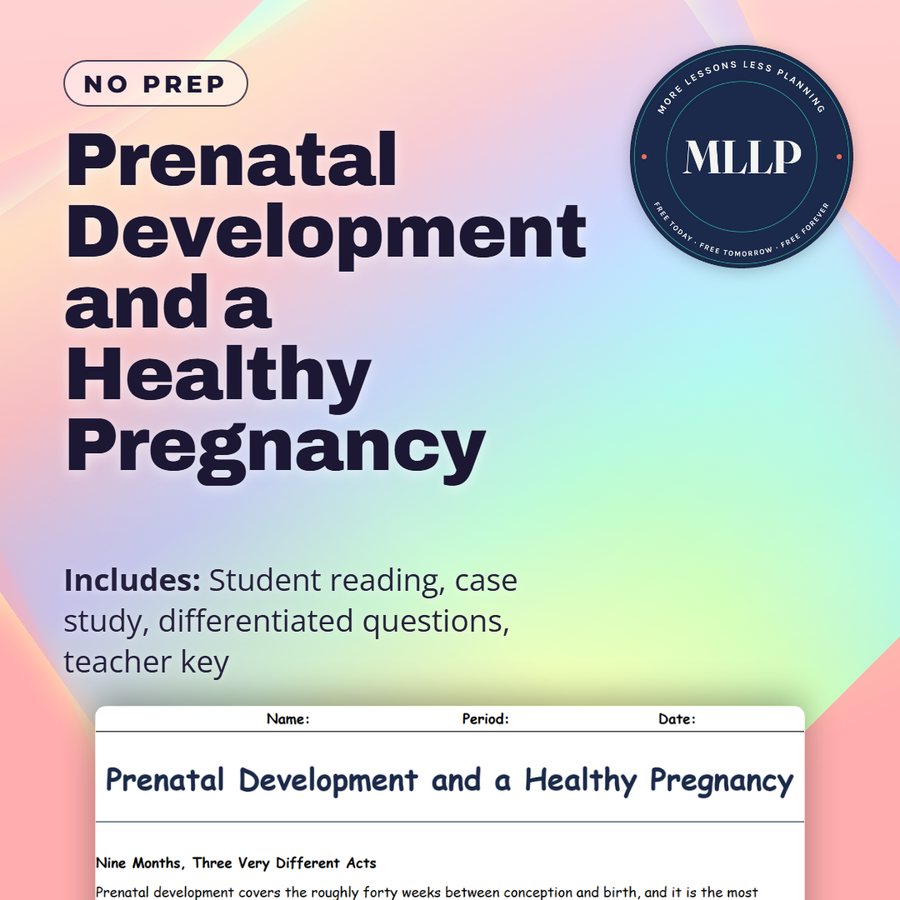
Prenatal Development and a Healthy Pregnancy
Quality reviewed September 2026
Facts verified September 23, 2026
- Subject
- Career & Life Skills
- Grades
- Grades 9-12
- Length
- 9-page student worksheet
- Time
- About one 50-minute class period
- Great for
- Sub plans and independent work
- Includes
- Reading passage, comprehension questions + full answer key
- Format
- Print-and-go PDF
What students do
- The germinal, embryonic and fetal stages get placed in order along with what makes weeks three through eight the riskiest
- Aisha's question about the two glasses of champagne she had at week four shows exactly why the critical period timing matters so much
- Explain why doctors recommend no alcohol at all instead of naming a safe amount
- Identify what a teratogen is and why the same exposure can cause very different harm depending on timing
What it covers
- The three prenatal stages, germinal, embryonic and fetal, and why weeks three through eight carry the most risk
- How alcohol and tobacco damage a developing fetus through two different mechanisms
- Why folic acid is recommended before a pregnancy is even confirmed
Start reading this worksheet
Nine Months, Three Very Different Acts
Prenatal development covers the roughly forty weeks between conception and birth, and it is the most dramatic stretch of growth in a human life. A single fertilized cell becomes a complete infant with a beating heart, a working nervous system, and functioning organs. Scientists divide that span into three stages, and the stages are not equal in either length or risk. The germinal stage covers roughly the first two weeks after conception. The fertilized egg, called a zygote, divides rapidly as it travels down the fallopian tube toward the uterus, and near the end of this stage it implants in the uterine wall. This period is fragile in a specific way, since a large share of zygotes never successfully implant, usually before a pregnancy is even suspected. The embryonic stage runs from about week three through week eight. This is the shortest stage and by far the most consequential, because it is when every major organ and body structure begins to form. The heart starts beating around week five, and by the end of week eight the embryo is only about an inch long yet already has the beginnings of a brain, spine, limbs, eyes, and internal organs. The fetal stage runs from week nine until birth, the longest stretch by far. Structures that already exist now grow, mature, and begin to function, and the fetus gains most of its eventual weight during the final months. Those final weeks are not merely padding. Lung development in particular continues right up to delivery, which is a large part of why a birth even a few weeks early carries meaningfully different risks.
Why Timing Decides the Damage
A teratogen is any substance or condition that can cause harm to a developing embryo or fetus. The list includes alcohol, tobacco, certain prescription and illegal drugs, some infections, radiation, and particular environmental chemicals. The most important and least intuitive fact about teratogens is that the same exposure produces wildly different results depending on when it happens. Researchers call this the critical period principle. Each body structure has a window during which it is forming, and that window is when it is most vulnerable. Because nearly all major structures form during the embryonic stage, weeks three through eight are the period of highest risk for major structural birth defects. That timing creates a genuine public health problem, because those weeks fall exactly when many people do not yet know they are pregnant. Exposure during the fetal stage tends to produce different kinds of harm, affecting growth, brain development, and function rather than gross structure, which does not make it minor. Dose matters, and so does duration, and individual genetics affect how much damage a given exposure does. This is also why the medical advice around pregnancy can sound frustratingly absolute. Researchers cannot ethically run experiments to find a safe threshold for something like alcohol, so when no safe level has been established, the honest recommendation is none at all. That reasoning frustrates people who want a number, and the frustration is understandable. The alternative would be inventing a threshold that no study supports and letting families act on it as though it were established.
Alcohol, Tobacco, and the Preventable Column
Alcohol deserves separate attention because of how completely preventable the damage is. Alcohol crosses the placenta freely, and the developing fetus, lacking a mature liver, cannot process it the way an adult can. The resulting harm is grouped under the term fetal alcohol spectrum disorders. The most severe form, fetal alcohol syndrome, involves a recognizable pattern of facial differences, growth below expectations, and lifelong problems with learning, memory, attention, and impulse control. Less severe forms may involve no visible physical signs at all while still producing significant cognitive and behavioral difficulties. All of it is permanent, none of it is curable, and every case is preventable. No safe amount and no safe trimester have been established, which is why every major medical organization recommends abstaining entirely during pregnancy. Tobacco causes different problems through a different mechanism. Nicotine narrows blood vessels and carbon monoxide reduces the oxygen the blood can carry, so the fetus receives less oxygen and fewer nutrients than it should. The documented results include low birth weight, premature birth, higher rates of miscarriage and stillbirth, and increased risk of sudden infant death syndrome. Secondhand smoke carries risk as well. The encouraging part of the tobacco research is that quitting helps at any point in a pregnancy, and the earlier it happens the more benefit the baby receives. This is worth stating plainly to anyone who assumes the damage is already done. There is no point in a pregnancy at which stopping stops mattering, and framing it as too late is both false and discouraging.
Like what you read? The full reading, the case study, and every question set are in the free download below, along with the answer key.
Why this matters
This reading lands close to home for a class of teenagers, some of whom will be pregnant themselves someday and some of whom already know a parent, sister or friend who is. The critical period material explains something that genuinely surprises students, that the riskiest weeks for a developing embryo usually happen before a pregnancy is even confirmed, which is exactly why the folic acid recommendation targets anyone who could become pregnant rather than only those who already know they are. The Aisha case study is handled the way her nurse practitioner handled it in the reading, focused on next steps rather than blame, and that tone is worth naming out loud with students before they answer the questions about it.
From one teacher to another
Forty weeks separate conception from birth, and this reading breaks that span into the germinal, embryonic and fetal stages, with a full passage on why the embryonic stage, weeks three through eight, carries the highest risk for major structural harm. A teratogen passage explains why the same exposure can cause very different damage depending on exactly when it happens, then walks through alcohol and tobacco as two different mechanisms of harm. A prenatal care passage covers the visit schedule, screening for conditions like preeclampsia, and why folic acid is recommended before a pregnancy is even confirmed. The case study follows Aisha, who is eight weeks pregnant and anxious about the two glasses of champagne she had before she knew, and how her nurse practitioner responds. A closing passage covers labor, prematurity, low birth weight and the Apgar score.
What you get
Download
Where should I send the next one?
Everything here is free and it stays that way. Leave your email and I'll send you the new lessons as they go up. You can unsubscribe from any one of them.
Related resources
Brain Development in Early Childhood

How Children Learn Language
Infant Development: The First Year
School-Age Development
Temperament: Why No Two Children Are Alike

The Preschool Years: Play and Early Learning
Every lesson on this site is free to download and use. If one of them saved you a prep period, you can chip in a few bucks toward my three kids' daycare fund. That's genuinely where tips go.