How Children Learn Language
Quality reviewed September 2026
Facts verified September 23, 2026
- Subject
- Career & Life Skills
- Grades
- Grades 9-12
- Length
- 9-page student worksheet
- Time
- About one 50-minute class period
- Great for
- Sub plans and independent work
- Includes
- Reading passage, comprehension questions + full answer key
- Format
- Print-and-go PDF
What students do
- The prelinguistic stage, cooing, babbling and pointing, gets placed on the timeline before any real word arrives
- Identify why errors like goed and foots count as evidence of learning rather than setbacks
- Theo's shift from went to goed and back again traces the exact overregularization pattern the reading describes
- Compare overextension and underextension using the reading's own animal examples
What it covers
- The prelinguistic stage, from cooing and babbling through pointing at nine to twelve months
- Why overregularization errors such as goed and foots prove a grammar rule was learned
- What the reading says about bilingualism, including the myths it directly corrects
Start reading this worksheet
The Hardest Thing Anyone Ever Learns
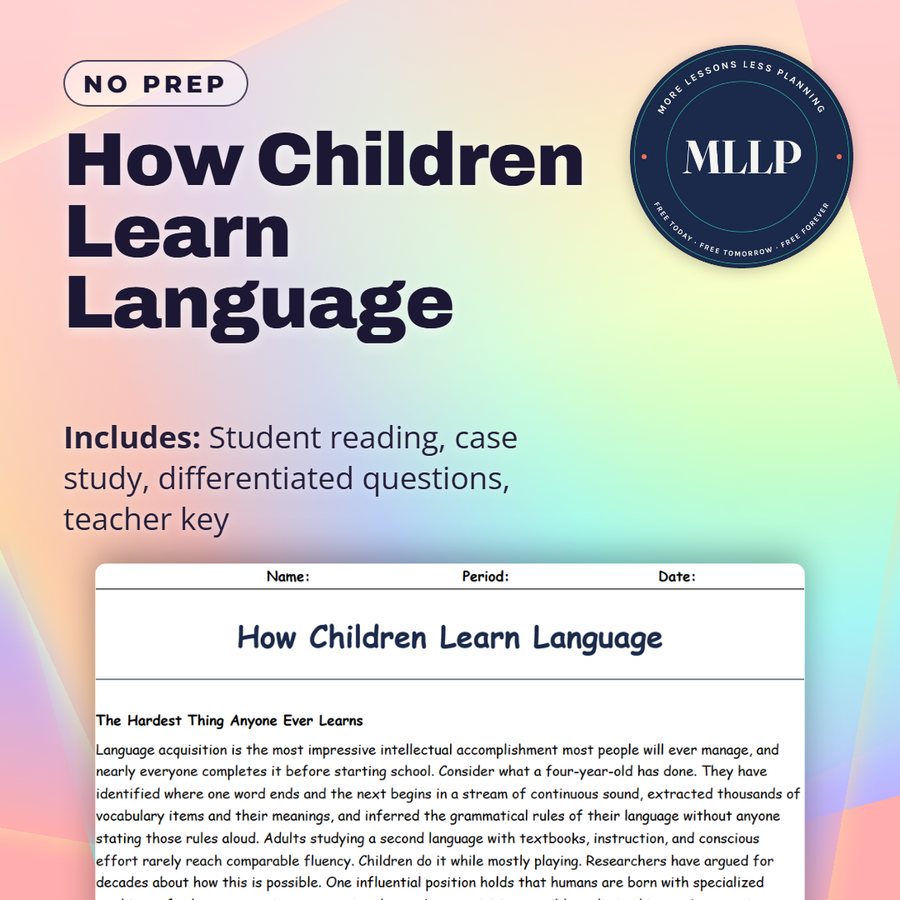
Language acquisition is the most impressive intellectual accomplishment most people will ever manage, and nearly everyone completes it before starting school. Consider what a four-year-old has done. They have identified where one word ends and the next begins in a stream of continuous sound, extracted thousands of vocabulary items and their meanings, and inferred the grammatical rules of their language without anyone stating those rules aloud. Adults studying a second language with textbooks, instruction, and conscious effort rarely reach comparable fluency. Children do it while mostly playing. Researchers have argued for decades about how this is possible. One influential position holds that humans are born with specialized machinery for language, an innate capacity that makes acquisition possible on limited input. A competing position emphasizes learning, arguing that children extract patterns from the enormous amount of speech they hear using general-purpose statistical learning abilities. Most researchers now hold some combination, accepting that children arrive biologically prepared to acquire language and that they still require substantial real input to do it. What is not in dispute is the sequence, since the stages of language development are remarkably consistent across children and across the world's languages, even though the specific languages being learned differ enormously in structure and sound. That consistency is what makes the milestones useful to clinicians. When a child departs from the sequence rather than simply moving through it slowly, it is one of the more reliable early signals available.
Before the First Word
Language development begins well before a child says anything recognizable, and the prelinguistic stage lasts about a year. Newborns already show a preference for their native language's rhythm, which they were exposed to in the womb, and they prefer human speech to other sounds from the beginning. Crying is the earliest communication, and while it is not intentional at first, caregivers quickly learn to distinguish different cries. Cooing appears around two months, consisting of drawn-out vowel sounds. Babbling begins around six months and is the major landmark of this period, involving repeated consonant-vowel combinations such as bababa or dadada. Babbling is not random noise but is vocal practice, and it follows its own progression, beginning with sounds from many languages and narrowing over months toward the sounds of the language the baby is actually hearing. Deaf infants exposed to sign language babble with their hands, which is strong evidence that babbling is about language rather than about mouths. Gestures arrive alongside, and pointing around nine to twelve months is one of the most significant prelinguistic milestones there is, because pointing means the baby understands that attention can be shared and directed. Receptive language, meaning what a child understands, runs consistently ahead of expressive language, meaning what a child can say, and that gap persists for years. Forgetting this gap causes real problems, since adults regularly discuss a toddler as though the child cannot understand the conversation happening directly above their head, and quite often the child understands most of it.
First Words to Full Sentences
The first recognizable word typically arrives around twelve months, give or take several months, and early vocabulary grows slowly at first, reaching roughly fifty words by around eighteen months. Then something changes. Many children experience what is often called the vocabulary spurt or naming explosion, in which word learning accelerates sharply, and by age two a typical child has a few hundred words while by age six most have several thousand. Early words are heavily weighted toward things the child cares about, meaning caregivers, food, animals, and body parts, along with social words like hi and no. Around eighteen to twenty-four months, children begin combining words into two-word utterances, and this telegraphic speech keeps the content words and drops the small connecting ones, producing want cookie or mommy sock. Even these short strings follow consistent word order, which shows that grammar is already forming. From there, sentence length and complexity grow steadily, adding plurals, past tense, questions, and negation in a fairly predictable order. By age four or five, children handle complex sentences and can tell a story with a beginning, middle, and end. Pronunciation lags behind grammar and vocabulary, and some sounds, particularly r, l, s, and th, commonly remain imperfect until age six or seven without indicating any problem at all. Adults sometimes correct these sounds aggressively, which rarely speeds anything up and can make a child self-conscious about talking, which is the opposite of what builds language.
Like what you read? The full reading, the case study, and every question set are in the free download below, along with the answer key.
Why this matters
Family and consumer science students who babysit, coach younger siblings, or plan to work in childcare hear a lot of folk wisdom about talking to kids, and some of it is backward. This reading gives them the actual mechanism, directed speech and back and forth conversation build language, while a screen playing the same words regardless of what a child does mostly does not. Knowing that overregularization and bilingual vocabulary gaps are normal, expected stages rather than warning signs changes how a future parent or caregiver reacts the first time they hear a three-year-old say foots.
From one teacher to another
Every four-year-old has quietly pulled off one of the hardest intellectual feats a person ever manages, sorting a stream of sound into words and grammar without a single lesson. This reading walks through the prelinguistic stage, when cooing, babbling and pointing come before any real word does, then moves through the vocabulary spurt and into two-word telegraphic speech. A full passage is built around overregularization, the pattern where a child who once said went correctly starts saying goed, which the reading treats as proof a rule was learned rather than a step backward. The case study follows Amara and her son Theo through exactly that pattern, and what his pediatrician tells her to do about it. A closing passage takes on the myths around raising a bilingual child directly.
What you get
Download
Where should I send the next one?
Everything here is free and it stays that way. Leave your email and I'll send you the new lessons as they go up. You can unsubscribe from any one of them.
Related resources
Brain Development in Early Childhood
Infant Development: The First Year
Prenatal Development and a Healthy Pregnancy

School-Age Development
Temperament: Why No Two Children Are Alike
The Preschool Years: Play and Early Learning
Every lesson on this site is free to download and use. If one of them saved you a prep period, you can chip in a few bucks toward my three kids' daycare fund. That's genuinely where tips go.