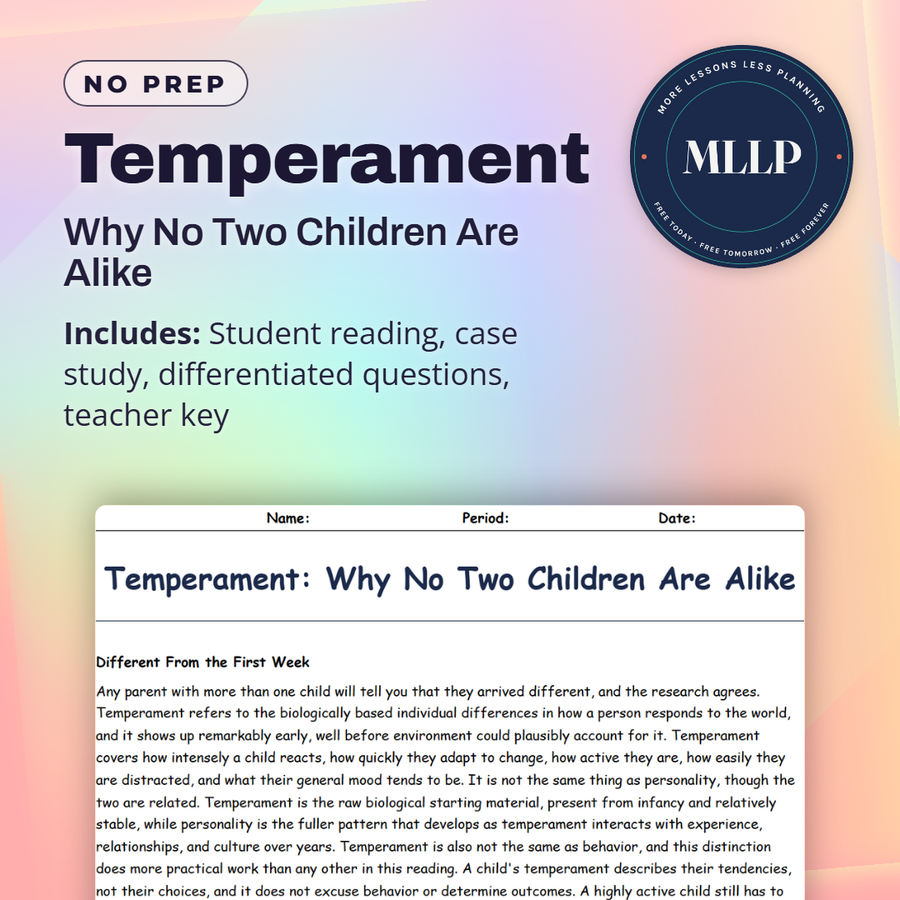
Temperament: Why No Two Children Are Alike
Quality reviewed September 2026
Facts verified September 23, 2026
- Subject
- Career & Life Skills
- Grades
- Grades 9-12
- Length
- 9-page student worksheet
- Time
- About one 50-minute class period
- Great for
- Sub plans and independent work
- Includes
- Reading passage, comprehension questions + full answer key
- Format
- Print-and-go PDF
What students do
- The nine dimensions Thomas and Chess identified, from activity level to persistence, get sorted into three broad patterns
- Match terms such as goodness of fit and slow-to-warm-up to their definitions
- Owen's refusal to leave the car at camp connects to a specific temperament pattern and to what actually helped him join in
- Decide what goodness of fit does and does not mean using the reading's own examples
What it covers
- The nine temperament dimensions and the three broad patterns Thomas and Chess identified
- Why the label difficult describes an adult's experience more than a child's character
- Goodness of fit, the match between a child's temperament and their environment, and why it predicts outcomes
Start reading this worksheet
Different From the First Week
Any parent with more than one child will tell you that they arrived different, and the research agrees. Temperament refers to the biologically based individual differences in how a person responds to the world, and it shows up remarkably early, well before environment could plausibly account for it. Temperament covers how intensely a child reacts, how quickly they adapt to change, how active they are, how easily they are distracted, and what their general mood tends to be. It is not the same thing as personality, though the two are related. Temperament is the raw biological starting material, present from infancy and relatively stable, while personality is the fuller pattern that develops as temperament interacts with experience, relationships, and culture over years. Temperament is also not the same as behavior, and this distinction does more practical work than any other in this reading. A child's temperament describes their tendencies, not their choices, and it does not excuse behavior or determine outcomes. A highly active child still has to learn to sit during a lesson, but understanding that sitting still genuinely costs them more than it costs the child beside them changes how an adult approaches teaching it. The most common mistake adults make with temperament is treating a tendency as a character flaw, and the second most common is treating it as a fixed destiny. Both mistakes lead somewhere unhelpful. The first produces a child who believes something is wrong with them, and the second produces adults who stop trying because they have decided the outcome is already settled.
Nine Traits and Three Patterns
The foundational research on temperament came from Alexander Thomas and Stella Chess, who followed a large group of children from infancy into adulthood beginning in the nineteen fifties. They identified nine dimensions along which infants reliably differ. Activity level describes how much a child moves. Rhythmicity describes how regular their sleeping, eating, and elimination patterns are. Approach or withdrawal describes their initial reaction to something new. Adaptability describes how easily they adjust once change has happened. Intensity of reaction describes how loudly or strongly they respond. Threshold of responsiveness describes how much stimulation it takes to get a reaction. Quality of mood describes whether their baseline leans pleasant or negative. Distractibility describes how easily their attention is pulled away. Attention span and persistence describe how long they stay with a task, especially a difficult one. From these dimensions, Thomas and Chess described three broad patterns. Easy children, roughly forty percent of their sample, had regular routines, adapted readily, and were generally cheerful. Difficult children, about ten percent, had irregular routines, withdrew from new situations, adapted slowly, and reacted intensely. Slow-to-warm-up children, about fifteen percent, were mild in reaction and initially hesitant but adapted given time and no pressure. The remaining share did not fit neatly into any category, which is a detail worth keeping. Roughly a third of the children studied were not describable by any of the three patterns, which is a useful corrective for anyone tempted to sort a classroom of real children into three tidy boxes.
The Problem With the Word Difficult
The label difficult has aged poorly and deserves direct examination, because it describes the adult's experience rather than the child's worth. A child in that category is harder to care for in most ordinary settings, and pretending otherwise helps no one, but the label smuggles in a judgment the research does not support. The traits underneath it are neutral in isolation. Intense reaction means a child who feels things strongly, which is difficult at bedtime and is also the foundation of passion and deep engagement. Slow adaptation means a child who does not abandon what they were doing on command, which overlaps considerably with persistence. High persistence itself is prized in a student working through a hard problem and is exhausting in a toddler who will not stop trying to open the cabinet. The same trait gets labeled differently depending entirely on whether it happens to be convenient at that moment. Cultural context matters as well, since traits valued in one setting may be discouraged in another, and a child considered spirited in one family may be considered disruptive in a classroom with different demands. Research does find that children with difficult temperaments face somewhat higher risk of later behavior problems, but the risk is not fixed and it depends heavily on how the adults around them respond, which brings up the single most useful concept in this area. It is also worth noticing who gets to define the trait. The same child is spirited at a family reunion and disruptive in a quiet classroom, and nothing about the child changed between those two rooms.
Like what you read? The full reading, the case study, and every question set are in the free download below, along with the answer key.
Why this matters
A lot of students in this class have already caught themselves calling a sibling or a kid they babysit difficult, and this reading gives them research-backed language for that instead of a character verdict. The goodness of fit concept has an obvious application the moment a student starts babysitting or working at a daycare, since it puts the responsibility for adjusting on the adult rather than expecting a hesitant or highly active kid to simply behave differently. Owen's case study makes the stakes concrete. His father's pulling made things worse, and Bianca's ten minutes with a clipboard did not lower any expectation, it just changed the approach.
From one teacher to another
Two siblings can come out of the same house with completely different temperaments, and this reading uses the research of Alexander Thomas and Stella Chess to explain why that difference shows up so early. Students work through the nine dimensions, activity level, adaptability, intensity and the rest, and the three broad patterns, easy, difficult and slow-to-warm-up, that emerged from decades of following real children. A full passage takes apart the word difficult itself, arguing the same trait reads as spirited in one room and disruptive in another depending on who is judging it. The case study follows Owen, a seven-year-old who would not get out of the car on the first day of camp, and the program leader who worked with his temperament instead of against it. Goodness of fit closes the reading out as the single concept the reading calls the most useful finding in the whole field.
What you get
Download
Where should I send the next one?
Everything here is free and it stays that way. Leave your email and I'll send you the new lessons as they go up. You can unsubscribe from any one of them.
Related resources

Brain Development in Early Childhood

How Children Learn Language

Infant Development: The First Year

Prenatal Development and a Healthy Pregnancy

School-Age Development

The Preschool Years: Play and Early Learning
Every lesson on this site is free to download and use. If one of them saved you a prep period, you can chip in a few bucks toward my three kids' daycare fund. That's genuinely where tips go.