
School-Age Development
Quality reviewed September 2026
Facts verified September 23, 2026
- Subject
- Career & Life Skills
- Grades
- Grades 9-12
- Length
- 9-page student worksheet
- Time
- About one 50-minute class period
- Great for
- Sub plans and independent work
- Includes
- Reading passage, comprehension questions + full answer key
- Format
- Print-and-go PDF
What students do
- Diego's decision to stop running at recess once he learned his exact rank ties directly to Erikson's industry versus inferiority stage
- Compare reversibility, classification and seriation as three concrete operational skills
- Explain why praising effort holds up better over time than praising ability
- Puberty's wide starting range, eight to fourteen depending on the child, gets connected to why one classroom can hold kids at very different stages
What it covers
- Piaget's concrete operational stage, including conservation, reversibility and seriation
- How peer friendship, status and bullying shift during the school-age years
- Why insufficient sleep in this age group is often mistaken for a different problem entirely
Start reading this worksheet
The Years of Getting Good at Things
The school-age years, roughly six to twelve, are the least dramatic and most underrated stretch of childhood. There is no equivalent of learning to walk or hitting puberty, and the changes are steady rather than explosive, which is exactly why they get overlooked. Erik Erikson named this stage industry versus inferiority, and the word industry means something specific here, referring to the drive to produce, build, and become genuinely competent at real things. School-age children want to be good at something, whether that is reading, soccer, drawing, video games, or an encyclopedic knowledge of some narrow topic. When they find areas where effort produces visible improvement, they build a durable sense of competence. When they repeatedly try and fail without support, or when the only feedback available is comparison to someone better, they build inferiority, which is a belief that they are simply not capable. This is the stage where a child's self-concept shifts from concrete description to comparative judgment. A four-year-old says they have a red bike. A ten-year-old says they are the third-fastest kid in their class. That shift toward social comparison is developmentally normal and it makes this stage the one where adult framing of failure matters enormously, since the child is now actively deciding what kind of person they are based on evidence. That is why praising effort and strategy tends to hold up better than praising ability. A child told they are smart has a label to protect, while a child told they worked through something hard has a method to repeat.
Thinking That Finally Holds Still
Piaget called this stage concrete operational thought, and the changes it brings solve most of the puzzles that stumped the preschooler. Conservation now makes sense, and the same child who insisted the tall glass held more will look at the identical demonstration and explain that it is the same water, just in a different shape. Underlying that is reversibility, the ability to mentally run an action backward, so the child can imagine pouring the juice back and see that nothing changed. Classification develops, meaning children can sort objects by multiple features at once and understand that a category can sit inside a larger category, so a child grasps that beagles are dogs and dogs are animals. Seriation develops, meaning the ability to arrange items in order along a dimension such as length or weight. Egocentrism substantially declines, and school-age children become far better at taking another person's perspective, which is what makes real friendship, cooperation, and genuine apology possible. The word concrete is the important limit. These children reason powerfully about things they can see, handle, or picture, but they struggle with the purely abstract and hypothetical. This is why school-age math instruction leans on manipulatives, diagrams, and real quantities, and why a word problem about actual apples lands where the same problem stated as pure algebra does not. The limit is genuinely a limit rather than a teaching failure. Abstract reasoning arrives with the formal operational stage in adolescence, and no amount of earlier drilling reliably moves that arrival forward.
Friends Become the Main Event
The social center of gravity shifts decisively during these years. Preschool friendship is built on who happens to be nearby, but school-age friendship is built on shared interests, mutual trust, and loyalty, and children this age can articulate what they value in a friend. Peer groups grow more structured, often organizing by gender through the middle of this period, and they establish their own norms about dress, language, humor, and behavior. Peer acceptance becomes a major driver of well-being, and social status differences become visible and stable in ways adults often underestimate. Children who are consistently rejected face genuinely elevated risks for loneliness, academic difficulty, and later mental health problems, which is why adult attention to social dynamics matters even when the conflicts look trivial from the outside. Belonging to a group also brings conformity pressure, and this is the stage where a child may abandon a favorite shirt or interest because of a single comment. Bullying becomes a recognizable pattern in these years, defined by repeated aggression combined with a power imbalance, which distinguishes it from ordinary conflict between equals. Meanwhile family remains critically important even as it becomes less visible, since children who feel securely connected at home handle peer difficulty markedly better. The peer world is where they practice, but home is still where they refuel. Parents often read a child's growing privacy as rejection and pull back in response. The research points the other way, since availability matters more than access, and a child who knows where the adult is uses them more.
Like what you read? The full reading, the case study, and every question set are in the free download below, along with the answer key.
Why this matters
Diego's story is the one I go back to most in this unit, because losing recess entirely over a real ranking from a timed race is exactly the kind of thing a teacher misses unless they are watching for it. The industry versus inferiority framing gives a name to something a lot of teenagers already sense, that being told they are smart creates something to protect while being told they worked hard through something difficult gives them a method they can repeat. The sleep passage is worth pulling out on its own, since a nine to twelve hour requirement collides directly with the homework and activity schedules these same students will eventually be managing for kids of their own.
From one teacher to another
Nothing about ten-year-olds looks as dramatic as a first step or a growth spurt, and this reading argues that is exactly why the school-age years get underrated. A full passage builds out Erikson's industry versus inferiority stage, the drive to get genuinely good at something, alongside Piaget's concrete operational thought, where conservation, reversibility and seriation finally click into place. Another passage tracks how friendship shifts from proximity to shared interests and loyalty, and how bullying differs from ordinary conflict. The case study follows Diego, a fourth grader who stopped running at recess once he learned his exact rank, and what his teacher did about it. A closing passage covers the physical side, steady growth, wide variation in puberty timing, and why nine to twelve hours of sleep matters more than it looks like it should.
What you get
Download
Where should I send the next one?
Everything here is free and it stays that way. Leave your email and I'll send you the new lessons as they go up. You can unsubscribe from any one of them.
Related resources

Brain Development in Early Childhood

How Children Learn Language

Infant Development: The First Year

Prenatal Development and a Healthy Pregnancy
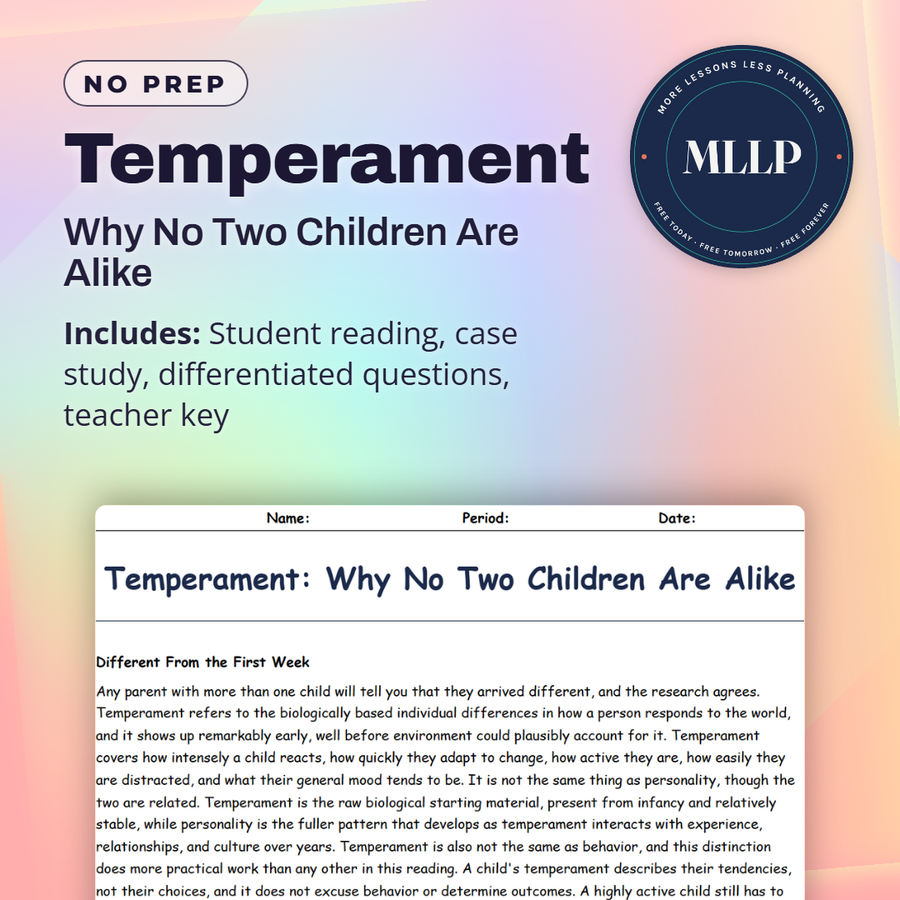
Temperament: Why No Two Children Are Alike

The Preschool Years: Play and Early Learning
Every lesson on this site is free to download and use. If one of them saved you a prep period, you can chip in a few bucks toward my three kids' daycare fund. That's genuinely where tips go.