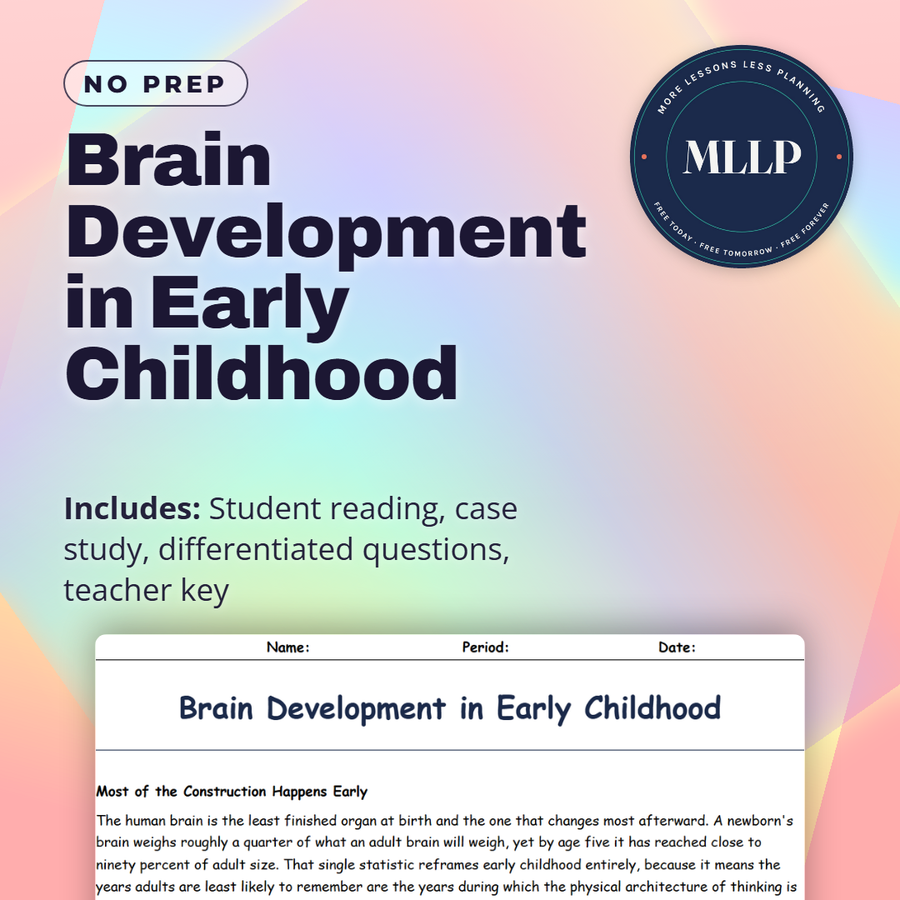
Brain Development in Early Childhood
Quality reviewed September 2026
Facts verified September 23, 2026
- Subject
- Career & Life Skills
- Grades
- Grades 9-12
- Length
- 9-page student worksheet
- Time
- About one 50-minute class period
- Great for
- Sub plans and independent work
- Includes
- Reading passage, comprehension questions + full answer key
- Format
- Print-and-go PDF
What students do
- The one million synapses forming every second get tied to why early experience carries such outsized weight
- Match key terms such as synapse, pruning and myelination to their definitions
- Renata's advice to Mr. Alvarez shows what serve and return looks like in practice with his son Mateo
- Explain why a screen could not replace the live response Mr. Alvarez gave Mateo
What it covers
- How synaptic pruning turns a general-purpose brain into one tuned to a child's actual world
- The difference between tolerable stress and toxic stress, and the adult relationship that makes the difference
- Why serve and return, not screen time, builds the circuits behind language and attention
Start reading this worksheet
Most of the Construction Happens Early
The human brain is the least finished organ at birth and the one that changes most afterward. A newborn's brain weighs roughly a quarter of what an adult brain will weigh, yet by age five it has reached close to ninety percent of adult size. That single statistic reframes early childhood entirely, because it means the years adults are least likely to remember are the years during which the physical architecture of thinking is largely assembled. The brain is built from neurons, which are nerve cells that carry electrical and chemical signals, and a newborn arrives with roughly eighty-six billion of them, close to all they will ever have. What a newborn does not have is the wiring. Neurons communicate across connections called synapses, and it is the synapses, not the neurons, that get built during early childhood, at a genuinely difficult-to-imagine pace. During peak periods, researchers estimate that more than one million new neural connections form every second. This is why early experience matters out of proportion to how brief it is and why the phrase brain development is misleading if it suggests slow steady growth. What is actually happening in the first years is closer to large-scale construction, and the blueprint being followed is a combination of genetic instruction and the specific experiences the child is actually having. This is also why the popular framing of a baby's brain as a sponge undersells what is happening. A sponge absorbs whatever it touches, while a developing brain is actively building the structure it will later think with.
Building Too Much on Purpose
The brain's construction strategy is deliberately wasteful, and understanding why explains a great deal about early childhood. Early on, the brain produces far more synapses than it will keep, a process called synaptogenesis that peaks at different times in different brain regions. Then it begins removing them, a process called synaptic pruning. Pruning sounds destructive and is the opposite, since a brain with every possible connection intact would be slow, noisy, and inefficient. Pruning is how a general-purpose brain becomes a specialized one tuned to the particular world the child actually lives in. The rule governing which connections survive is straightforward and is often summarized as use it or lose it. Connections that are used repeatedly are strengthened and preserved, while connections that go unused are eliminated. This is why experience is not merely helpful but is literally the mechanism that shapes the final structure. Language offers the clearest example. Infants can initially distinguish the sounds used in every human language, but by around twelve months they have specialized in the sounds they actually hear, losing sensitivity to distinctions their language does not use. Nothing broke. The brain optimized for the environment it was given. Alongside pruning runs myelination, in which a fatty sheath called myelin wraps around nerve fibers and dramatically speeds signal transmission, continuing well into a person's twenties. Myelination follows its own order, and the regions handling judgment and impulse control are among the last to finish, which is part of why teenagers can reason well in the abstract and still make decisions that baffle the adults around them.
Windows That Open and Close
Some capacities develop most readily during specific windows of time, which researchers call sensitive periods. During a sensitive period, the brain is unusually receptive to particular kinds of input, and the relevant circuits are being actively built. Vision offers the clearest and most rigorously documented example. If a child has a condition such as a severe cataract blocking visual input from one eye and it is not corrected within the first few years, the visual circuits for that eye do not develop normally, and correcting the problem later cannot fully restore the vision. The eye works, but the brain never built the wiring to use it. Language has a sensitive period as well, which is why children acquire language with an ease adults never recover and why early identification of hearing loss matters so much. The concept is frequently overstated in popular writing, and the honest version is more measured. Sensitive periods are windows of heightened opportunity rather than hard deadlines after which nothing is possible, and the brain retains meaningful plasticity, meaning the ability to change and reorganize, throughout life. What changes is the effort required, since what is nearly automatic at three may be achievable but laborious at thirty. The practical implication is not that parents must drill infants but that ordinary rich experience during these years is doing structural work. The commercial versions of this idea should be treated with suspicion. Products marketed as building baby brains rarely outperform conversation, books, and unstructured play, all of which cost nothing and are already available.
Like what you read? The full reading, the case study, and every question set are in the free download below, along with the answer key.
Why this matters
I like handing this one to students who plan to work with kids, because the serve and return idea reframes what caregiving actually requires. It is not about buying flashcards or downloading the right app. It is picking up what a baby is already doing, a look, a babble, a point, and responding to it, over and over. The toxic stress passage matters too, since it shows a single protective factor across an entire body of research, one stable, responsive adult. That is something any teenager can be for a younger sibling or a kid they watch after school, not a job that requires a credential.
From one teacher to another
A newborn's brain arrives with nearly all the neurons it will ever have, yet almost none of the wiring, and this reading walks through how that wiring gets built. Students read about synaptogenesis and synaptic pruning, the process that keeps well used connections and removes the rest, plus myelination, which speeds signals into a person's twenties. A section on sensitive periods uses the vision and language examples from the reading to show what a window of opportunity actually means. The case study follows Mr. Alvarez, whose son Mateo has a tablet loaded with a language program, and what changed once Mr. Alvarez started narrating and responding instead. The last passage separates positive, tolerable and toxic stress by one factor, whether a supportive adult is present.
What you get
Download
Where should I send the next one?
Everything here is free and it stays that way. Leave your email and I'll send you the new lessons as they go up. You can unsubscribe from any one of them.
Related resources

How Children Learn Language
Infant Development: The First Year
Prenatal Development and a Healthy Pregnancy
School-Age Development
Temperament: Why No Two Children Are Alike
The Preschool Years: Play and Early Learning
Every lesson on this site is free to download and use. If one of them saved you a prep period, you can chip in a few bucks toward my three kids' daycare fund. That's genuinely where tips go.