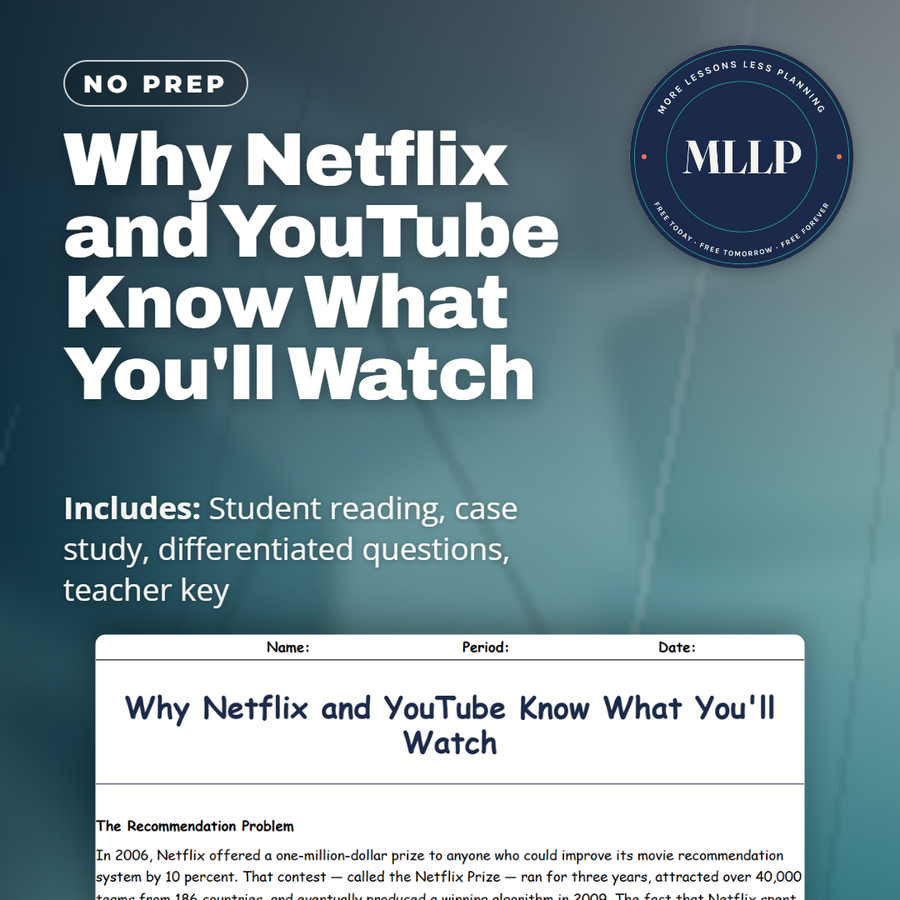
Why Netflix and YouTube Know What You'll Watch
Quality reviewed September 2026
Facts verified September 20, 2026
- Subject
- Career & Life Skills
- Grades
- Grades 9-12
- Length
- 10-page student worksheet
- Time
- About one 50-minute class period
- Great for
- Sub plans and independent work
- Includes
- Reading passage, comprehension questions + full answer key
- Format
- Print-and-go PDF
What students do
- Trace how collaborative filtering and content based filtering work together to build a Netflix recommendation
- Even a movie's thumbnail image changes depending on which genres a viewer usually watches
- Write a short paragraph on how YouTube's ad based business model pushed its algorithm toward clickbait before 2019
- Marcus's school project on climate change pulled him toward conspiracy content he never searched for
What it covers
- Netflix's collaborative filtering, content tagging, and personalized thumbnail testing
- Why YouTube's ad supported model pushed its algorithm toward clickbait before a 2019 overhaul
- Marcus's case study on how a school project on climate change led him toward conspiracy content
Start reading this worksheet
The Recommendation Problem
In 2006, Netflix offered a one-million-dollar prize to anyone who could improve its movie recommendation system by 10 percent. That contest, called the Netflix Prize, ran for three years, attracted over 40,000 teams from 186 countries, and eventually produced a winning algorithm in 2009. The fact that Netflix spent seven figures trying to solve this problem tells you everything about how important accurate recommendations are to a streaming platform's survival. The core challenge is called the recommendation problem: with thousands or millions of options, how do you figure out (as quickly and accurately as possible) what a specific individual wants to watch next? Bad recommendations mean wasted time for users, which leads to cancelled subscriptions. Good recommendations mean effortless discovery, which leads to binge-watching and loyalty. Platforms like Netflix, YouTube, and Hulu have spent billions of dollars and decades of engineering to crack this problem.
How Netflix Builds Your Profile
Netflix's recommendation system is built on two main engines. The first is collaborative filtering, the same technique TikTok uses: find other users whose viewing histories closely match yours, and assume you'll enjoy what they enjoyed. If a thousand people who loved the same three shows you loved all binged a fourth show you haven't seen yet, Netflix's algorithm will push that fourth show to the top of your row. The second engine is content-based filtering. Netflix has a team of human taggers who watch every piece of content on the platform and label it with hundreds of attributes: the pacing of the plot, the emotional tone, whether it ends happily or ambiguously, how much action is in it, the time period it's set in, whether it features a diverse cast, the type of humor if any, and dozens more. The algorithm then matches those content attributes to your behavior patterns. If you consistently watch shows tagged 'slow burn,' 'morally complex protagonist,' and 'ambiguous ending,' Netflix will surface other content with those same tags, even if it's in a genre you've never tried before.
The Artwork You See Is Personalized Too
Here is something most Netflix users don't realize: the thumbnail image you see for a movie or show is not the same image everyone sees. Netflix A/B tests dozens of different thumbnail options for each title and shows different users the artwork most likely to make them click. A user who frequently watches romantic comedies might see a thumbnail highlighting the love story in a movie. A user who mostly watches thrillers might see the same movie's thumbnail featuring a tense, dramatic moment. This means even the visual packaging of content is algorithmically customized. Netflix has published research showing that which thumbnail a user sees dramatically affects click-through rates, sometimes by as much as 30 percent. The goal is simple: get you to click. Once you click, the recommendation has done its job. Everything from the title cards in autoplay previews to the order of rows on your home screen is the result of algorithmic decision-making.
Like what you read? The full reading, the case study, and every question set are in the free download below, along with the answer key.
Why this matters
Every student streaming a show tonight will hand Netflix or YouTube more data about what keeps them watching, and that data trains an algorithm with its own financial incentives, not the viewer's. The reading's contrast between a subscription model and an ad model gives students a concrete way to ask why a platform is showing them something: is it because they will like it, or because it will keep them on screen longer. Marcus's drift from documentaries to conspiracy content is not a hypothetical. It is the kind of pattern that happens quietly to real teenagers, which is exactly why recognizing it matters.
From one teacher to another
Netflix once paid a million dollars to anyone who could improve its recommendations by ten percent, and the reading explains why that bet made sense: collaborative filtering matches a viewer to similar watchers, content based filtering matches a show's hundreds of human generated tags to a viewer's patterns, and even the thumbnail image gets tested and swapped per user. YouTube runs on a different incentive entirely. Because it earns money from ads rather than subscriptions, its algorithm spent years optimizing for clicks, which the reading ties directly to clickbait and, after 2019, a shift toward watch time and satisfaction. Marcus's case study shows the cost of that older approach: a school project on climate change pulled him, one video at a time, into conspiracy content he never searched for. Students close by weighing what a platform owes a viewer once it knows this much about what keeps them watching.
What you get
Download
Where should I send the next one?
Everything here is free and it stays that way. Leave your email and I'll send you the new lessons as they go up. You can unsubscribe from any one of them.
Related resources
AI Customer Service Chatbots: When to Push for a Human
AI in Banking: Fraud Detection and Auto-Approvals
AI in Self-Driving Cars: Tesla, Waymo, and the Rest
AI in Sports: From Cameras to Coaching
AI in Video Games: NPCs and Procedural Worlds
Smart Home AI: Thermostats, Doorbells, Security
Every lesson on this site is free to download and use. If one of them saved you a prep period, you can chip in a few bucks toward my three kids' daycare fund. That's genuinely where tips go.